>>
Industry>>
Energy and Utility>>
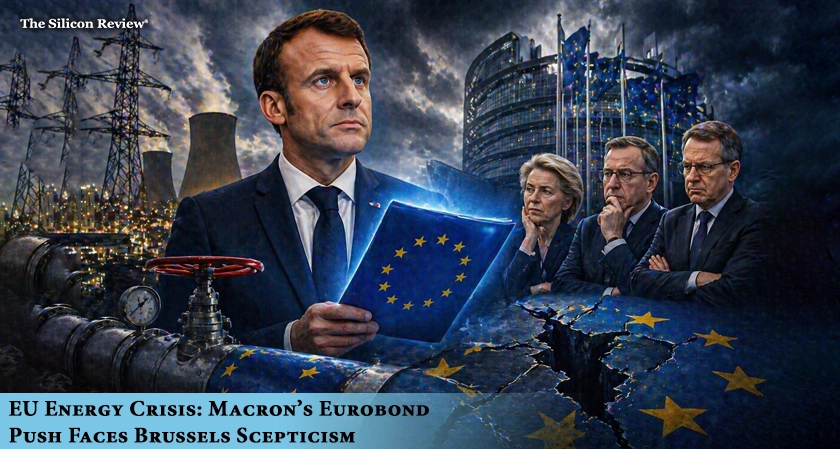
EU Energy Crisis: Macron's Eur...EU Energy Crisis: Macron's Eurobond Push Faces Brussels Scepticism
The Silicon Review
28 April, 2026
Author:
Sashindra Suresh
President Macron revived calls for joint EU borrowing to tackle the energy crisis triggered by the Iran war, but Eurobond plans face stiff resistance from Germany. The Silicon Review reports on the EU's struggle to finance its strategic autonomy.
French President Emmanuel Macron has revived calls for a common European borrowing mechanism to finance the bloc’s response to the energy crisis triggered by the Iran war, but his push for Eurobonds is facing stiff resistance from Germany and other "frugal" states.
At an informal summit in Nicosia, Cyprus, EU leaders grappled with the fallout of the ongoing Middle East conflict. Macron argued that the bloc needs massive, joint investment in energy infrastructure, defence, artificial intelligence, and green technologies to counter the economic shock, estimating annual needs at up to €1.2 trillion. He proposed issuing new common debt to fund these priorities, warning that without joint action, the crisis would exacerbate existing economic disparities between member states.
However, German Chancellor Friedrich Merz closed the door on new joint borrowing, stating that increasing EU debt to tackle the energy shock is "out of the question." The Netherlands and other northern states fear that mutualizing debt would remove pressure on fiscally weaker nations to reform their economies, a concern that has historically blocked such initiatives.
The debate comes as the Iran conflict has sent energy prices soaring. The Strait of Hormuz closure has choked global supplies, and markets now price in significant risk of recession, with the ECB facing pressure to raise rates even as growth stalls. A chasm has opened between member states. Southern nations like Italy and Spain, struggling with high energy costs and debt burdens, are largely sympathetic to the French push, calling for more "courageous" EU action. Greeks even supported a slower repayment of Covid recovery funds to free up cash.
While the European Commission has floated the idea of new "own resources" for the 2028-2034 budget, a concrete Eurobond proposal remains unlikely. Macron has framed the effort as existential, arguing that Europe must learn to compete with the US and China. "Markets are seeking safe and liquid assets," he said. "This is a unique opportunity, one that could also challenge the dominance of the dollar."
As an unprecedented energy crisis splits Europe over the need for joint debt, The Silicon Review examines whether Macron's Eurobond push will collapse against German resistance or become the bloc's Next Generation EU 2.0.