>>
Industry>>
Robotics>>
Humanoid Robots to Handle Bagg...Humanoid Robots to Handle Baggage at Tokyo's Haneda Airport in May Trial
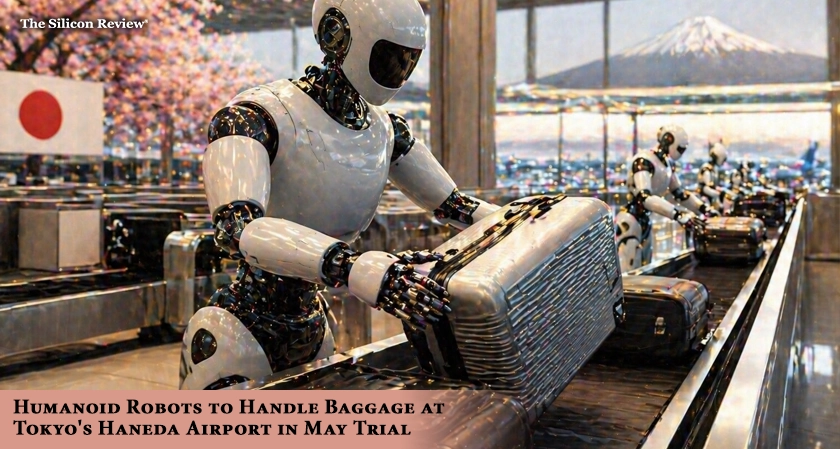
Japan Airlines & GMO Internet Group will trial humanoid robots for baggage handling at Tokyo's Haneda Airport from May 2026. The Silicon Review reports on the first-of-its-kind demonstration aimed at tackling severe labor shortages in Japan's aviation ground operations.
Humanoid robots will begin handling luggage at Tokyo's Haneda Airport from May 2026, as Japan Airlines (JAL) and GMO Internet Group launch a demonstration experiment to address severe labour shortages in ground operations.
The project, which runs through 2028, will deploy Chinese-made humanoid robots capable of operating continuously for two to three hours to load and unload cargo containers. The initiative is led by JAL Ground Service Co. and GMO AI & Robotics Corp., marking the first such trial in Japan.
"We have approximately 4,000 ground handling staff, and replacing physically demanding tasks with robots is likely to inevitably reduce workers' burden, providing significant benefits to employees," said Yoshiteru Suzuki, president of JAL Ground Service . He noted that safety management will remain exclusively human duty.
The trial comes as Japan's aviation industry grapples with surging inbound tourism over seven million foreign visitors arrived in the first two months of 2026 and a declining working-age population. "While airports appear highly automated and standardised, their back-end operations still rely heavily on human labour and face serious labour shortages," said Tomohiro Uchida, president of GMO AI & Robotics.
Beyond baggage handling, JAL plans to expand robot use to other areas, including aircraft cabin cleaning and ground support equipment operation. Humanoid robots already perform security patrols and retail assistance at some Japanese airports, but the Haneda trial represents a significant step into cargo operations.
As Japan prepares to deploy humanoid robots for baggage handling at its busiest airport, The Silicon Review examines how a shrinking workforce and record tourism are forcing the aviation industry to embrace automation and whether two to three hours of battery life is enough to move the nation's luggage.