>>
Industry>>
Architecture and interior design>>
Invisible Frame Techniques Sha...ARCHITECTURE AND INTERIOR DESIGN
Invisible Frame Techniques Shaping the Future of Gallery Displays
The Silicon Review
24 April, 2026
Author:
The Silicon Review Team
Invisible frame systems require a well-crafted material to create a clean and borderless appearance. Aluminum is the most common base material due to its light weight, strength and corrosion resistance. Having practical experience with installing it, aluminum profiles always provide a stable support even to large-format graphics. When combined with fabric prints, particularly in a SEG Solution, the effect is a tight, wrinkle-free surface that is seemingly suspended on the wall.
PVC-based fabrics are also other important materials as they offer flexibility and durability, and acrylic panels that are employed in the backlit displays to diffuse the light evenly. Quick graphic replacement is sometimes achieved by the addition of magnetic strips. The purpose of each component is clear. With bad quality materials it may bend the frame, or the cloth might loosen with time and this automatically diminishes the visual effect of the display.
Graphic Replacement and Campaign Updates
One of the strongest practical advantages of invisible frame systems is how quickly graphics can be updated. Unlike traditional framing, where changing artwork means removing hardware and often damaging walls, SEG systems allow a full graphic swap in minutes. The silicone edge simply pulls out of the groove, and a new fabric print snaps back in its place.
This matters most when campaigns change frequently. A retail gallery running seasonal promotions, for example, can update visuals overnight without any tools or technical crew. The frame stays in place. Only the print changes.
From hands-on experience, a standard 2x3 meter panel takes one person under 15 minutes to reprint and reinstall. For larger walls with multiple panels, a small team can complete the full update in a single morning.
Key points to keep in mind:
- Store spare fabric prints flat or rolled to avoid creases before installation
- Always start pressing the silicone edge from corners to keep tension even
- Check alignment before pressing the full edge to avoid repositioning
For galleries and brands that work with a reliable SEG Solution provider, this process becomes a routine part of campaign management rather than a logistical challenge. The result is a display system that stays current, looks sharp, and costs far less to maintain than any traditional alternative.
Installation Methods and Mount Techniques
The installation of the invisible frame systems should be precise and well planned. Any minor deviation will disrupt the smooth appearance that these screens are reputed to have. According to real world experience, the preparation phase of measuring, leveling and testing may be more time consuming than the actual installation.
Wall mounting is the most popular. The frames are mounted on a flat surface with the help of anchors or brackets. The wall should be as straight as possible and installers normally use laser devices to check the straightness. In case of an uneven base, the fabric will not be stretched to produce some distorted images.
Another alternative is suspended installation which is commonly utilized in contemporary gallery. These systems are suspended at the ceiling on cables and make the display appear to be in the air. They do however need heavy anchor points and distribution of weight. The stress of the cables should be equal; otherwise, the frame may lean or drift out of position.
Recessed is the most integrated appearance. With this technique, the frame is constructed into the wall such that it is level with the wall. This method is typically designed when constructing and it is particularly effective with a SEG Solution because the fabric can be added and/or removed without modification of the building.
Some useful tips will help a lot. The frame position should be tested always before the graphic is installed to ensure alignment. Corner connectors ought to be fixed adequately to ensure the shape of the frame. The screws must be tight so as to hold the structure without deforming the aluminum. Another thing to check before final assembly is to check lighting location since it is hard to make changes later.
The omission of these steps can result in uneven tension or noticeable gaps. The additional time during installation will make sure that the final display will be clean, stable and professionally finished.
Visual Effects Created by Invisible Frames
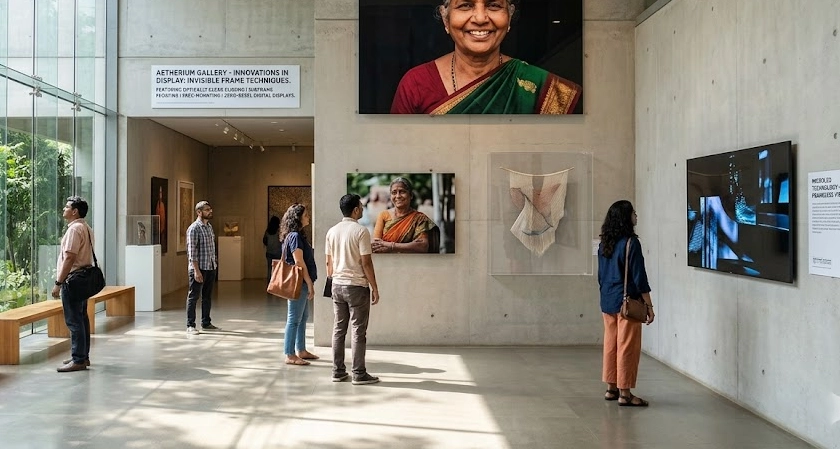
Enter into a gallery and see what catches your eye first. It is seldom the frame--it is the painting itself. This is the same impact that invisible frame systems are meant to produce. These systems create a sense that the picture is hanging on the wall because they eliminate any visible lines. I have also observed people going up to the display almost automatically attempting to figure out the method of holding the display.
The visual effects that are remarkable are:
- Effect of floating: The painting does not seem to be attached to the surface.
- Edge-to-edge clarity: There are no intermittences in the image.
- Even light: SEG Solution Backlit systems evenly distribute light without shadows.
Depth is the other subtle effect. With the right placement of lighting, there is a slight shadow behind the frame, which adds dimension without distracting. This is particularly effective in the case of photography exhibitions in which detail counts.
Invisible frames do not simply complement the artwork they silently improve it, should you be in need of a clean and modern presentation.
Use Cases in Different Gallery Spaces
There is no single type of gallery which is restricted to invisible frame systems. Their versatility allows them to be used in a variety of conditions. In my experience, they are best used in areas where visual clarity and speed of updates are significant.
Applications:
- Art galleries: Perfect when it comes to photography and digital prints and detail should not be lost.
- Museums: These are applied in temporary exhibitions because of the ease in changing graphics.
- Retail galleries: SEG Solution displays are frequently utilized by brands to display campaigns in clean displays.
- Corporate spaces: Minimal displays are good in offices and lobbies.
These frames assist in lessening the visual clutter in smaller galleries. They can be used in larger areas to enable a consistent presentation on multiple walls. The fact that they can easily change graphics without the use of tools makes them feasible in rotating exhibitions.
Benefits Compared to Traditional Framing
The traditional frames are not totally phased out, but the invisible frame system has obvious benefits in cases when it comes to presentation. Visual focus is one of the largest distinctions. There are no thick borders and therefore the focus of the viewer is on the artwork, not the frame.
Key benefits include:
- Neat look: No edges or large materials in sight.
- Quicker upgrades: With a SEG Solution, graphics can be changed within minutes.
- Reduced long term expenses: There is no necessity in purchasing new frames per artwork.
- Lightweight construction: Less cumbersome to carry and assemble.
Consistency is another significant aspect. The traditional frames are different in style, as well as thickness, which might give a disjointed appearance throughout a gallery. Invisible systems have a consistent look that is essential in professional exhibitions.
When the intention is to showcase the artwork without distraction, the use of invisible framing is not only a possibility but it is usually the most appropriate.