>>
Industry>>
Compliance and governance>>
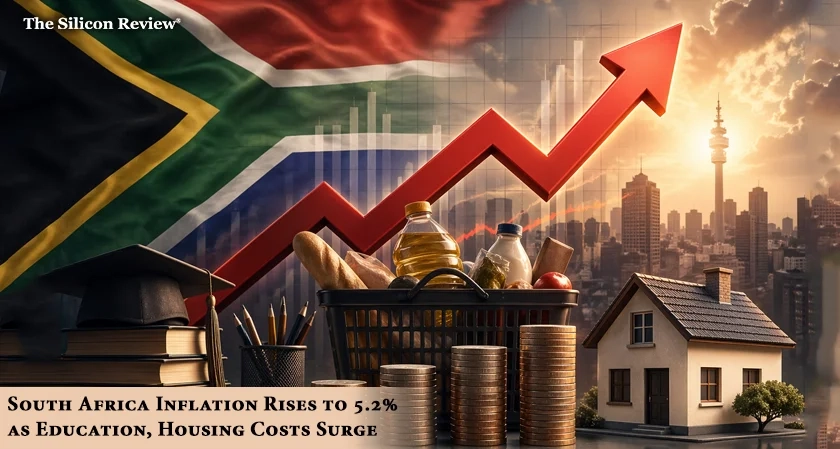
South Africa Inflation Rises t...South Africa Inflation Rises to 5.2% as Education, Housing Costs Surge
The Silicon Review
23 April, 2026
Author:
The Silicon Review Team
South Africa inflation accelerated to 5.2% in March, up from 4.8%, driven by surging education and housing costs. The Silicon Review reports on the rising cost of living pressure as the central bank weighs interest rate decisions.
South Africa inflation accelerated to 5.2% in March from 4.8% in February, driven by sharp increases in education and housing costs, according to data released Thursday by Statistics South Africa.
Education costs jumped 7.5% year-on-year, reflecting the implementation of new school and university tuition fees for the 2026 academic year. Housing and utilities rose 5.8%, while food and non-alcoholic beverages increased 4.5%.
The inflation reading exceeded market expectations of 5.0% and pushed the rate further above the South African Reserve Bank's preferred midpoint of 4.5%, though it remains within the target range of 3% to 6% .
Core inflation, which excludes volatile food and fuel prices, rose to 5.0% from 4.7% in February. Transport inflation slowed to 3.2% from 4.1%, offering some relief as global oil prices stabilized following the reopening of the Strait of Hormuz.
The South Africa cost of living has become a central political issue ahead of local government elections scheduled for October. The rand has weakened 8% against the US dollar since the start of the Iran war, making imported goods more expensive.
The central bank raised its benchmark repo rate by 25 basis points to 8.25% in January and has signaled it may hold rates steady at its May meeting if inflation remains contained. However, economists now expect at least one more rate hike this year.
"Education costs are largely administrative and outside the central bank's control," said Elize Kruger, an independent economist. "But the continued pressure on housing and utilities suggests that underlying demand pressures remain elevated."
Manufacturing and mining sectors showed signs of strain, with factory output contracting 1.2% in February and mining production falling 3.5%, both affected by load-shedding and weak global demand.
The inflation data comes as President Cyril Ramaphosa's administration faces growing public frustration over rising living costs and persistent power outages. The National Treasury has forecast inflation to average 4.9% in 2026, down from 5.6% in 2025.
As South Africa inflation rises to 5.2% on surging education and housing costs, The Silicon Review examines how the cost of living crisis is squeezing households and whether the central bank's cautious rate approach can balance inflation control with economic growth.
About the Author
Sashindra Suresh is an experienced writer specializing in artificial intelligence, software development, and emerging technologies. With a strong ability to translate complex technical concepts into clear, engaging insights, she has contributed to a wide range of publications and platforms. Her work focuses on making cutting-edge innovations accessible to both industry professionals and curious readers alike.