>>
Technology>>
Artificial intelligence>>
AI replaces Tech Jobs, Warns R...AI replaces Tech Jobs, Warns Raspberry Pi CEO Eben Upton
The Silicon Review
15 May, 2026
Author:
Sashindra Suresh
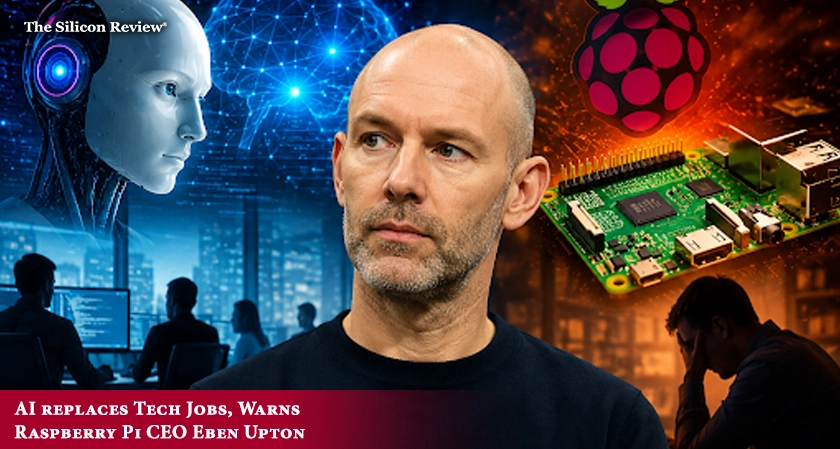
Raspberry Pi CEO Eben Upton warns that AI could discourage young people from pursuing tech careers as AI replaces jobs. The Silicon Review reports on the skills shortage risk and Upton's prediction of a productivity-led economic boom.
Raspberry Pi CEO Eben Upton has warned that artificial intelligence could discourage young people from pursuing careers in technology, potentially creating a skills shortage even as the UK positions itself as a global AI hub.
Speaking to the BBC, Upton acknowledged that AI replacing jobs is a legitimate concern, particularly for entry-level programming roles that have traditionally served as the gateway into the tech industry. "If we aren't careful, we could see a generation of young people decide that coding isn't worth learning because they think machines will do it all," he said.
Upton noted that he has already observed a decline in the number of young people applying for computer science degrees, which he attributes to the perception that AI will make traditional programming skills obsolete. This trend, if left unchecked, could have serious implications for the UK's future workforce.
However, Upton offered a more optimistic long-term view. He predicted that businesses will eventually harness AI to boost productivity, sparking a "sustained economic boom" that could persist until the early 2040s. He draws a historical parallel to the introduction of the graphical user interface in the 1980s, which similarly caused anxiety about the future of computing but ultimately expanded the industry.
"The introduction of the graphical user interface didn't kill computing; it supercharged it," Upton explained. "AI will do the same. But we have to manage the transition carefully and ensure that young people still see a future for themselves in this field."
Upton's warning comes as the UK government pushes forward with its National AI Strategy, which aims to make Britain a global leader in artificial intelligence. The strategy includes significant investment in AI research and development, as well as initiatives to upskill the existing workforce.
However, critics argue that the government's focus on attracting international AI talent may come at the expense of nurturing home-grown skills. Upton stressed that a balanced approach is needed; one that encourages young people to enter the field while also supporting those whose jobs may be displaced by automation.
Upton called for educational reforms that emphasise the creative and problem-solving aspects of coding, rather than rote learning or repetitive tasks that are easily automated. He also urged tech companies to invest in apprenticeship programmes and outreach initiatives targeting underprivileged communities.
As Raspberry Pi CEO Eben Upton warns that AI could discourage young people from tech careers, The Silicon Review examines how a generation might be lost to automation fears and why a productivity boom may not materialise without enough engineers to build it.
Q: What did the Raspberry Pi CEO warn about AI and tech jobs?
A: Eben Upton warned that AI could discourage young people from pursuing tech careers because they might believe machines will make traditional programming skills obsolete, potentially creating a future skills shortage.
Q: Is AI replacing jobs a real concern according to Raspberry Pi CEO?
A: Yes, Upton acknowledged that AI replacing jobs is a legitimate concern, particularly for entry-level programming roles that have traditionally served as the gateway into the tech industry.
Q: What did the Raspberry Pi CEO predict about AI and the economy?
A: Upton predicted that businesses will harness AI to boost productivity, sparking a "sustained economic boom" that could persist until the early 2040s, drawing a historical parallel to the introduction of the graphical user interface.
Q: How many young people are applying for computer science degrees according to Upton?
A: Upton noted that he has already observed a decline in the number of young people applying for computer science degrees, which he attributes to the perception that AI will make traditional programming skills obsolete.
Q: What did Upton compare AI's impact on tech jobs to?
A: Upton compared AI to the introduction of the graphical user interface in the 1980s, which similarly caused anxiety about the future of computing but ultimately expanded the industry rather than destroying it.
Q: What educational reforms did the Raspberry Pi CEO call for?
A: Upton called for educational reforms that emphasise the creative and problem-solving aspects of coding, rather than rote learning or repetitive tasks that are easily automated by AI.