>>
Industry>>
Space>>
Artemis II Mission: Giant Radi...Artemis II Mission: Giant Radio Telescope Sees 4 Astronauts in Fuzzy Pixels
The Silicon Review
18 May, 2026
Author:
Sashindra Suresh
The Green Bank Telescope tracked Artemis II's mission Orion spacecraft within 0.2mm/s accuracy. The Silicon Review reports on the pixelated image capturing four astronauts over 213,000 miles away.
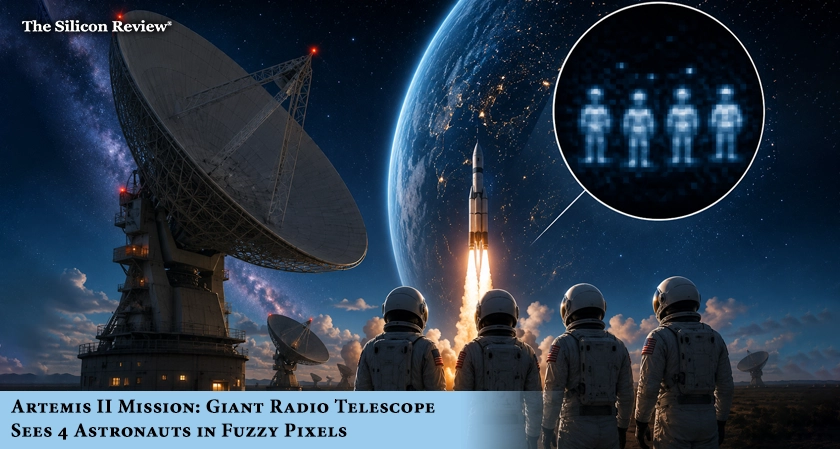
The world’s largest fully steerable radio telescope tracked NASA’s Artemis II mission around the Moon for five days, producing a pixelated image that, while fuzzy, captured something extraordinary: four human beings aboard the Orion spacecraft more than 213,000 miles from Earth.
"There are four people in those pixels," Will Armentrout, a scientist at the Green Bank Observatory, told colleagues while presenting the image. The observation came from the U.S. National Science Foundation Green Bank Telescope (NSF GBT) in West Virginia, a 485-foot-tall structure weighing 17 million pounds with a dish covering 2.3 acres the largest moving structure on land.
Working in partnership with NASA’s Space Communications and Navigation program, the GBT conducted five separate observations, each lasting six hours, tracking the Orion spacecraft named Integrity by the Artemis II crew at the moments it was farthest from Earth and deepest into its lunar trajectory.
The precision was staggering. Scientists measured Orion’s movement within 0.2 millimeters per second of NASA’s calculations. "It's like having a speedometer in your car that can track your speed within 0.0004 decimal places per hour," said Anthony Remijan, the observatory’s site director.
The radar observations were active rather than passive. A NASA Deep Space Network antenna in California beamed radio energy toward Orion, and the massive GBT picked up the extremely faint reflection off the spacecraft a technique that works without relying on Orion’s onboard communication antennas. "Performing radar observations at the distance of the Moon requires powerful transmitters and really, really big radio telescopes, like the GBT," Armentrout said.
The Artemis II crew NASA astronauts Reid Wiseman, Victor Glover, Christina Koch, & Canadian Space Agency astronaut Jeremy Hansen lifted off on April 1, 2026, for an approximately 10-day journey around the Moon. They traveled a total of 695,081 miles, reaching a maximum distance of 252,760 miles from Earth surpassing the Apollo 13 record by about 4,105 miles.
The GBT has a history of supporting deep space missions, including radar observations for NASA’s Double Asteroid Redirection Test (DART) planetary defense mission in 2022. The National Radio Astronomy Observatory said these Artemis II observations demonstrate how radio telescopes can support future lunar missions both for NASA and for commercial aerospace companies.
By the third quarter of 2026, NASA & the NSF expect to formalize expanded partnerships for using ground-based radio astronomy assets to support the increasing cadence of lunar missions under the Artemis program.
The Silicon Review’s analysis indicates that the GBT’s radar tracking capability provides NASA with a redundant, independent method for precisely locating spacecraft at lunar distances a critical capability as commercial landers, orbital platforms, and eventually surface habitats multiply the number of active assets in cislunar space.
Q: What telescope tracked the Artemis II Orion spacecraft around the Moon?
A: The Green Bank Telescope in West Virginia, the world’s largest fully steerable radio telescope, tracked Orion for five days during the Artemis II mission.
Q: How accurate was the Green Bank Telescope’s tracking of the Artemis II spacecraft?
A: The GBT tracked Orion’s movement within 0.2 millimeters per second of NASA’s projections. The observatory’s site director compared it to a speedometer tracking a car’s speed within 0.0004 decimal places per hour.
Q: Who are the four astronauts aboard the Artemis II Orion spacecraft?
A: The Artemis II crew includes NASA astronauts Reid Wiseman (commander), Victor Glover (pilot), Christina Koch (mission specialist), and Canadian Space Agency astronaut Jeremy Hansen (mission specialist).
Q: What does “there are four people in those pixels” mean?
A: The phrase refers to a pixelated image captured by the Green Bank Telescope of Orion over 213,000 miles from Earth. Each blurry pixel represented the reflected radar signal from the spacecraft carrying four astronauts.
Q: How does the Green Bank Telescope track spacecraft at lunar distances?
A: A NASA Deep Space Network antenna beams radio energy toward the spacecraft, and the massive GBT picks up the extremely faint reflection. This active radar method works without relying on the spacecraft’s onboard communication antennas.
Q: Has the Green Bank Telescope supported other NASA missions?
A: Yes. The GBT provided radar observations for NASA’s DART planetary defense mission in 2022 and continues to support NASA’s Deep Space Network for lunar and deep space exploration.