>>
Industry>>
Space>>
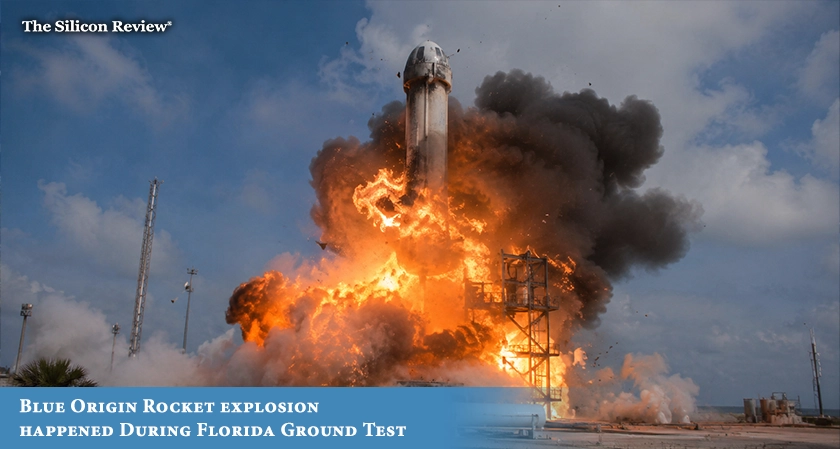
Blue Origin Rocket explosion h...Blue Origin Rocket explosion happened During Florida Ground Test
The Silicon Review
29 May, 2026
Author:
Vinay Kumar
Blue Origin's New Glenn rocket explosion happened during a hotfire test at Cape Canaveral, Florida. The Silicon Review reports on the anomaly that will delay Amazon satellite launches and NASA moon missions.
A Blue Origin New Glenn rocket explosion happened during a ground test at Cape Canaveral Space Force Station in Florida, engulfing Launch Complex 36 in a massive fireball. The incident occurred around 9:00 p.m. local time on May 28, 2026, during a standard pre-launch "hotfire" test where the rocket was anchored to the pad while its engines were ignited.
No personnel were injured in the explosion. Blue Origin confirmed all employees have been accounted for and are safe. The company released a statement on X saying they experienced an anomaly during the hotfire test and would provide updates as they learn more. Company founder Jeff Bezos said it is too early to determine the root cause but an investigation is already underway. "Very rough day, but we'll rebuild whatever needs rebuilding and get back to flying. It's worth it," Bezos wrote on X.
The New Glenn rocket was being prepared for its fourth mission, which had been scheduled for June 4, 2026. That flight was intended to carry 48 satellites for Amazon's Project Kuiper internet constellation, a direct competitor to Elon Musk's Starlink. The satellites were not aboard the rocket at the time of the explosion. The test was not within the scope of FAA-licensed activities, and the agency confirmed there was no impact to air traffic.
The explosion marks another setback for Blue Origin following an April 19 mission failure. During that flight, the rocket's first stage booster successfully landed on a sea barge, but the upper stage failed to deliver its payload, AST SpaceMobile's BlueBird 7 satellite, to a safe orbit. The FAA had opened an investigation into that failure before approving a return to flight.
Space Launch Complex 36 is currently the only launch facility capable of launching New Glenn rockets. The extent of damage to the launch pad and ground equipment has not been disclosed. Industry analysts warn that rebuilding could take months. Space journalist Eric Berger commented on the severity, stating that the explosion likely removes Blue Origin from the Artemis lunar program for the next 12 months.
NASA Administrator Jared Isaacman acknowledged the incident, stating that NASA would work with its partners to support a thorough investigation and assess impacts on near-term missions, including the Artemis program's lunar landing goals.
Blue Origin CEO Dave Limp previously stated the company aimed to complete at least eight New Glenn missions in 2026. That goal is now unattainable following the explosion.
As Blue Origin's New Glenn rocket explodes during a Florida ground test, The Silicon Review examines how this anomaly will delay Amazon's satellite internet deployment, disrupt NASA's lunar exploration timeline, and further widen SpaceX's lead in the commercial space race.
Q: What caused the Blue Origin rocket explosion?
A: The cause is not yet known. Blue Origin founder Jeff Bezos said it is too early to determine the root cause and that the company has already begun its investigation.
Q: Was anyone injured in the Blue Origin rocket explosion?
A: No. Blue Origin confirmed that all personnel have been accounted for and are safe. NASA and Space Force officials also confirmed no injuries or fatalities.
Q: What was the New Glenn rocket's mission before the explosion?
A: The rocket was scheduled to launch its fourth mission on June 4, 2026, carrying 48 satellites for Amazon's Project Kuiper internet constellation, a competitor to SpaceX's Starlink.
Q: How will the Blue Origin explosion affect NASA's Artemis program?
A: New Glenn is designed to support future lunar missions, including Blue Origin's Blue Moon lunar lander. NASA is assessing the impact on Artemis missions, including the 2027 Artemis III flight that aims to return astronauts to the moon.
Q: How does this explosion compare to Blue Origin's previous failures?
A: This is Blue Origin's most serious anomaly to date. The company experienced a failure during its third mission on April 19, 2026, when the rocket's upper stage failed to deliver a satellite to its target orbit, but the rocket did not explode on the pad.
Q: What damage was caused by the Blue Origin rocket explosion?
A: The explosion caused significant damage to Launch Complex 36, which is the only facility capable of launching New Glenn rockets. The extent of the damage to ground equipment and infrastructure has not been fully disclosed.