>>
Technology>>
Cyber security>>
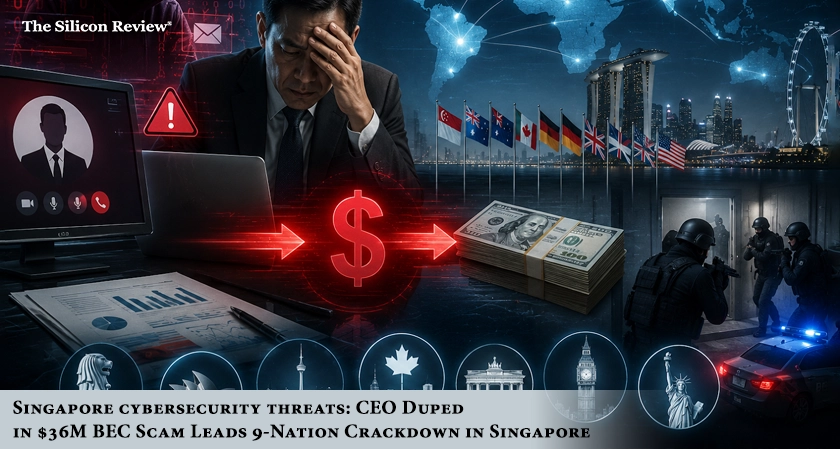
Singapore cybersecurity threat...Singapore cybersecurity threats: CEO Duped in $36M BEC Scam Leads 9-Nation Crackdown in Singapore
The Silicon Review
21 May, 2026
Author:
Vinay Kumar
A Singapore company CEO was duped in a $36M BEC scam, triggering a 9-nation Interpol-led crackdown. The Silicon Review reports on the elite banking infiltration, record asset seizures, and Singapore cybersecurity threats.
A Singapore-based company CEO was duped in a $36 million business email compromise scam that has triggered a 9-nation Interpol-led crackdown, exposing sophisticated cybercriminal networks that have infiltrated banking systems across Southeast Asia.
The cybersecurity threats emerged when the Singapore CEO received an email appearing to be from the parent company's CFO requesting an urgent transfer for an acquisition. The email used the CFO's actual signature block, internal jargon, and knowledge of pending deals. Funds were moved to accounts across Malaysia, Indonesia, Thailand, Vietnam, and the Philippines within hours.
The online financial fraud was uncovered when the real CFO called the CEO the next day to confirm the transfer. Singapore's Commercial Affairs Department traced the money through 47 accounts across nine countries, leading to simultaneous raids on May 20. Authorities arrested 12 suspects and seized $18 million in assets including luxury cars, watches, and cryptocurrency wallets.
Interpol's Singapore bureau coordinated the operation, which involved cybercrime units from Malaysia, Indonesia, Thailand, Vietnam, the Philippines, Brunei, Cambodia, and Laos. The investigation revealed that the criminal group had compromised banking employee credentials, allowing them to approve large transfers without triggering standard fraud alerts.
The BEC scam is the largest such case prosecuted in Singapore, surpassing the $14 million case in 2023. The Commercial Affairs Department confirmed that the funds were laundered through shell companies, cryptocurrency exchanges, and luxury goods purchases. Three suspects were apprehended trying to leave Singapore for Dubai.
By the third quarter of 2026, Singapore's Monetary Authority will require all banks to implement real-time verification for any transfer exceeding $500,000, including biometric authentication for both the initiating and approving employees. The new rules were fast-tracked in response to this case.
The Silicon Review's analysis indicates that BEC scams have evolved from crude phishing to sophisticated operations that compromise banking employees directly. The Singapore case demonstrates that the weakest link is no longer the targeted employee but the banking infrastructure itself.
Q: How much money was stolen in the Singapore BEC scam?
A: A Singapore company CEO was duped in a $36 million business email compromise scam, the largest such case prosecuted in Singapore.
Q: How did the BEC scam succeed despite banking controls?
A: The criminal group compromised banking employee credentials, allowing them to approve large transfers without triggering standard fraud alerts.
Q: Which countries participated in the Interpol-led crackdown?
A: The operation involved cybercrime units from Singapore, Malaysia, Indonesia, Thailand, Vietnam, the Philippines, Brunei, Cambodia, and Laos.
Q: How much was seized in the 9-nation operation?
A: Authorities arrested 12 suspects and seized $18 million in assets including luxury cars, watches, and cryptocurrency wallets.
Q: What new banking regulations will Singapore implement after this BEC scam?
A: By the third quarter of 2026, Singapore's Monetary Authority will require all banks to implement real-time verification for any transfer exceeding $500,000, including biometric authentication for both initiating and approving employees.
Q: How did the Singapore CEO become a victim of the BEC scam?
A: The CEO received an email appearing to be from the parent company's CFO requesting an urgent transfer for an acquisition. The email used the CFO's actual signature block, internal jargon, and knowledge of pending deals.