>>
Technology>>
Data analytics>>
How Modern Businesses Use Data...How Modern Businesses Use Data to Stay Competitive
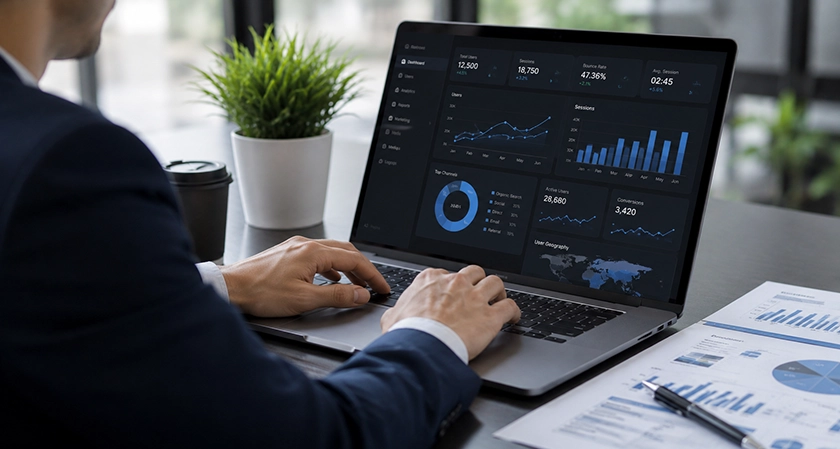
The prevalence of data usage is now widespread in most businesses. This is what makes a business relevant in this day and age, bringing it into the modern era. Data is used at all levels of the business: in your digital marketing campaigns, in C-suite decision making, in operational efficiency, in product development, and in risk management protocols.
Exactly how data is used differs widely throughout these aspects of running a modern business, and in this article, we will seek to explain each particular instance to help you make an informed decision about how to take your business to the next level as you look to compete with and outperform your rivals.
Marketers are the most likely current users of data
One of the most obvious uses of data is in your marketing output. Most modern businesses employ a digital marketing specialist who knows exactly how to make you tick in the virtual world and stand out amongst the crowd online. However, what you may not have yet realised is that whilst marketers have been able to personalise their customer communications for years, a new development that data is enabling is called hyper-personalisation.
This means that your digital marketing team can now tailor products, recommendations, and their marketing campaigns to match an individual user’s preferences. This is done through a combination of analysing data within a company’s CRM, the purchasing history of a customer, and even their browsing behavior on your website.
These new hyper-personalised customer experiences drive a much stronger customer loyalty with your business, as you are actively speaking to them directly and accurately reflecting their individual needs. Using data in this way leads to higher retention numbers and an increased volume of sales.
Data can lead to evidence-based decision-making
Data should also be used by business leaders in order to ensure their business stays competitive in the marketplace. These days, most C-suite business leaders are using data to produce real-time dashboards in order to understand exactly how their business is functioning. Predictive analytics are also used to model scenarios based on up-to-date data, permitting business leaders to evaluate the risk involved during decision-making processes as well as to plan longer-term strategies in terms of product development and market opportunities.
This use of data has shifted the way those in leadership roles for the business can now proactively capitalize on future opportunities and gaps in the market, rather than only being able to react to past events. It can be suggested that this is the most common way that modern businesses use data, with their competitiveness being born out of quickly understanding what works and what doesn’t.
Data also powers both operational efficiency and cost optimization
When it comes to your business’s operational efficiency, data can also be used to run audits on how your company works. The most frequent type of dashboard used to assess how the business works is one that analyses internal workflows. By having this type of overview, the leadership can quickly reveal any bottlenecks created, cost inefficiencies, and ultimately any other areas of financial waste that arise during the production process.
But how exactly do you use this data to remain competitive? Well, by having such data-driven dashboards that highlight the inefficiencies, you can easily optimize your inventory and reduce any operational costs that appear superfluous without accidentally cutting areas that are actually delivering you quality.
Product innovation and market adaptation can only be reached by data analysis
Earlier in this article, we talked about how you can use data to find gaps in the market. This type of data-driven change can be referred to as market adaptation. By evaluating your user metrics, customer feedback, and even your competitor activities, you can identify where to move your business next.
Most digital marketing teams in modern businesses will recommend to their C-suite representative that they should be deploying automations that scrape data from their competitors as this both reduces the likelihood of human error and also increases the relevance of the data. Automations can be set up to run at regular intervals, examining competitor websites for any changes to their product listings and the pricing of their products or services.
However, for these automations to run at their best capability and not to impact the usual running of digital marketing activities of your business, you should operate them by using a proxy server. This is because such web scraping activities could trigger a temporary block on your head office being able to access a competitor’s website because you accessed it too many times within a short timespan.
A provider like BestProxy can give your marketing team access to a wide range of locations to connect from and ensure that your automations run uninterrupted, as the location can be changed at the click of a button. Using this data, the business can then move quickly to adjust existing products or launch new offerings that meet the demand or needs of its customers.
Data plays a huge role in risk mitigation and security
One final factor to take into consideration is that data can also be used to mitigate risk and provide extra layers of security for the business. Whilst this doesn’t specifically lead to you staying competitive, it does give you the advantage of uptime and avoiding loss of business to competitors.
The main way that companies can mitigate risk is to monitor transactional and system data by using automated tools that can instantaneously detect any anomalous patterns. It is this data-backed approach that can protect a business from fraud, cyber threats, and even compliance issues; all three of which can reduce availability for a business, whether that be due to loss of product, loss of finance, or loss of web platform.
There is no one-size-fits-all way to use data in every business
Across these five different factors, you may now think data can enhance your business in several ways. However, it is up to you to implement whichever methods we have outlined in this article. There is no one exact way that can supercharge every business and take it to the next level by the use of data. The truth will lie somewhere in the middle, and can even be implemented stage by stage so that you can easily understand the benefits that each action brings to your business.
One thing is for sure: modern businesses all operate by using data to their advantage. The real-time dashboards present an accurate reflection of how your company currently operates and therefore guarantee that decision-making is as relevant as it can be.