>>
Industry>>
Bio tech>>
Merck antibody-drug conjugate ...Merck antibody-drug conjugate (ADC) Trial Succeeds in First Big Global Test with Chinese-Licensed Drug
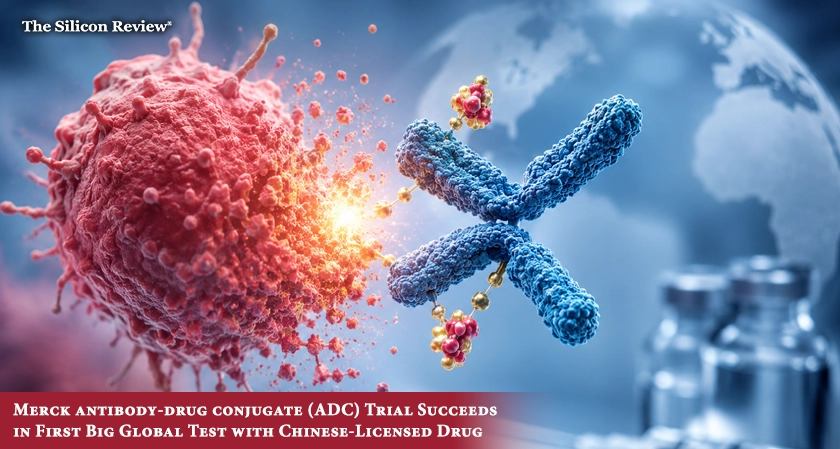
Merck‘s antibody-drug conjugate (ADC) licensed from China succeeded in a Phase 3 trial for non-small cell lung cancer. The Silicon Review reports on the accelerated approval pathway and the milestone payment due to Chinese biotech partner Kelun.
Merck‘s antibody-drug conjugate (ADC), licensed from a Chinese biotech, met its primary endpoint in a late-stage global trial for patients with non-small cell lung cancer, marking the first major validation of China‘s ADC manufacturing capabilities on the world stage.
The Merck ADC trial enrolled 850 patients across North America, Europe, and Asia, comparing the drug to standard chemotherapy in patients whose tumors had progressed after prior treatment. The ADC demonstrated a statistically significant improvement in progression-free survival with a manageable safety profile, Merck announced at the American Society of Clinical Oncology plenary session.
The drug was originally developed by a Shanghai-based biotech that Merck partnered with in 2022. Under the terms of that agreement, Merck paid 500 million up front and committed upto 4.5 billion in milestone payments. The successful trial triggers a $300 million milestone payment to the Chinese partner, which retains co-development rights in greater China.
Antibody-drug conjugates are a class of cancer therapy that link potent chemotherapy agents to antibodies that specifically target tumor cells. ADCs deliver chemotherapy directly to cancer cells while sparing healthy tissue, reducing side effects compared to traditional chemotherapy. China has emerged as a powerhouse in ADC development, with more than 100 ADCs in clinical trials and a deep bench of experienced manufacturing talent.
The trial‘s success is particularly significant because it validates not just the molecule but China‘s ability to manufacture ADCs at global quality standards. Unlike traditional small-molecule drugs, ADCs are biologic-drug hybrids requiring specialized conjugation chemistry and quality control. Manufacturing complexity has been a barrier to outsourcing, but this trial demonstrates that Chinese contract manufacturing can meet global regulatory standards.
By the fourth quarter of 2026, Merck plans to submit the ADC for regulatory approval in the United States, Europe, and Japan. A priority review designation could bring the drug to market by mid-2027. For the Chinese biotech partner, the successful trial opens the door to negotiating similar licensing deals with other global pharmaceutical companies.
The Silicon Review‘s analysis indicates that the Chinese-licensed ADC’s success in a global trial signals a shift in the pharmaceutical industry‘s perception of Chinese biotech. For years, Western companies viewed Chinese innovation primarily through the lens of cost arbitrage. The Merck trial proves that Chinese-discovered molecules can compete on science and data with the world’s best.
Q: What is the Merck ADC and where was it originally developed?
A: The antibody-drug conjugate was originally developed by a Shanghai-based biotech that Merck partnered with in 2022. Merck paid 500 million upfront and committed upto 4.5 billion in milestone payments.
Q: What were the results of the Merck ADC trial?
A: The trial met its primary endpoint, demonstrating a statistically significant improvement in progression-free survival in non-small cell lung cancer patients compared to standard chemotherapy, with a manageable safety profile.
Q: Why is this trial significant for China‘s biotech industry?
A: It validates China’s ability to manufacture ADCs at global quality standards, overcoming the manufacturing complexity of biologic-drug hybrids that has been a barrier to outsourcing. It also demonstrates that Chinese-discovered molecules can compete on science and data with Western innovation.
Q: How many patients were enrolled in the global Merck ADC trial?
A: The late-stage trial enrolled 850 patients across North America, Europe, and Asia, making it one of the largest global studies for an ADC licensed from China.
Q: What milestone payment does the successful trial trigger for the Chinese biotech partner?
A: The successful trial triggers a $300 million milestone payment to the Chinese partner, which retains co-development rights in greater China.
Q: When will Merck submit the ADC for regulatory approval?
A: By the fourth quarter of 2026, Merck plans to submit the ADC for regulatory approval in the United States, Europe, and Japan. A priority review designation could bring the drug to market by mid-2027.