>>
Industry>>
Robotics>>
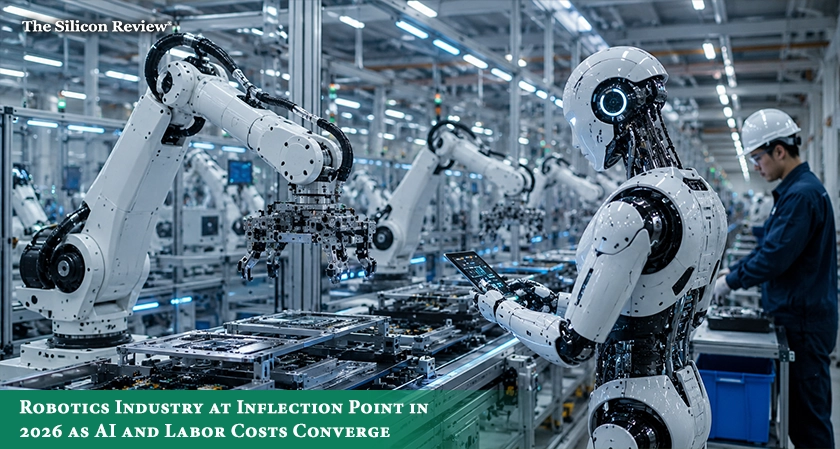
Robotics Industry at Inflectio...Robotics Industry at Inflection Point in 2026 as AI and Labor Costs Converge
The Silicon Review
26 May, 2026
Author:
Sashindra Suresh
The robotics industry is at a turning point as AI integration and rising labor costs drive record adoption. The Silicon Review reports on key trends reshaping manufacturing, logistics, and service robotics.
The robotics industry has entered 2026 at an inflection point, with converging forces of AI integration, labor shortages, and falling hardware costs driving the most rapid adoption cycle in the sector's history. Global robotics revenues are projected to reach 85 billion in 2026, up from 62 billion in 2024.
The ai robotics sector has seen the most dramatic transformation. Generative AI has enabled robots to understand natural language commands, adapt to unstructured environments, and learn new tasks without explicit programming. This shift has opened use cases previously considered impossible for automation.
Industrial robotics remains the largest segment, accounting for 55 percent of total market revenue. China installed 350,000 industrial robots in 2025, representing 55 percent of global installations. The United States installed 45,000 units, up 15 percent year-over-year, driven by the CHIPS Act and domestic manufacturing reshoring.
Logistics robotics is the fastest-growing segment, with revenues projected to grow 28 percent annually through 2028. Amazon, Walmart, and Alibaba have collectively deployed over 750,000 autonomous mobile robots in their fulfillment centers. The average payback period for logistics robots has fallen from three years to 18 months.
Humanoid robotics has moved from research labs to commercial pilots. Tesla's Optimus, Figure's 01, and Amazon-backed Agility Robotics' Digit are now being tested in warehouse and manufacturing environments. Unit sales of humanoid robots are expected to reach 25,000 units in 2026, up from 3,000 in 2024.
Collaborative robots designed to work alongside humans without safety cages now account for 15 percent of all industrial robot sales. Prices have fallen below $15,000 for entry-level cobots, making automation accessible to small manufacturers.
The robotics industry faces headwinds including a shortage of integration engineers, cybersecurity vulnerabilities in connected systems, and regulatory uncertainty around AI decision-making. The industry also lacks standardization, with each major vendor using proprietary software and interfaces.
The Silicon Review's analysis indicates that the robotics industry inflection point is driven by three converging forces: AI making robots smarter, labor shortages making automation necessary, and Chinese manufacturing makes hardware affordable. Companies that fail to adopt risk being left behind.