>>
Industry>>
Legal>>
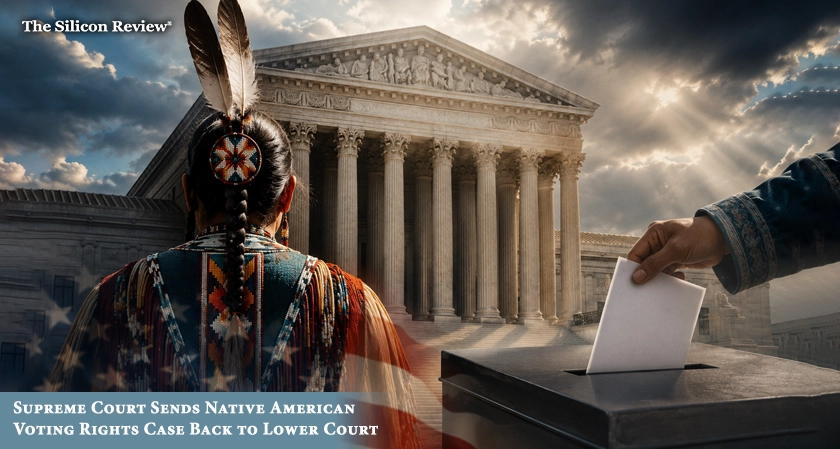
Supreme Court Sends Native Ame...Supreme Court Sends Native American Voting Rights Case Back to Lower Court
The Silicon Review
19 May, 2026
Author:
Vinay Kumar
US Supreme Court decisions: Supreme Court sent a Native American voting rights decision back to a lower court without ruling on the merits. The Silicon Review reports on the divided ruling ahead of the 2026 midterms.
US Supreme Court decisions: The Supreme Court sent a closely watched Native American voting rights case back to a lower court, declining to issue a definitive ruling on whether a Montana law that eliminated same-day voter registration disproportionately burdens tribal members.
The unsigned order directs the Ninth Circuit Court of Appeals to reconsider the case in light of the Supreme Court's 2025 decision in a separate voting rights case. Justice Neil Gorsuch, joined by Justice Sonia Sotomayor, dissented, arguing that the lower court had already applied the correct legal standard.
At issue is a 2022 Montana law that eliminated same-day voter registration across the state. Native American plaintiffs argued that the law disproportionately burdens tribal members, who face significant travel distances to county seats and lack reliable mail service on reservations. A federal district court had blocked the law, finding it violated the Voting Rights Act.
The US Supreme Court's decision to send the case back without a merits ruling leaves Montana's polling place restrictions in an uncertain status heading into the 2026 midterm elections. State officials have indicated they will seek to enforce the law, while voting rights advocates will ask the Ninth Circuit to maintain the block.
The case has drawn national attention because it tests the scope of the Voting Rights Act's protections for Native American voters. More than 30 tribal nations filed amicus briefs in support of the plaintiffs, warning that the Montana law could serve as a model for other states with significant tribal populations, including Arizona, New Mexico, South Dakota, and Alaska.
By the third quarter of 2026, the Ninth Circuit is expected to issue a new ruling that will almost certainly return to the Supreme Court for final resolution, potentially by spring 2027.
The Silicon Review's analysis indicates that the Supreme Court's refusal to rule on the merits reflects the justices' deep division over how to apply the Voting Rights Act to Native American voting challenges. For tribal members in Montana and potentially across the West the uncertainty means another election cycle will be fought in courtrooms, not just at polling places.
Q: What is the Montana voting law at issue in the Supreme Court case?
A: The 2022 Montana law eliminated same-day voter registration across the state. Native American plaintiffs argue that tribal members, who face significant travel distances to county seats and lack reliable mail service, are disproportionately burdened by the change.
Q: What did the Supreme Court decide in the Native American voting rights case?
A: The Supreme Court did not rule on the merits. Instead, it sent the case back to the Ninth Circuit Court of Appeals to reconsider in light of a separate 2025 Supreme Court voting rights decision.
Q: Which justices dissented from the Supreme Court's order?
A: Justice Neil Gorsuch, joined by Justice Sonia Sotomayor, dissented. Gorsuch argued that the lower court had already applied the correct legal standard and that the case should have been resolved now.
Q: How does the Montana law affect Native American voters?
A: Tribal members living on reservations often travel long distances to reach county seats and have unreliable mail service. Eliminating same-day registration means they must register weeks before an election, a burden the plaintiffs argue violates the Voting Rights Act.
Q: What happens next in the voting rights case?
A: The Ninth Circuit will reconsider the case. After that court issues a new ruling, the case is expected to return to the Supreme Court for final resolution, potentially by spring 2027.
Q: Why is this case important for other states?
A: More than 30 tribal nations filed briefs supporting the plaintiffs, warning that if Montana's law is upheld, other states with significant tribal populations including Arizona, New Mexico, South Dakota, and Alaska could adopt similar restrictions.