>>
Industry>>
Healthcare>>
Ebola virus outbreak: US Worki...Ebola virus outbreak: US Working with Small Biotech Firm on Experimental Ebola Treatment
The Silicon Review
21 May, 2026
Author:
Sashindra Suresh
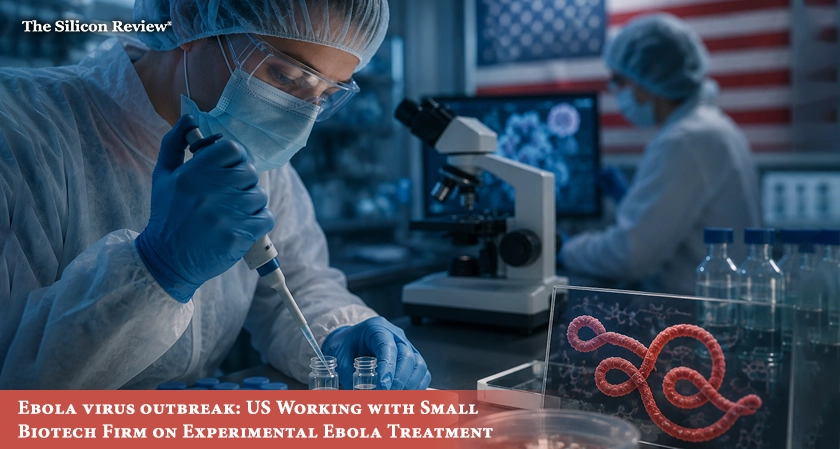
The US government is working with a small biotech firm to accelerate an experimental Ebola treatment as the DR Congo ebola virus outbreak spreads. The Silicon Review reports on the rapid response and the Bundibugyo strain challenge.
The US Department of Health and Human Services is working with a small American biotech firm to accelerate the development of an experimental Ebola treatment as the outbreak in the Democratic Republic of Congo continues to spread. The treatment uses monoclonal antibodies targeting the Bundibugyo strain.
The ebola virus outbreak has now infected 350 people and killed 91 in DR Congo, with confirmed cases also reported in Uganda and a single case in Goma, a city of over one million people on the Rwandan border. The Bundibugyo strain has no approved vaccine or specific antiviral treatment, with a fatality rate of 30 to 50 percent.
The US health department news comes as the Centers for Disease Control and Prevention has invoked Title 42, temporarily banning non-US passport holders who have visited DR Congo, Uganda, or South Sudan in the past 21 days. The CDC has also activated its Emergency Operations Center and deployed response teams to the region.
The biotech firm, which has fewer than 100 employees, developed the antibody cocktail using a proprietary platform that accelerates antibody discovery from months to days. The experimental treatment has shown promise in non-human primate studies but has not yet been tested in humans.
HHS has committed $45 million to fast-track the treatment through Phase 1 safety trials, which are scheduled to begin in July. If successful, the treatment could be deployed under emergency use authorization by late 2026, bypassing the typical years-long approval process.
The current outbreak is particularly concerning because the Bundibugyo strain circulates in forested regions where the public health infrastructure is weak. The Uganda cases were imported by travelers from DR Congo, demonstrating the potential for cross-border spread. The case in Goma, a densely populated city with active armed conflict, raises the stakes further.
By the fourth quarter of 2026, HHS expects to have manufactured 50,000 courses of the experimental treatment, stockpiled at strategic locations in Central and East Africa. The agency is also funding research into a companion vaccine, though that effort remains in early stages.
The Silicon Review's analysis indicates that the US government's partnership with a small biotech firm reflects lessons learned from the 2014-2016 West Africa Ebola virus outbreaks, when the international response was criticized as slow and fragmented. This time, agencies are moving before the outbreak becomes a global emergency.
Q: What is the US government doing to address the Ebola outbreak in DR Congo?
A: HHS is working with a small biotech firm to accelerate development of an experimental monoclonal antibody treatment targeting the Bundibugyo strain, which has no approved vaccine or specific treatment.
Q: How many people have been infected and killed in the current Ebola outbreak?
A: As of May 2026, 350 people have been infected and 91 have died in DR Congo, with confirmed cases also reported in Uganda and Goma.
Q: What travel restrictions has the CDC implemented due to the Ebola outbreak?
A: The CDC invoked Title 42, temporarily banning non-US passport holders who have visited DR Congo, Uganda, or South Sudan in the past 21 days.
Q: How much funding has HHS committed to fast-track the experimental Ebola treatment?
A: HHS has committed $45 million to fast-track the treatment through Phase 1 safety trials, which are scheduled to begin in July.
Q: When could the experimental Ebola treatment be deployed under emergency use authorization?
A: If trials are successful, the treatment could be deployed under emergency use authorization by late 2026.
Q: How many courses of the experimental treatment does HHS expect to manufacture?
A: By the fourth quarter of 2026, HHS expects to have manufactured 50,000 courses of the experimental treatment, stockpiled at strategic locations in Central and East Africa.