>>
Technology>>
Artificial intelligence>>
Artificial Intelligence in HR ...Artificial Intelligence in HR and Payroll Systems: Operational Transformation, Governance Risks, and the Future of Human-Centered Digital Workforce Administration
Human Resources has evolved from a transactional administrative function into a data-driven operational system embedded within organizational decision-making architectures. AI has accelerated that change by taking on high-volume tasks such as résumé screening, employee query handling, payroll checks, and workforce data analysis.
Deloitte reports that more than 70% of large organizations are investing in AI-enabled HR systems. That level of adoption points to a broader change in how companies manage people: HR is becoming a computational governance layer for workforce management[2].
This article contributes an original perspective by framing HR digitalization not only as automation, but as the reconfiguration of human decision authority into algorithmic systems.
AI in Recruitment Systems: From Human Judgment to Algorithmic Filtering
AI is changing recruitment and payroll most visibly at the operational level, where repetitive tasks can now be processed with speed and consistency.
Automated Screening and Structural Efficiency Gains
AI-enabled recruitment systems have significantly reduced manual screening workloads by:
- Parsing CVs using NLP-based models
- Ranking candidates based on predictive matching algorithms
- Automating communication and scheduling workflows
- Standardizing applicant evaluation pipelines
LinkedIn Talent Solutions reports up to 75% reductions in screening time[3]. However, the bigger structural change isn't efficiency alone. Recruitment is moving from human interpretation toward statistical selection, where candidate profiles pass through model-based filters before many recruiters ever see them.
Predictive Hiring and the Risk of Algorithmic Conformity
Predictive hiring systems increasingly optimize for historically successful profiles, using past employee data to identify ideal candidates. However, this creates a structural risk: organizations may unintentionally optimize for replication of existing workforce patterns rather than diversification of capability.
In my recruiting experience, strong hires often stood out through motivation, adaptability, and long-term potential, which are qualities that rarely appear on a resume alone. AI can help assess objective data, but some hiring decisions still require human judgment, even when that judgment must be checked for bias.
Payroll and Compliance Systems: Automation of Regulatory Logic
AI-driven payroll systems now operate as embedded compliance engines capable of:
- Detecting anomalies in payroll processing
- Automating tax and regulatory calculations
- Integrating workforce scheduling with compensation logic
- Managing multi-jurisdiction compliance requirements
PwC highlights improvements in accuracy and processing efficiency in AI-enabled payroll environments, particularly in multinational organizations[4]. Yet payroll automation also changes how organizations understand correctness. Accuracy becomes something validated by system logic rather than checked through human oversight.
This creates “compliance automation dependency risk”, or the organizational reliance on algorithmic systems as primary validators of legal and financial correctness. Administrative automation can reduce repetitive work and give HR teams more time for tasks that require judgment.
However, we don’t want to throw AI into all aspects of our day just because of convenience. Organizations need clear boundaries for automation, human review, and employee access to support.
Workforce Analytics: Employees as Predictive Data Structures
AI-enabled workforce analytics systems increasingly model employees as predictive entities, using:
- Behavioral metrics
- Performance data
- Engagement signals
- Historical HR records
While this enables predictive workforce planning, it also reframes employees as data structures within optimization systems, rather than contextual human actors. This creates “behavioral abstraction of the workforce,” where human complexity is reduced to algorithmically interpretable signals.
Critical Contribution: Human Displacement in HR Systems
AI-driven HR systems can reduce administrative burden, but they also change how employees access support, challenge decisions, and reach human judgment in cases that require explanation or individual review.
Removal of Human Intermediaries
One of the most significant structural shifts in AI-driven HR systems is the reduction of direct human interaction in employment processes.
This includes:
- Automated HR query resolution via chatbots
- Algorithmic recruitment screening
- System-driven payroll dispute resolution
- Digital-only employee support interfaces
In this systemic trend, HR is transitioning from a relational service model to a digital interface model.
Impact on Older Workers and Digital Exclusion
A key contribution of this article is its focus on generational and digital inequality within HR systems.
Older employees and less digitally fluent individuals may experience:
- Reduced ability to navigate HR systems
- Increased dependency on digital self-service platforms
- Barriers to accessing benefits or resolving payroll issues
- Perceived loss of organizational support accessibility
Research on digital inequality shows persistent gaps in digital competence across age groups[6]. Applied to HR systems design, those gaps may unintentionally create structural exclusion mechanisms within organizations.
Digitalization as a “Low-Trust Interaction Environment”
AI-driven HR systems may be perceived as:
- Impersonal
- Procedurally rigid
- Emotionally unresponsive
In sensitive HR contexts such as payroll disputes or disciplinary processes, limited access to human explanation may come at the cost of relational trust infrastructure within organizations.
Ethical and Governance Implications
AI adoption in HR introduces several governance challenges:
- Algorithmic bias and historical reproduction of inequality[5]
- Opacity in decision-making systems
- Expansion of employee surveillance capabilities[1]
- Data privacy risks under GDPR frameworks
Current governance models are still primarily reactive, focusing on compliance rather than structural design ethics in HR systems architecture.
Original Framework Contribution: “Hybrid HR Governance Model”
Current governance models are still primarily reactive, addressing bias, access barriers, and system errors after they occur. A balanced HR architecture combines:
- Algorithmic efficiency (AI-driven processing)
- Human interpretive oversight (decision validation layer)
- Employee relational access points (human HR interaction channels)
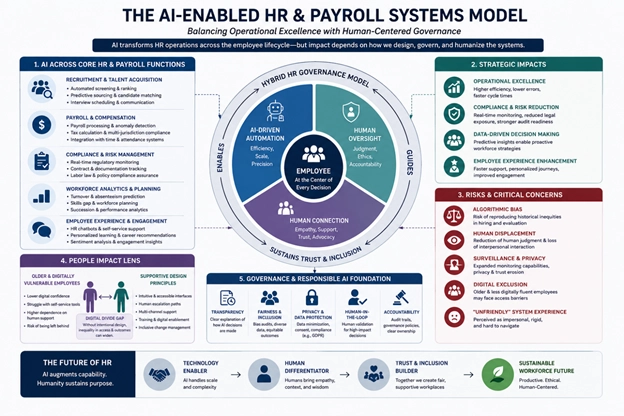
(Diagram: AI-enabled HR and payroll systems model built around a Hybrid HR Governance Model)
AI should strengthen HR systems by improving scale, precision, and service access while preserving human oversight, judgment, and relational governance structures.
Future Role of HR Professionals: From Administrators to System Governors
HR professionals are taking on responsibilities that require stronger oversight of workforce technologies, including:
- AI system oversight and governance
- Workforce analytics interpretation
- Ethical auditing of HR algorithms
- Organizational change mediation
This represents a shift from operational execution to system-level governance of workforce technologies.
Conclusion: Strategic Implications for Workforce System Design
AI is transforming HR into a digitally mediated decision infrastructure that improves efficiency, scalability, and compliance precision. However, this transformation introduces structural risks related to human displacement, digital exclusion, and reduced relational accessibility.
This article frames HR digitalization as a dual transformation: operational optimization of workforce systems and relational restructuring of employer-employee interaction models.
The long-term sustainability of AI-driven HR systems will depend on technological performance, human accessibility, interpretive judgment, and trust-based governance structures.
About the Author:
Vera Nordstrand is an HR and business operations professional specializing in recruitment, onboarding, payroll, compliance, HR systems, and workforce coordination. Her work focuses on improving HR operations through clear processes, digital tools, and people-centered support.
References:
- Ajunwa, I., Crawford, K., & Schultz, J. (2017). Limitless worker surveillance. California Law Review, 105(3), 735–776. https://ssrn.com/abstract=2746211
- Deloitte’s ‘2024 Global Human Capital Trends’ Report Identifies Trust and Human Sustainability as Top Issues. (2024, February 7). Deloitte. https://www.deloitte.com/ua/en/about/press-room/human-capital-trends.html
- Future of Recruiting. (2023). LinkedIn Talent Solutions. https://business.linkedin.com/hire/resources/future-of-recruiting/archival/future-of-recruiting-2023
- AI and the future of work: PwC. (2023). PricewaterhouseCoopers. https://www.pwc.com/us/en/services/ai/ai-and-the-future-of-work.html
- Raghavan, M., Barocas, S., Kleinberg, J., & Levy, K. (2020). Mitigating bias in algorithmic hiring. Proceedings of the ACM Conference on Fairness, Accountability, and Transparency (FAccT). https://doi.org/10.1145/3351095.3372828
- van Deursen, A. J. A. M., & Helsper, E. J. (2015). The third-level digital divide. Communication and Information Technologies Annual, 10, 29–52. https://doi.org/10.1108/s2050-206020150000010002