>>
Technology>>
Artificial intelligence>>
Aly Kuly Khan and Shoaib A. Kh...Aly Kuly Khan and Shoaib A. Khan See Governed Execution as the Defining Infrastructure Challenge of the Agentic Era
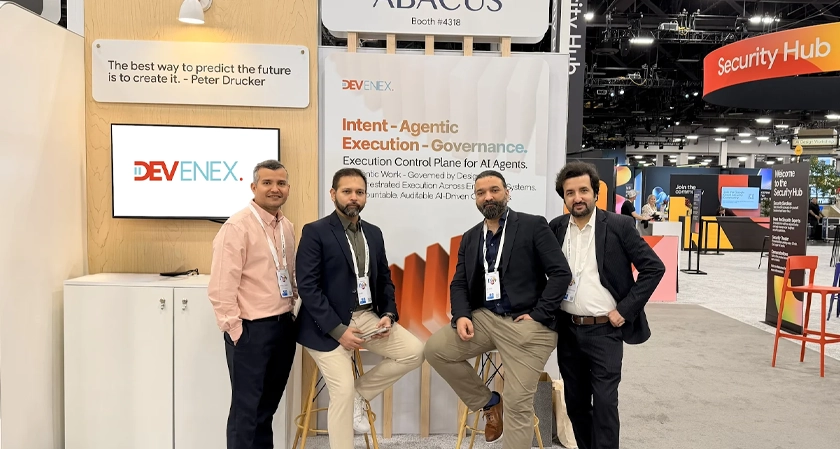
With Devenex, the co-founders are making the case that the agentic era requires a new accountability model for enterprise action.
Aly Kuly Khan and Shoaib A. Khan have developed Devenex around a line enterprise leaders can no longer afford to leave undefined: the line where a proposed action becomes an enterprise consequence.
That line matters because agentic AI is moving into workflows that touch records, approvals, payments, and operational processes. For the Devenex co-founders, the leadership question is not only whether enterprises can deploy intelligent systems. It is whether they can keep authority, accountability, and proof attached to every action those systems take.
“The agentic era is not only about intelligence,” says Aly Kuly Khan, Co-Founder and Chairman of Devenex. “It is about authority. Once AI systems can act inside enterprise environments, accountability has to be built into the action itself.”
That perspective comes from the Abacus backdrop. The team behind Devenex has spent nearly four decades working with enterprises through complex technology shifts, giving Aly and Shoaib a view of what happens when new capabilities enter regulated environments before the control model is fully formed.
Abacus, the global enterprise technology group behind Devenex, has more than 5,000 resources across four continents and more than 1,500 enterprise clients. That institutional scale matters because Devenex is not being built as a lightweight AI add-on. It is being positioned as governance infrastructure for enterprises where execution touches compliance, risk, and operational control.
“The pattern was familiar, but the stakes were different,” Aly says. “Every major technology wave creates a control problem. Agentic AI created an execution problem.”
That recognition shaped the founders’ decision not to build a monitoring dashboard, a generic compliance tool, or another layer of reporting. The gap they saw was earlier in the chain. Enterprises did not only need to see what happened. They needed a control layer that could govern action before it moved through the business.
Shoaib A. Khan, Co-Founder and CEO of Devenex, frames the problem in architectural terms. The enterprise stack already has identity systems, workflow tools, integration platforms, access controls, logs, and observability. Those tools still matter, but they do not answer the question Devenex was built to address: should this action proceed right now?
“Enterprise systems were not designed for autonomous execution at this scale,” Shoaib says. “The missing layer is not another place to inspect activity. It is the infrastructure that determines whether execution is allowed to happen.”
That infrastructure is what Devenex calls the Execution Control Plane. It governs enterprise action before it becomes operational, whether the source is an AI agent, a human operator, an automated process, or a system event. Each proposed action is checked against policy, authorized, tied to identity, and recorded as audit-grade evidence.
The four artifacts are the practical expression of that thesis. Canonical Plan, Authorization Record, Execution Trace, and Evidence Pack are meant to make each governed action traceable from purpose to permission to proof. Together, they create Decision to Execution Lineage.
“Lineage matters because enterprises cannot rely on memory when regulators, boards, or auditors ask what happened,” Shoaib says. “They need a system-generated record of how an action moved from intent to approval to execution evidence.”
That model is designed to support enterprise compliance needs around the EU AI Act, SOC 2, and ISO 42001. Devenex is not presented as a certification. It is designed as compliance infrastructure, helping organizations demonstrate governed execution under the frameworks that are shaping AI deployment.
For Aly, the institutional dimension is central. In regulated markets, governance infrastructure is not bought only on technical promise. It has to carry delivery credibility. Abacus’s four-decade track record gives Devenex a foundation that a typical new AI product would not have.
“Regulated enterprises have to trust the people behind the infrastructure,” Aly says. “Governance sits too close to liability, compliance, and operational control for the vendor’s history to be irrelevant.”
The April 22, 2026, launch at Google Cloud Next in Las Vegas was a deliberate public marker. For Aly and Shoaib, it was the moment to move Devenex from internal thesis to external category argument.
“Google Cloud Next was the right moment because the market was ready to talk about execution,” Aly says. “The conversation had moved beyond what AI can generate. It had become what AI should be allowed to do.”
Devenex is available immediately, with deployment support from Abacus teams across the globe. Enterprise pilot programmes are open to qualified organisations seeking to bring governed execution to production AI workloads. Devenex is also building deeper native integrations across major cloud and agentic AI platforms, with flexible deployment across SaaS, hybrid, and self-deployed environments.
That flexibility matters to Shoaib because governance infrastructure has to work inside existing enterprise reality. Large organizations cannot replace their systems of record, identity providers, integration platforms, and security architectures every time a new control need emerges. The control layer has to fit across what they already run.
“Governance cannot become the reason an enterprise slows deployment for months,” Shoaib says. “It has to integrate into the environment and apply control where execution is about to occur.”
The broader ambition is to make governed execution the default operating model for enterprise AI. The founders want Devenex to become the infrastructure that compliance teams, regulators, AI framework providers, and enterprise leaders can point to when defining responsible agentic AI deployment in practice.
That is the larger vision behind the company. Agentic AI will not remain confined to pilots forever. Enterprises will keep pushing toward systems that act, automate, approve, and execute. The real question is whether those actions will carry accountability from the start.
“The execution era needs a new leadership discipline,” Aly says. “If enterprises are going to let systems act on their behalf, they need to know that every action carries authorization, evidence, and accountability with it.”
For more information, visit the Devenex website.