>>
Technology>>
Artificial intelligence>>
Artificial Intelligence Toys A...Artificial Intelligence Toys Are China's Answer to Lonely Children. But Who Is Really Raising the Next Generation?
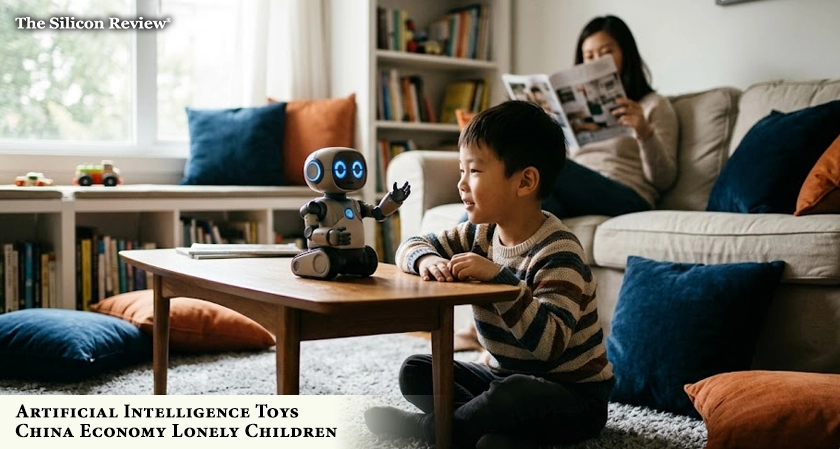
Artificial intelligence toys are the latest entrant to China's booming companionship economy, with smart dolls and robotic pets replacing human interaction. The Silicon Review asks: when a machine becomes a child's best friend, what happens to real relationships?
China has a loneliness problem. Parents work twelve-hour days. Grandparents live in different cities. Only children have no siblings to play with. The government wants more babies. The economy needs more workers. But no one has time to actually raise the children.
Enter artificial intelligence toys. Smart dolls that hold conversations. Robotic pets that respond to emotions. Voice-activated companions that never get tired, never lose patience, and never go home at the end of the day.
They are the latest entrant to China's companionship economy. And they are selling faster than anyone expected.
Here is the uncomfortable question. Are artificial intelligence toys solving a problem or creating a new one? A child who talks to a robot learns nothing about human conflict, human emotion, or human imperfection. They learn efficiency. They learn obedience. They learn that relationships are predictable and controllable. Real people are none of those things.
Chinese tech companies are pouring resources into artificial intelligence toys. Tencent has launched smart companions integrated with its messaging platforms. Baidu has developed voice-activated educational dolls. Startups are raising millions for AI-powered pets that learn a child's preferences and adapt their behavior accordingly.
The market is massive. China has approximately two hundred million children under the age of fourteen. A significant percentage of them are only children. A significant percentage spends more time with screens than with parents.
The Chinese government has encouraged the development of artificial intelligence toys as part of its broader AI strategy. Smart companions are seen as educational tools. They teach languages. They reinforce academic concepts. They provide homework help. They are, officially, learning devices.
Unofficially, they are babysitters. Parents who cannot be present buy artificial intelligence toys to fill the gap. The toy talks. The toy listens. The toy remembers what the child said yesterday and brings it up today. That feels like friendship. It is not.
Critics point to research on screen time and social development. Children learn emotional intelligence by reading faces, interpreting tone, and navigating disagreements. Artificial intelligence toys do not have real faces. Their tone is algorithmically generated. They are programmed to agree, not to disagree.
A child who never hears "no" from their artificial intelligence toy is not learning how to handle rejection. A child who never has to wait for a response is not learning patience. A child who controls every interaction is not learning compromise.
The companionship economy is not unique to China. Japan has had robotic pets for decades. South Korea has AI companions for elderly citizens. The United States has smart speakers that children talk to like family members. But China has embraced artificial intelligence toys with particular urgency.
The reasons are demographic. China's birth rate is falling. The population is aging. The government has eliminated the one-child policy and is now offering incentives for larger families. But policies cannot create time. Parents still work. Grandparents still live far away.
Artificial intelligence toys are a stopgap. They are better than nothing. That is the argument manufacturers make. A child who talks to a robot is at least talking. A child who plays with an AI pet is at least playing. Isolation is the enemy. Artificial intelligence toys are the weapon.
But here is the truth that no marketing campaign will admit. Artificial intelligence toys are not solving loneliness. They are normalizing it. They are teaching children that relationships are transactional. That companionship can be purchased. That when a person is unavailable, a machine is an acceptable substitute.
That lesson lasts a lifetime.
As artificial intelligence toys become the latest entrant to China's companionship economy, The Silicon Review asks a final question. When today's children grow up having befriended machines, will they even know how to befriend each other?
FAQ:
Q: What are artificial intelligence toys in China's companionship economy?
A: Artificial intelligence toys are smart dolls and robotic pets that hold conversations, respond to emotions, and serve as companions for children.
Q: Why is China seeing rapid growth in artificial intelligence toys?
A: Artificial intelligence toys are growing rapidly because Chinese parents work long hours and many children are only children without siblings.
Q: Which Chinese tech companies are making artificial intelligence toys?
A: Tencent, Baidu, and numerous startups are developing artificial intelligence toys including smart companions and voice-activated educational dolls.
Q: Are artificial intelligence toys considered educational in China?
A: Yes, the Chinese government encourages artificial intelligence toys as educational tools for teaching languages and reinforcing academic concepts.
Q: What are the risks of children using artificial intelligence toys too much?
A: Critics say artificial intelligence toys may harm social development by teaching children that relationships are predictable and controllable.
Q: How many children under fourteen live in China?
A: China has approximately two hundred million children under the age of fourteen who are potential users of artificial intelligence toys.