>>
Industry>>
Transportation>>
Converting Your Bike to Electr...Converting Your Bike to Electric: How to Choose the Right eBike Conversion Kit
Why Conversion Kits Are a Serious Alternative to Buying an eBike
The conventional path to an electric bike is to buy one — a purpose-built unit from a manufacturer, engineered as a complete system. That path is straightforward, but it comes with trade-offs that a growing number of riders are choosing to avoid. Purpose-built eBikes are designed around a specific frame geometry, a specific motor placement, and a specific set of component choices that the buyer accepts as a package. The rider who already has a high-quality bicycle — a well-fitted frame, components selected over time, a riding position that works — is effectively being asked to abandon that investment and start over.
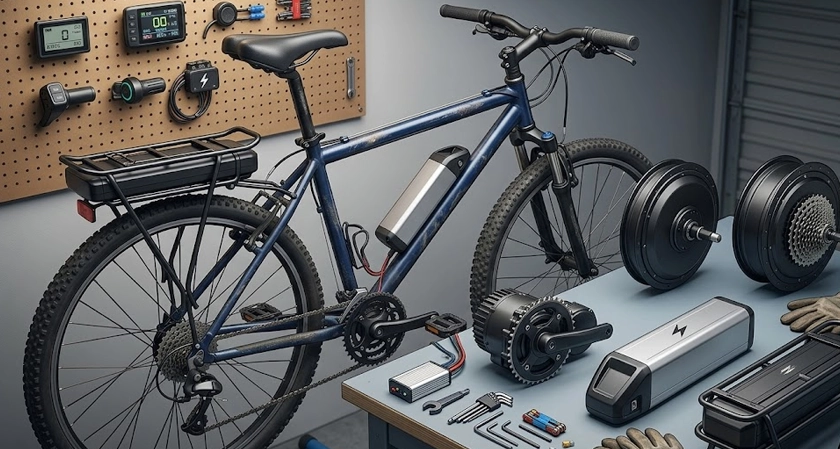
eBike conversion kits offer a different model: keep the bike you know, add electric drive power to it. The mechanical frame, the fit, the components you've already dialed in — all of it stays in place. What changes is the addition of a motorized wheel hub, a battery, a controller, and the wiring that connects them into a functional electric drive system. The result is a bicycle that rides exactly as before when you want to pedal unassisted and delivers electric power when you want it.
The conversion approach also separates the frame investment from the drive system investment, which matters when technology changes. A complete eBike purchased today is a fixed package; if the battery technology, motor efficiency, or control systems improve meaningfully in three years, upgrading means buying a new bike. A converted bike with a kit-based drive system means the upgrade path runs through replacing the kit rather than the entire bicycle.
What an eBike Conversion Kit Contains and How the System Works
A complete ebike conversion kit typically consists of four primary components that work together as an integrated drive system: the motorized wheel hub, the battery pack, the controller, and the display or throttle interface through which the rider manages power delivery. Understanding what each component does and how they interact clarifies both the installation process and the factors that determine ride performance.
The hub motor is the mechanical core of the conversion. In a direct drive hub motor — the configuration used in higher-power kits — the motor occupies the entire hub shell and drives the wheel directly without intermediate gearing. This design is mechanically simple, produces minimal maintenance requirements over time, and handles sustained power delivery efficiently without the heat buildup that geared motors experience under continuous load. The trade-off is weight: direct drive hubs are heavier than geared alternatives, which affects the handling characteristics of the front or rear wheel depending on installation position.
The battery pack determines the system's energy capacity and, by extension, the range available on a single charge. Voltage and amp-hour ratings together define the total energy stored: a 48V 20Ah battery holds 960Wh of energy, which translates to a real-world range that varies based on rider weight, terrain, assist level, and weather. The controller manages the relationship between battery output and motor input, regulating power delivery in response to throttle position, pedal assist sensor signals, and the motor's operating parameters. The display provides the rider with real-time feedback on battery state, speed, assist level, and distance.
Installation follows a consistent sequence regardless of kit wattage: the motorized wheel replaces the existing front or rear wheel, the battery mounts to the frame, the controller connects the two, and the display and throttle route to the handlebars. Most hub motor kits are designed for standard wheel sizes and use quick-disconnect wiring that simplifies the assembly process for builders who aren't working from an electronics background. The mechanical complexity is roughly comparable to a standard wheel swap; the electrical work involves connecting labeled connectors in the correct sequence, which most kit documentation covers in detail.
High-Power Builds: What the 2000W Direct Drive Kit Delivers
For riders whose use case involves sustained high-speed riding, significant load carrying, extended hill climbing, or performance-oriented builds where top-end power matters, the 2000w electric bike kit moves into territory that no purpose-built consumer eBike in a comparable price range can match. A 2000W direct drive hub motor produces enough torque for aggressive acceleration from a stop, handles extended grades without thermal throttling, and maintains usable speed under load conditions that would bring a lower-wattage system to its ceiling.
The direct drive configuration at this power level is particularly well-suited to builds where continuous output matters more than efficiency at light loads. Unlike geared hub motors, which can overheat under sustained high-current demand, a properly sized direct drive motor in the 2000W class handles the thermal load of extended climbs or high-assist riding without requiring recovery periods. This makes it the appropriate choice for cargo bike builds, tandem conversions, or any application where the motor will regularly operate near its rated output rather than occasionally spiking to it.
Frame and fork compatibility is the most important structural consideration at this power level. The forces a 2000W hub motor transmits through the axle — particularly during aggressive acceleration — are substantially higher than what a standard bicycle fork or rear dropout was designed to handle. Steel dropouts are generally adequate; aluminum dropouts require careful inspection and often benefit from torque arms that distribute the rotational force across a larger contact area. Verifying the frame's suitability for the kit's axle width and confirming dropout material before installation is a step that prevents structural failures in use.
Mid-Range Power: Where the 1200W Kit Fits
Between the entry-level kits adequate for flat-terrain commuting and the high-power builds designed for maximum performance sits a category of conversion that most serious recreational riders find covers the majority of real-world use cases: the 1200w ebike kit delivers enough power for meaningful hill-climbing performance, sustained highway shoulder riding, and loaded commuting without the weight penalty, legal complexity, and frame stress that come with moving to 2000W and above.
At 1200W, a direct drive hub motor provides torque characteristics that genuinely transform the riding experience on varied terrain. Riders who have used lower-wattage kits on routes with moderate elevation gain typically notice the difference immediately — the 1200W system maintains assist intensity through climbs rather than fading as the motor approaches its thermal ceiling, and the top-end speed under throttle is high enough to keep pace with light traffic on secondary roads where a 500W system would fall short.
The 1200W range also represents a practical sweet spot for battery pairing. Running a 1200W motor at moderate assist levels on a 48V system draws current at a rate that a mid-capacity battery pack can sustain efficiently, producing real-world ranges in the 25 to 40 mile range depending on terrain and assist intensity. This performance profile suits riders whose primary use is a mix of commuting and recreational riding on routes with elevation variation — a category that describes the majority of conversion kit buyers who have moved past the entry-level tier.
Hub Motor Types: Direct Drive vs. Geared
The choice between direct drive and geared hub motors runs across all wattage levels and affects the conversion's performance characteristics in ways that matter differently to different riders. Direct drive motors have no internal gearing — the motor's rotor is the wheel hub, and the wheel turns at the motor's rotational speed. This produces a smooth, quiet power delivery with no mechanical components subject to wear, and it enables regenerative braking in systems where the controller supports it. The penalty is weight: a direct drive motor in the 1200 to 2000W range adds significant rotational mass to the wheel.
Geared hub motors use a planetary reduction gear set between the motor and the hub shell, allowing the motor to spin at a higher, more efficient speed while the wheel turns more slowly. This produces a lighter, more compact motor that performs well at lower speeds and excels at acceleration from a standstill. The gear mechanism introduces a point of potential wear that direct drive systems avoid, and geared motors generally cannot be used for regenerative braking due to the freewheel mechanism that prevents back-driving the gear set. For riders whose primary use is urban commuting on relatively flat terrain and who prioritize a lighter wheel feel, geared motors often produce a more natural riding experience than direct drive alternatives.
Conclusion
The decision between a 1200W and a 2000W conversion kit reduces to a straightforward assessment of how the build will be used. Varied terrain commuting, recreational riding, and light cargo applications are well-served by the 1200W range, which provides genuine performance without the frame stress and legal complexity of higher wattages. Sustained high-power applications — cargo builds, tandem conversions, extended climbing — justify the step to 2000W, provided the frame and fork have been confirmed as compatible with the forces the motor generates. In either case, matching the kit to the actual use case rather than defaulting to more power produces a conversion that performs consistently across the conditions it will regularly encounter.













Comments