>>
Industry>>
Compliance and governance>>
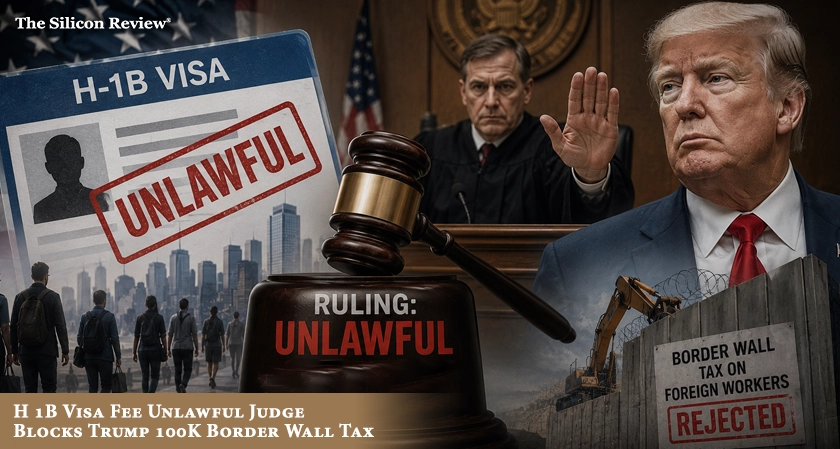
H 1B Visa Fee Ruled Unlawful: ...H 1B Visa Fee Ruled Unlawful: Judge Says President Trump Cannot Tax Foreign Workers to Pay for Border Wall
The Silicon Review
09 June, 2026
Author:
The Silicon Review Team
A US federal judge has ruled that President Trump's $100,000 H 1B visa fee is unlawful. The Silicon Review asks: since when does a president have the power to tax legal immigrants to fund a wall that Congress already refused to pay for?
A United States federal judge just struck down President Donald Trump's $100,000 H 1B visa fee. The ruling calls the fee unlawful. Unauthorized. A blatant overreach of executive power.
Here is what the president tried to do. He imposed a $100,000 surcharge on every H 1B visa application. Not for tech companies. Not for processing. For the border wall. A wall that Congress explicitly refused to fund multiple times.
The H 1B visa is a nonimmigrant visa that allows United States companies to employ foreign workers in specialty occupations requiring technical expertise. Technology giants like Google, Microsoft, Amazon, and Apple rely on the H 1B visa to fill critical engineering and software development roles when qualified American workers are not available.
President Trump decided that these workers should pay for his signature campaign promise. One hundred thousand dollars per visa. On top of existing filing fees that already exceed several thousand dollars.
Think about that for a moment. The president of the United States tried to tax legal immigrants to pay for a physical barrier that Congress said no to. Not once. Multiple times. He did not go back to Congress. He just invented a tax and called it a fee.
Judge John D. Bates of the United States District Court for the District of Columbia ruled that the administration lacked statutory authority to impose the fee. The judge wrote that the Immigration and Nationality Act gives the executive branch the power to set filing fees but only to recover the costs of adjudicating visa applications. Not to fund border infrastructure. Not to build walls. Not to bypass Congress.
The ruling came in response to a lawsuit filed by a coalition of technology trade groups including the Information Technology Industry Council, BSA The Software Alliance, and the National Association of Manufacturers. The plaintiffs argued that the $100,000 fee would cripple American competitiveness and drive talent to Canada, Europe, and other countries with friendlier immigration policies.
Industry data shows that the H 1B visa already costs employers approximately $4,000 to $7,000 per application in standard government fees. The $100,000 surcharge would have made the United States the most expensive destination in the world for skilled foreign workers.
Here is the truth that neither political party wants to admit. American universities graduate thousands of foreign students every year in science, technology, engineering, and mathematics fields. The H 1B visa is the primary pathway for those graduates to stay in the country and contribute to the American economy. Without it, they go home. Or worse for the United States, they go to Canada.
President Trump's administration argued that the fee was necessary to discourage companies from replacing American workers with cheaper foreign labor. But the data does not support that argument. H 1B visa holders earn salaries comparable to or higher than their American counterparts. They pay taxes. They buy homes. They start companies. They are not stealing jobs. They are creating them.
The White House has not yet indicated whether it will appeal the ruling. If the administration does appeal, the case will go to the United States Court of Appeals for the District of Columbia Circuit. Legal analysts expect the ruling to stand given the clear statutory language limiting fee authority.
As a US judge rules that President Trump's $100,000 H 1B visa fee is unlawful, The Silicon Review asks a different question. If a president can tax legal immigrants to fund a wall, what stops the next president from taxing green card holders to fund universal healthcare? Or taxing student visa holders to fund climate initiatives? Once the precedent is set, it never goes back.
FAQ:
Q: What did the federal judge rule about President Trump's H 1B visa fee?
A: Judge John D. Bates ruled that the $100,000 H 1B visa fee is unlawful because the administration lacked statutory authority to impose it.
Q: What was President Trump trying to fund with the H 1B visa fee?
A: President Trump attempted to use the $100,000 H 1B visa surcharge to fund construction of the border wall that Congress refused to pay for.
Q: Which industries opposed the H 1B visa fee the most?
A: Technology trade groups including the Information Technology Industry Council and National Association of Manufacturers sued to block the fee.
Q: How much do standard H 1B visa fees typically cost employers?
A: Standard H 1B visa fees range from approximately $4,000 to $7,000 per application before the proposed $100,000 surcharge.
Q: Can President Trump appeal the ruling against the H 1B visa fee?
A: Yes, the White House could appeal to the United States Court of Appeals for the District of Columbia Circuit.
Q: Does the H 1B visa allow foreign workers to take American jobs at lower wages?
A: Data shows H 1B visa holders earn salaries comparable to or higher than American workers in similar positions.