>>
Industry>>
Supply chain management>>
How to Improve Order Fulfillme...How to Improve Order Fulfillment Speed Through Smarter Warehouse Layout and Process Coordination
The Silicon Review
10 June, 2026
Author:
The Silicon Review Team
Fulfillment delays can cause up to 3 days of disruption on average, and usually stem from hidden friction in your physical space, not from your team moving too slowly. When workers spend more time walking across the warehouse floor than actually picking items, your entire fulfillment timeline stretches out. Shifting your operational approach from reactive material handling to a highly predictive performance strategy allows you to synchronize your workforce with a smarter warehouse layout.
Unnecessary manual transport drains your operational budget and adds hours to daily order processing times. Eliminating these wasted movements requires a deliberate alignment of layout geometry, workforce scheduling, and live tracking data. When these elements operate in harmony, inventory moves continuously through the facility and out the door.
Eliminating Material Handling Bottlenecks
Traditional warehouse configurations rely heavily on manual travel, which quickly creates severe operational bottlenecks. Every single time a picker has to stop, turn around, or walk down a long aisle to retrieve a pallet, your order cycle time increases. High SKU variability can easily overwhelm standard static shelving, leading to crowded aisles and disorganized picking zones.
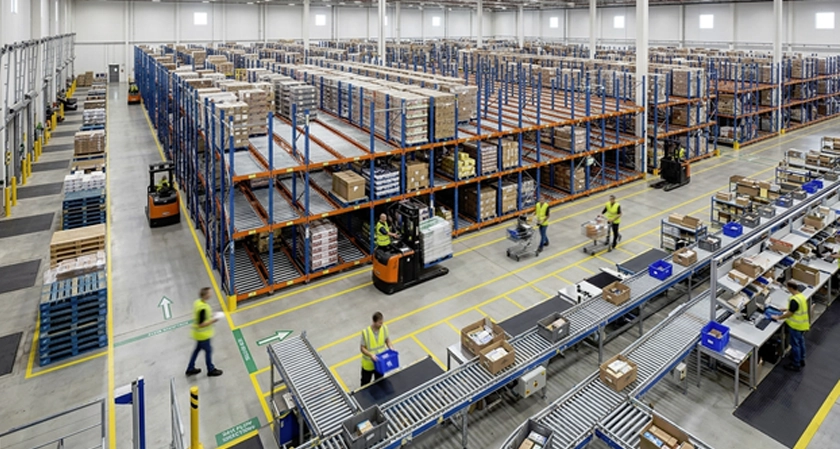
To prevent these delays, high-density storage solutions must match the natural flow of your order volume. Facilities often implement dynamic gravity-fed systems to automatically move inventory forward to the picking face as older stock is cleared.
Businesses can optimize warehouse storage with pallet flow setups, maintaining a strict first-in, first-out inventory rotation without requiring manual transport vehicles to constantly reposition bulk goods, for example. Operational friction decreases dramatically when your physical storage infrastructure does the physical moving for you. This structural shift keeps your primary picking aisles fully stocked and completely clear of heavy replenishment machinery.
Coordinating Digital Tracking and Physical Workflows
A smart layout is only as effective as the data guiding your floor team. Relying on paper picking lists or outdated batch processing causes workers to cross paths, duplicate routes, and stall at busy intersections. True process coordination requires real-time data to orchestrate human actions in concert with your facility architecture.
McKinsey research shows that labor constraints account for roughly 65% to 70% of total warehouse costs, making layout travel time reduction a top cost-saving priority for growing fulfillment operations. Warehouse managers can address this challenge directly by using digital tracking software to calculate the most efficient picking paths.
Modern tracking systems eliminate spatial confusion by guiding workers through the warehouse in logical, non-overlapping routes. A well-coordinated system ensures that every step your workforce takes directly advances an order toward the shipping dock. This meticulous orchestration minimizes floor congestion and allows your team to handle higher order volumes with far less physical fatigue.
Streamlining Operational Workflows and Picking Accuracy
Optimizing your layout naturally simplifies your material handling processes by reducing the number of physical touchpoints required for each item. When inventory is stored logically based on accurate data insights, the likelihood of picking errors plummets. Workers no longer need to search through multiple mixed locations to find the correct SKU.
Integrating automated handling with digital warehouse tracking software boosts picking productivity by up to 40% and reduces overall operating costs, again according to McKinsey. These substantial gains are achieved by systematically removing guesswork from the daily workflow.
To achieve this level of efficiency, warehouse managers should implement the following core layout strategies:
- Position high-velocity SKUs closest to the packing stations to minimize travel distances
- Separate receiving docks entirely from shipping areas to prevent cross-traffic delays
- Implement dedicated staging lanes for kitting and assembly before final packaging
Fewer manual touchpoints mean fewer opportunities for damage, loss, or mislabeling. Your team can move confidently from one task to the next without pausing to verify questionable inventory data or navigate blocked aisles. It’s similar to how the future of supply chain management relies on a combination of innovation and optimization.
Modernizing Layout Flexibility for Future Growth
Warehouse environments must remain adaptable to handle unpredictable shifts in supply chains and consumer demand. Rigid, immovable storage setups prevent operations from scaling efficiently when new product lines are introduced. True warehouse coordination relies on dynamic software to balance manual and automated workloads, bypass fixed infrastructure bottlenecks, and maintain open, flexible layouts.
When looking for ways to refine your current workflows, reading through operational strategy articles can provide your team with practical, real-world layout ideas tailored to your specific industry constraints. Regularly updating your floor plan based on actual software insights ensures your facility remains highly productive over the long term. Continuous, incremental improvements to your spatial layout prevent major operational slowdowns and keep your fulfillment workflows fast, accurate, and predictable.
Our site has lots more posts to check out, covering various industries and technologies, as well as education and politics, so stay tuned.