>>
Industry>>
Space>>
NASA Mission: Can a Robot With...NASA Mission: Can a Robot With Lego Fingers Save a Falling NASA Telescope Before October?
The Silicon Review
29 June, 2026
Author:
Jishnuu
A $30 million robotic rescue, a shrinking window, and a NASA Space mission nobody thought possible can it actually succeed before it’s too late?
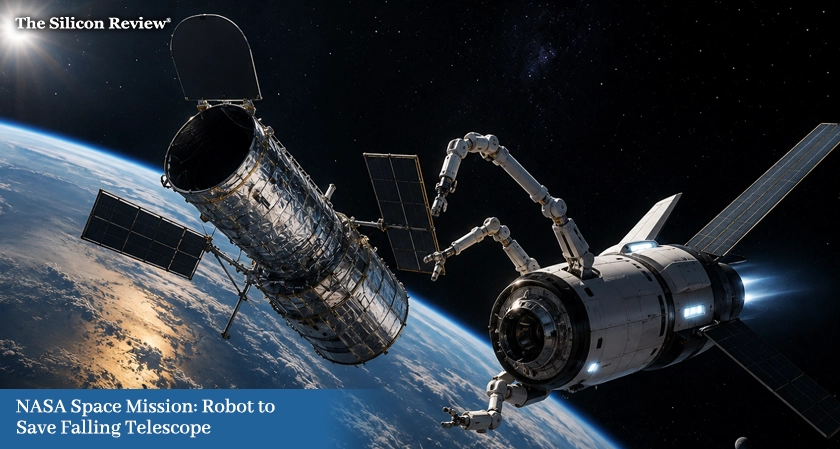
A NASA telescope that has hunted cosmic explosions since 2004 is falling back to Earth. NASA has one shot to stop it: a startup robot the size of a fridge, $30 million, and a shrinking window that closes in October.
Swift has spent 21 years in space without missing a beat. It hunted gamma ray bursts, watched stars die, and rewrote what we know about the universe. Now the sun is dragging it down. This NASA space mission to save it has never been attempted by an American spacecraft before. There is no backup plan. No budget for a replacement. If the robot fails, Swift burns up on reentry and is gone forever.
When a $30 million robot with Lego fingers is your only plan, how confident should the world really be?
The sun is the villain. An overactive solar cycle has been dragging Swift lower for months. It now orbits at just 224 miles above Earth. Below 185 miles, no rescue is possible. NASA's window slams shut in October.
Ghonhee Lee, CEO of Katalyst Space Technologies, told The Associated Press, "This is the first American space robot to go up and do anything like this."
Enter Katalyst Space Technologies. Nine months. Thirty million dollars. One robot called Lift, roughly the size of a kitchen fridge, with three arms and Lego-like grippers. This week it launches from the Marshall Islands on a rocket dropped from a plane, chases Swift across the sky for a month, grips it, and spends two more months pushing it up to a safe 373 miles.
Bold. Borderline absurd. Already on the Launchpad.
The universe's greatest detective is falling to Earth. A robot built in nine months is the only one chasing it.
Nobody is pretending this is easy. Swift was never built to be rescued. No handles. No docking ports. No instruction manual. NASA's own astrophysics director admitted nobody believed this was possible when it was first suggested. Nine months later, they are launching anyway.
Because the alternative is watching it burn.
NASA cannot afford to build another Swift. If Lift fails, 21 years of science turns to ash on reentry. Gone. Full stop.
Swift is not the only one falling. Hubble is losing altitude too. How many national treasures can NASA afford to lose before someone asks the harder question?
Hubble is falling too. The same angry sun pulling Swift down is dragging the world's most beloved telescope closer to Earth every single day. Katalyst is already building a more powerful robot to go after Hubble in 2028. The vision beyond that is enormous: hundreds of robots in orbit, fixing ageing spacecraft, refuelling satellites, and keeping humanity's eyes on the universe open for longer.
It starts this week. One robot. One falling telescope. One chance. The Silicon Review asks if NASA cannot afford to replace the telescopes it is losing, what does that say about how much the world's most powerful space agency actually values the science that made it legendary?
FAQ:
Q: What is the NASA telescope Swift and why does it matter?
A: Swift is a NASA telescope launched in 2004 that detects gamma ray bursts and cosmic explosions. It has made discoveries for 21 years and cannot be replaced within NASA's current budget.
Q: Why is the NASA space mission to save Swift so urgent?
A: Swift is falling toward Earth due to intense solar activity. Below 185 miles, rescue becomes impossible. NASA's deadline is October 2026. After that, Swift burns up on reentry.
Q: Who is carrying out this NASA space mission?
A: Katalyst Space Technologies, a US startup, won a $30 million NASA contract to build Lift, a robotic spacecraft that will chase, grip, and push Swift to a safer orbit of 373 miles.
Q: Has any country attempted a NASA telescope rescue like this before?
A: Only China has boosted a satellite to a higher orbit. This is the first time an American spacecraft has attempted a live orbital rescue of a working telescope.
Q: What happens if the NASA space mission fails?
A: Swift will fall below the rescue threshold, reenter Earth's atmosphere, and burn up completely. NASA has confirmed there is no budget to build a replacement NASA telescope.
Q: Is the Hubble telescope also at risk?
A: Yes. Hubble is losing altitude due to the same solar activity affecting Swift. Katalyst is developing a next-generation robot targeting a Hubble rescue mission in 2028.


















Comments