>>
Industry>>
Environmental sustainability>>
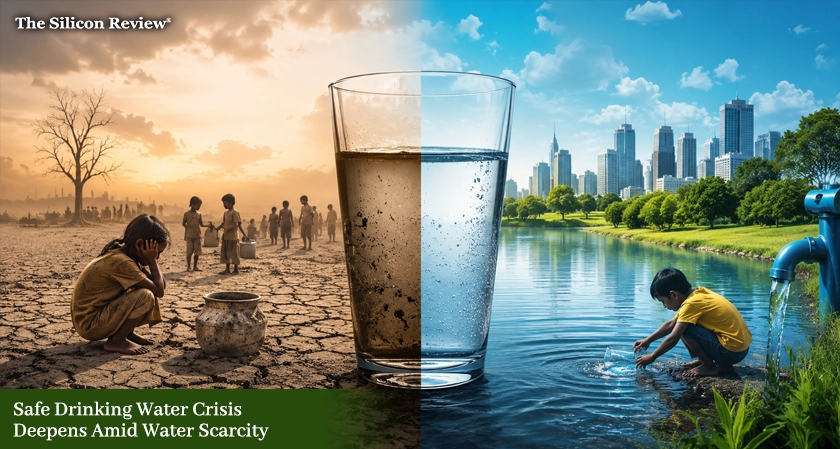
Safe Drinking Water Crisis Dee...Safe Drinking Water Crisis Deepens as Billions Are Left Behind: Is Water Scarcity the World's Biggest Governance Failure?
The Silicon Review
19 June, 2026
Author:
Jishnuu
Safe drinking water remains beyond the reach of 2.1 billion people, according to the WHO, as escalating water scarcity and years of inaction deepen one of the world's most overlooked crises.
Safe drinking water should be one of the world's simplest guarantees, yet nearly 2.1 billion people still lack it. According to the WHO, more than 106 million people continue to rely on untreated water sources, highlighting a crisis that persists despite decades of investment, promises, and global attention.
Safe drinking water should not be a privilege. Yet for billions, it still is.
Bruce Gordon, head of WHO's Water, Sanitation, Hygiene and Health Unit, warned that progress is being undermined by investment gaps, governance challenges, and a lack of political urgency.
"We see the trends are going in the right direction, but just slowly," Gordon said.
The warning comes as the WHO rolls out updated drinking water quality guidelines designed to help governments strengthen regulations and address emerging threats. Yet the message is clear: the biggest obstacle to safe drinking water is not a lack of knowledge, but a lack of action.
From microplastics and PFAS "forever chemicals" to industrial pollution and pharmaceutical waste, new contaminants are testing water systems worldwide. At the same time, climate-driven floods, droughts, and worsening pollution are accelerating water scarcity, placing millions at greater risk.
WHO officials argue that technology alone cannot close the gap. Governments, regulators, utilities, and local communities must work together to protect water supplies and prevent avoidable health crises. Yet despite years of warnings, outbreaks linked to unsafe water continue to occur, raising uncomfortable questions about accountability.
If safe drinking water is a basic human right, why do billions still live without it?
As water scarcity intensifies, the consequences extend far beyond access to water. Reliable safe drinking water underpins public health, economic growth, food security, and social stability. It is deciding whether the world is prepared to treat it as the emergency it has already become.
The numbers are clear. The solutions largely exist.
As water scarcity tightens its grip across the globe, the World Health Organization says 2.1 billion people still lack safe drinking water, turning what should be a basic human right into a growing global challenge. The Silicon Review asks one final question: If clean water is a basic human right, why are 2.1 billion people still being left behind?
FAQ:
Q: Is water scarcity becoming a global security risk?
A: Many experts believe increasing water scarcity could heighten competition for resources, strain economies, and contribute to social and geopolitical tensions.
Q: How does climate change threaten safe drinking water supplies?
A: Rising temperatures, prolonged droughts, severe flooding, and extreme weather events can reduce water availability, damage infrastructure, and increase contamination risks.
Q: What are the biggest emerging threats to drinking water quality?
A: Microplastics, PFAS "forever chemicals," pharmaceutical residues, industrial pollutants, and untreated wastewater are among the most closely monitored threats.
Q: Why are small water systems considered high-risk?
A: Smaller systems often face funding, staffing, and technical limitations, making them more vulnerable to contamination and disease outbreaks.
Q: Can technology alone solve the safe drinking water crisis?
A: No. While technology plays a critical role, experts say effective governance, investment, regulation, and community engagement are equally important.












Comments