>>
Platform>>
Juniper>>
Satellite mobile communication...Satellite mobile communication: Satellite Direct-to-Cell Users to Surge 7.6X to 133M by 2031
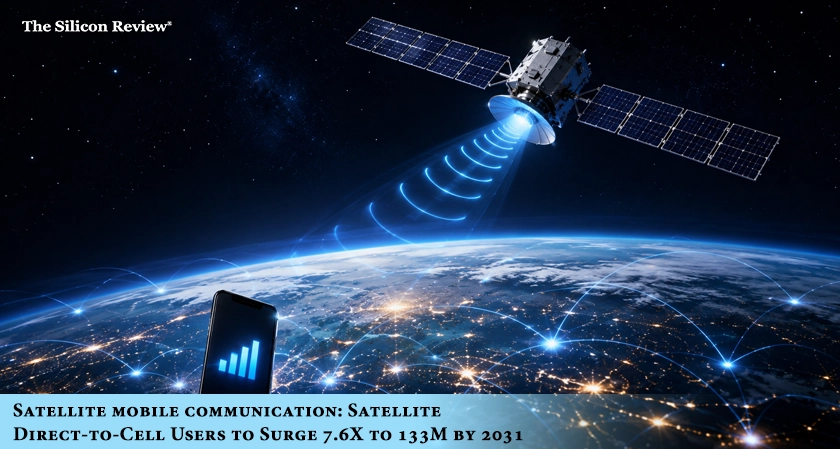
Satellite mobile communication: Juniper Research finds satellite direct-to-cell users will surge from 17.4M in 2026 to 133M by 2031. The Silicon Review reports on Satellite mobile communication.
A new study by global tech strategists Juniper Research projects that the total number of satellite direct-to-cell users will rise from 17.4 million in 2026 to 133 million by 2031, representing 665 percent growth over the five-year forecast period. However, the report warns that usage will remain below initial expectations.
The satellite direct-to-cell market is being driven by the rapid expansion of D2C networks, which allow standard smartphones to connect directly to satellites without requiring specialized hardware. Major operators including SpaceX's Starlink, AST SpaceMobile, Lynk Global, and Iridium are deploying D2C services globally.
However, Juniper warns that losses in coverage are often caused by dense urban settings and physical barriers such as thick walls, which D2C services do not address. Juniper Research forecasts that annual service revenue from D2C will reach $6.2 billion by 2031, up from $710 million in 2026, as operators launch commercial services across North America, Europe, and Asia-Pacific.
Research author Alex Webb said consumer demand for D2C is currently concentrated to specific trips and travel, such as to national parks and nature reserves, rather than during everyday usage of mobile services.
Regulatory approvals are accelerating. The FCC recently granted SpaceX and AST SpaceMobile permission to operate D2C services in the US, while the European Space Agency has launched a funding program for satellite direct-to-cell integration with 5G networks.
Despite these limitations, D2C holds significant value for consumers living in or visiting rural and remote areas, with Juniper expecting usage to spike during warm weather. The report recommends that MNOs offer temporary access models for seasonal users, with D2C services becoming a standard feature on mid-range and premium smartphones. Apple has already integrated D2C emergency SOS into iPhone, and Google is expected to follow with Android 17.
As satellite direct-to-cell users surge from 17.4 million to 133 million by 2031, The Silicon Review examines why Juniper Research warns usage will remain lower than anticipated due to structural coverage limitations in urban areas.
Q: How many satellite direct-to-cell users will there be by 2031?
A: Juniper Research projects that satellite direct-to-cell users will rise from 17.4 million in 2026 to 133 million by 2031, representing 665 percent growth.
Q: What is driving satellite direct-to-cell growth?
A: The growth is driven by the rapid expansion of D2C networks, which allow standard smartphones to connect directly to satellites without specialized hardware.
Q: Which companies are deploying satellite direct-to-cell services?
A: Major operators include SpaceX's Starlink, AST SpaceMobile, Lynk Global, and Iridium. Starlink has partnered with T-Mobile, Rogers, and One NZ, while AST SpaceMobile works with AT&T, Verizon, and Vodafone.
Q: How much annual revenue will D2C services generate by 2031?
A: Juniper Research forecasts that annual service revenue from satellite direct-to-cell will reach $6.2 billion by 2031, up from $710 million in 2026.
Q: What percentage of the global population will D2C cover by 2031?
A: By 2031, Juniper expects satellite direct-to-cell will cover 98 percent of the global population, with D2C becoming a standard feature on mid-range and premium smartphones.
Q: What regulatory approvals have been granted for D2C in the US?
A: The FCC recently granted SpaceX and AST SpaceMobile permission to operate D2C services in the US. The European Space Agency has also launched a funding program for D2C integration with 5G.