>>
Industry>>
Environmental sustainability>>
Semakau Landfill Running Out o...Semakau Landfill Running Out of Time? Is Singapore's Reputation as One of the World's Cleanest Cities Starting to Unravel?
The Silicon Review
17 June, 2026
Author:
Jishnuu
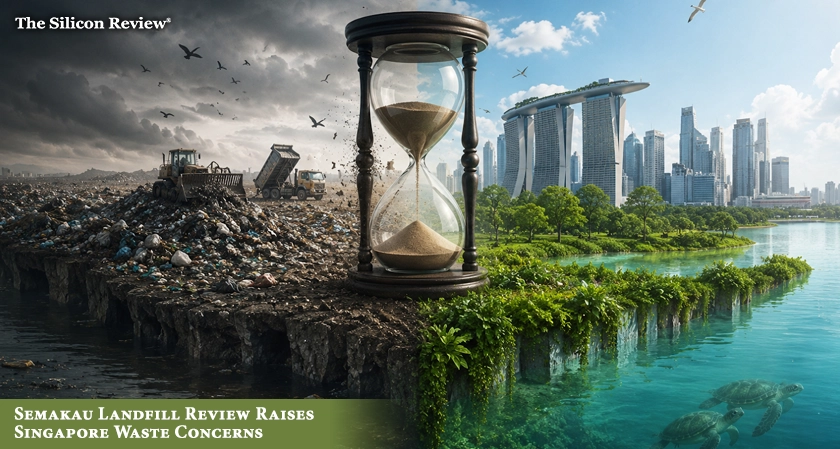
Singapore's recycling slowdown is forcing a hard rethink of the nation's waste strategy, with the government reviewing its plans to extend the lifespan of Semakau Landfill and confront growing concerns about the future of Singapore waste management.
Is Singapore sleepwalking toward a landfill crisis? As recycling rates decline and Semakau Landfill races against time, The Silicon Review asks.
The review comes as Singapore seeks new ways to strengthen Singapore waste management efforts and extend the lifespan of Semakau Landfill, the country's only landfill, beyond its currently projected capacity timeline.
Speaking in Parliament, Senior Minister of State for Sustainability and the Environment Janil Puthucheary said the review will assess progress since the Zero Waste Masterplan was launched in 2019 and identify fresh strategies to accelerate Singapore's transition toward a circular economy.
Recycling was meant to be the solution. Instead, it is becoming part of a growing problem.
For years, Semakau has been showcased internationally as a model of innovative waste disposal. Yet declining recycling performance has raised concerns about whether existing measures are delivering the intended results.
According to government data, Singapore's overall recycling rate has fallen in recent years despite sustained public awareness campaigns and investments in waste infrastructure. The trend has sparked debate over whether current recycling systems, consumer behavior, and industrial waste practices require more significant reforms.
The real crisis is no longer finding space for waste. It is confronting a system that continues to produce more of it.
The government's review is expected to examine how materials are consumed, reused, and recovered across the economy, with a focus on reducing waste before it reaches disposal facilities.
The stakes extend beyond environmental policy. Land scarcity remains one of Singapore's most significant constraints, making long-term waste management a strategic issue tied to urban planning, economic resilience, and sustainability goals.
Officials have repeatedly emphasized that extending Semakau's lifespan is critical, but landfill expansion alone is unlikely to address long-term waste challenges if waste generation continues to increase.
Can Singapore waste management evolve fast enough to save Semakau Landfill, or is the city-state approaching the limits of its current model?
FAQ:
Q: Why is Singapore reviewing its Zero Waste Masterplan?
A: The government wants to assess progress since 2019 and identify new ways to improve recycling outcomes and accelerate the shift toward a circular economy.
Q: What is Semakau Landfill?
A: Semakau Landfill is Singapore's only landfill and the final disposal site for incineration ash and certain waste streams.
Q: Why is Semakau Landfill important?
A: Limited land availability makes extending the landfill's lifespan a major national priority.
Q: What is the main concern?
A: Declining recycling rates could increase pressure on waste disposal infrastructure and shorten the landfill's operational lifespan.




















Comments