>>
Other>>
Infrastructure and development>>
Supercomputers Are Useless Wit...INFRASTRUCTURE AND DEVELOPMENT
Supercomputers Are Useless Without Brains: NSCC Chief Admits
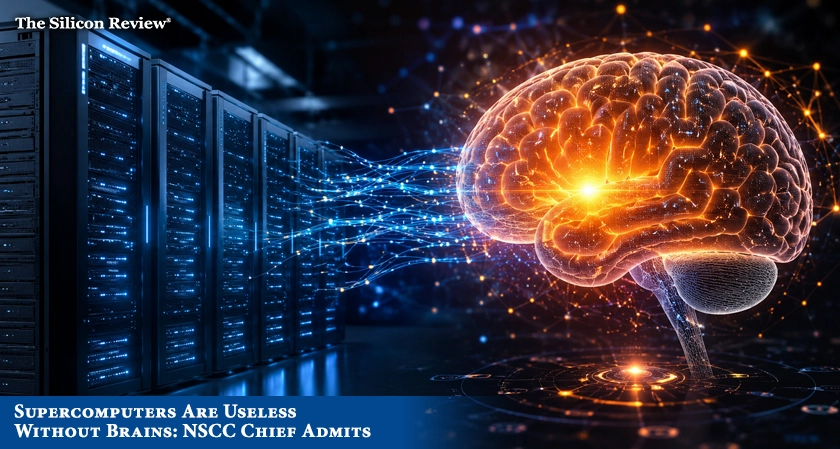
The head of Singapore's National Supercomputing Centre warns that supercomputers alone cannot accelerate scientific discoveries without a parallel investment in training researchers to use them effectively.
Singapore has spent billions on supercomputers. The National Supercomputing Centre operates machines that can perform quadrillions of calculations per second. They are among the most powerful in Southeast Asia. They are also sitting idle. Not because they are broken. Because no one knows how to use them.
The NSCC chief just admitted what governments around the world refuse to say out loud. Supercomputers are useless without trained researchers. And trained researchers do not grow on trees. They cost money. They require years of education. They demand salaries that governments are unwilling to pay.
Let us do the math. A single supercomputer costs hundreds of millions of dollars. A trained researcher who can actually use it costs a hundred thousand dollars per year in salary and benefits. For the price of one machine, you could train and employ an entire generation of scientists. But governments buy the machine every time. Because machines are visible. Machines are ribbon-cuttings. Machines are press releases. Humans are just line items.
Universities are producing PhDs who understand biology, chemistry, and physics. They do not understand parallel computing. They do not understand GPU architecture. They do not understand data workflow automation. They were never trained. Their professors never learned either.
"You cannot take a biologist who has only used Excel and expect them to write parallel code for a thousand-core cluster," the NSCC chief said. "That is like handing someone the keys to a fighter jet and telling them to figure it out."
The fighter jet analogy is perfect. Imagine buying an F-35, parking it on a runway, and handing the keys to someone who has only driven a sedan. Then imagine being surprised when the jet never takes off.
That is exactly what governments are doing with supercomputers.
Singapore has trained two thousand researchers through its programs. Two thousand. That sounds impressive until you realize that a single pharmaceutical company needs hundreds of computational biologists. A single climate modeling center needs dozens of atmospheric scientists trained in high-performance computing. Two thousand researchers for an entire region is not a success. It is a drop in an ocean of need.
The NSCC chief is correct about the problem. His solution is also correct. Train more researchers. Change the curriculum. Invest in people.
But as long as governments reward ribbon-cuttings over workforce development, nothing will change. The next supercomputer will arrive. The same untrained researchers will stare at it. And the NSCC chief will give the same warning again.
As supercomputers without trained researchers fail to accelerate discoveries, The Silicon Review asks a final question. How many billions must be wasted on machines that no one can operate before governments finally admit that the fastest computer in the world is still slower than a human who knows what they are doing?
FAQ:
Q: Why does the NSCC chief say supercomputers are useless without trained researchers?
A: The NSCC chief says supercomputers require researchers who understand parallel computing and data architecture, skills that most scientists lack.
Q: How much does a trained researcher cost compared to a supercomputer?
A: A supercomputer costs hundreds of millions while a trained researcher costs about one hundred thousand dollars per year in salary and benefits.
Q: How many researchers has Singapore trained to use its supercomputers?
A: Singapore has trained approximately two thousand researchers through NSCC programs, which experts say is far below actual need.
Q: Does the United States have the same supercomputer skills problem as Singapore?
A: Yes, the US Department of Energy operates the fastest supercomputers but also struggles to find Americans trained in high-performance computing.
Q: What does the NSCC chief want universities to change?
A: The NSCC chief wants biology, chemistry, and physics students to receive mandatory training in programming, parallel computing, and data architecture.
Q: Why are private companies ahead of governments in supercomputer training?
A: Private companies like Pfizer, Boeing, and Goldman Sachs run their own training programs because they cannot wait for universities to catch up.