>>
Industry>>
Legal>>
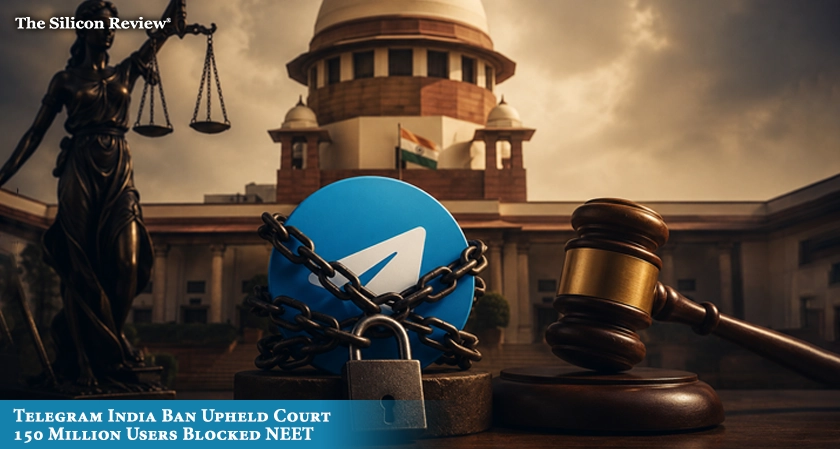
Telegram India Shutdown Shock:...Telegram India Shutdown Shock: Court Backs Ban, 150 Million Users Lost Their App. Who Decides Which Platform Gets Blocked Next?
The Silicon Review
19 June, 2026
Author:
Jishnuu
The Delhi High Court has upheld the Indian government's temporary ban on Telegram, ruling that blocking an entire platform used by 150 million people was a "proportionate" measure to prevent exam fraud. The Silicon Review asks: if a few scammers can shut down an entire platform, what stops the government from doing this to any app it dislikes?
India's dispute with Telegram has turned into a major national debate after the Delhi High Court supported the government's temporary ban on the messaging app. The decision came after allegations that leaked papers from the National Eligibility cum Entrance Test (NEET), India's highly competitive medical entrance examination taken by millions of aspiring doctors each year, were being circulated through Telegram channels.
What began as an effort to protect the integrity of the NEET examination and prevent the spread of leaked question papers has rapidly evolved into a much larger debate about digital freedom, government authority, and whether officials should have the power to temporarily shut down platforms used by millions of people across the country.
The decision has triggered outrage across social media and reignited fears about government control over online platforms.
What began as an investigation into leaked medical entrance exam papers has now raised a bigger question:
The ruling has quickly become one of the biggest stories in telegram news India, fueling a heated debate over digital rights, free speech, and government control of online platforms. The Delhi High Court backed the government's temporary ban on Telegram after allegations that leaked medical entrance exam papers were being circulated through channels on the app, ruling that authorities had the legal power to act in the interest of exam security and public welfare.
Supporters see it as responsible action. Critics see it as a step toward greater control over digital platforms.
But the controversy extends far beyond exam leaks. Critics argue the verdict could create a precedent for future restrictions on major communication platforms, while supporters view it as a necessary step to protect the integrity of India's education system. Telegram, which reportedly has more than 150 million users in India, said it had removed hundreds of links related to unlawful content and cooperated with authorities, while officials maintained that the platform's anonymous features make enforcement significantly more difficult.
The government's message is clear: Security is the priority. Critics ask an important question: how much control is too much?
As Telegram founder Pavel Durov questions whether banning an entire platform truly solves the problem, the debate has shifted to a bigger issue: where should India draw the line between public safety and digital freedom?
As the debate continues, one thing is clear: this is no longer only about Telegram. It has become an important discussion about where India should draw the line between public safety and digital freedom. The Silicon Review asks: If a platform used by more than 150 million people can be temporarily blocked because of the actions of a small group, how much control should governments have over the online spaces where millions communicate every day?
FAQ:
Q: Did the court support the government's decision?
A: Yes. The Delhi High Court ruled that the temporary Telegram ban was legal and justified under the circumstances.
Q: What was Telegram's response?
A: Telegram said it removed hundreds of links related to unlawful exam content and cooperated with authorities during the investigation.
Q: What did Telegram founder Pavel Durov say about the ban?
A: Durov criticized the restriction, arguing that blocking an entire platform affects millions of legitimate users.
Q: How long was Telegram blocked in India?
A: The temporary restriction was imposed from June 16 to June 22.
Q: Why did authorities focus specifically on Telegram?
A: Officials cited features such as anonymous usernames, hidden phone numbers, and the ability to recreate blocked channels.
Q: Is Telegram back online in India?
A: Yes. The restriction was temporary and lasted only for the specified period.




















Comments