>>
Industry>>
Capital Market>>
The hardest part of building a...The hardest part of building a venture fund isn't investing

When an investor starts a fund, the obvious assumption is that the hardest part will still be making the right investments. In my experience, it isn't. The bigger shift is moving from making investment decisions inside someone else's firm to building the firm itself: raising capital, managing LP relationships, creating deal flow, hiring a team and designing a structure that can eventually work without the founder at the centre of every decision. That matters even more in today's venture market, where capital remains concentrated among established managers and new funds have less room for organisational mistakes. It also raises a more basic question: whether starting a fund is actually the right next step for every experienced investor.
Venture capital can appear to offer a fairly straightforward career path. You learn to evaluate companies, build a track record and develop a network, then eventually launch a fund of your own.
What changes at that point is not simply the level of independence. The investment work is still there, but so are all the functions that an established firm normally provides around it. As a founder-GP, you suddenly have to think about how those pieces fit together while continuing to invest.
What carries over, and what doesn't
Some of what a fund needs comes with experience, while other parts have to be built from scratch.
Inside an established venture firm, you see a large number of companies and take part in many investment decisions, then watch how those decisions play out over time. You learn which questions are worth pursuing, which metrics deserve attention and which apparently compelling stories become less convincing under scrutiny.
You also develop a better sense of the time horizon on which venture operates. A strong year says relatively little on its own, just as a difficult one does not necessarily invalidate a strategy.
All of that carries over when you start a fund: sector knowledge, judgement and relationships built over years. What does not carry over is the infrastructure around the investment work.
That was one of the things I underestimated before running a fund myself. Inside an established firm, the brand already opens doors, legal and administrative systems are in place and reporting follows an established rhythm. Responsibilities are distributed across a team, while existing relationships continue to generate introductions.
Starting from scratch makes those dependencies much more visible. What looked like background support turns out to be part of the investment business itself. The job shifts from working inside an investment firm to building one.
A new fund has to build its own deal flow
An established fund has advantages accumulated over years: a reputation in the market, relationships with founders and other investors and a history that generates inbound opportunities. A new fund starts without most of this and cannot depend indefinitely on the GP's existing network.
Sourcing has to become more systematic. A fund needs to decide which markets to follow, what signals may indicate that a company is worth a closer look, where the team should focus its attention and when it makes sense to approach a founder.
Technology can help with that process. Data can allow a small team to monitor more companies and identify changes that would be difficult to follow manually. Those tools still have clear limits: at an early stage, a system may help identify where the team should look, while the investment decision still depends on how the investor reads the founders, the market and the business itself.
Running a fund also means managing investors
The relationship with limited partners is less visible from inside an established firm. An investor may spend most of the day evaluating companies while fundraising, reporting and LP communication are handled elsewhere. That separation largely disappears when you launch a fund of your own, as fundraising becomes part of your role alongside evaluating founders.
That is especially important in the current market. Even as fundraising has started to recover, LP commitments remain concentrated among managers they already know. For a new fund, that raises the bar: past investing experience helps, but you still need a clear reason why your strategy deserves a place in an LP's portfolio.
You have to explain why the strategy makes sense, persuade people to commit capital before the new firm has much of a track record of its own and communicate clearly when things do not unfold as expected. LP relationships last for years, so maintaining trust requires clear reporting, openness about important decisions and consistency as market conditions change.
For me, the investment work itself was not the hardest part of that transition. Building the team and managing LP relationships were.
When the GP becomes the bottleneck
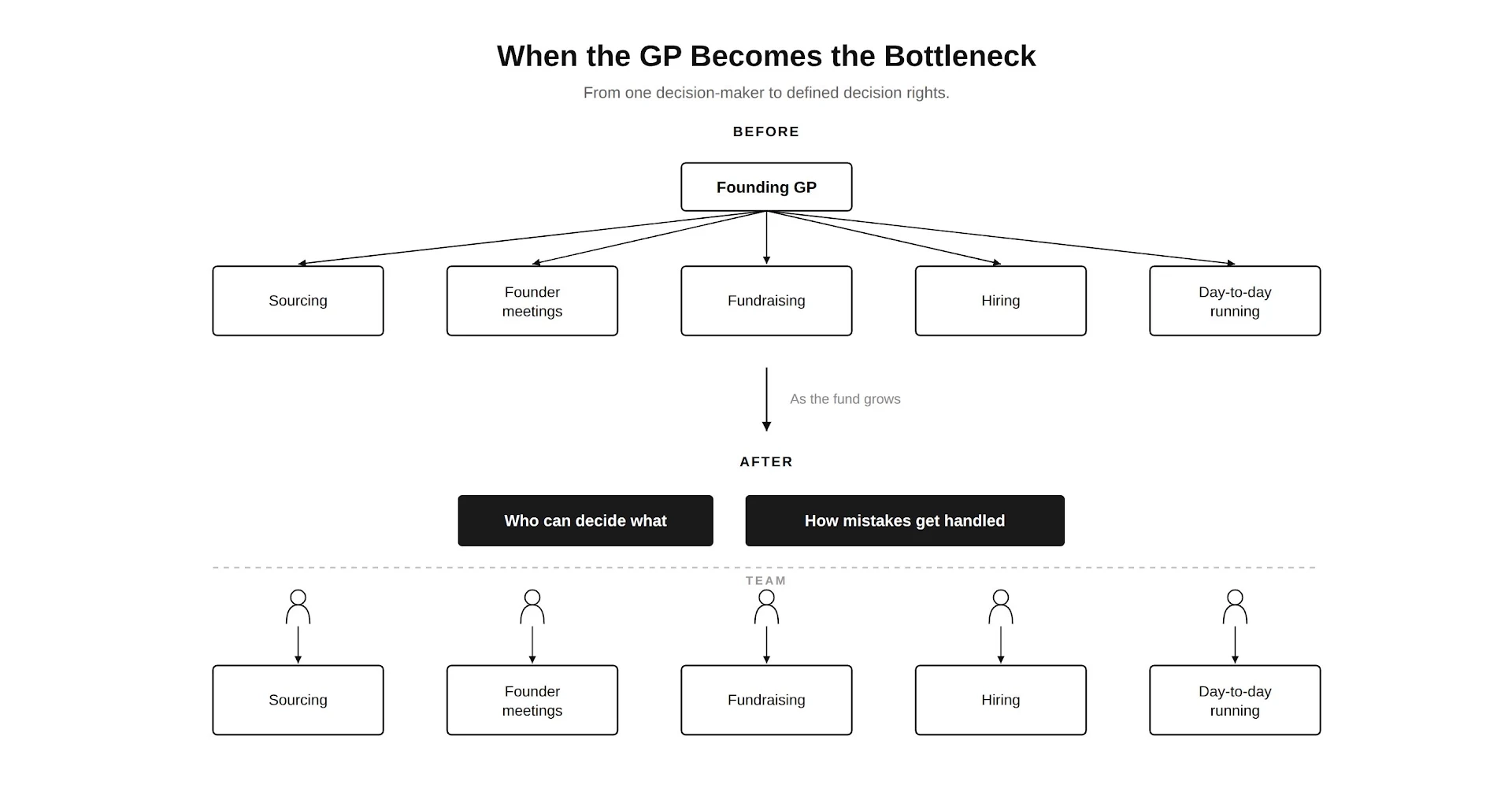
At the beginning, a founding GP is often involved in almost everything, from sourcing and founder meetings to fundraising, hiring and the day-to-day running of the firm. Some of this is unavoidable because it is difficult to understand how the work should be organised or who should eventually own it without first having done it yourself.
At that stage, the person getting to know a company may also make the investment decision and work with the founders afterwards, keeping responsibility clear and context close to the decision.
That level of involvement becomes harder to sustain as the fund grows. If every important decision still has to pass through the founding GP, hiring more people simply creates a larger organisation that remains dependent on the same individual.
scheme
As the team grows, it needs enough structure to function consistently, along with a shared understanding of who can decide what and how mistakes should be handled. Too little structure can lead to similar situations being handled very differently. Too much can erode the speed and directness that made a smaller firm effective in the first place.
The structure should not be treated as fixed from day one. The first year is also a period of adjustment, and roles, processes or parts of the strategy that look sensible on paper often need to change once the organisation begins operating.
Independence and running a firm are not the same thing
For an experienced investor considering a fund of their own, the most useful question may be a simple one: do you want greater independence over investment decisions, or do you want to build and run an investment firm?
The difference becomes obvious in the day-to-day work. If what you enjoy most is meeting founders, analysing companies and forming investment views, a strong existing fund may already offer the work you want. Starting one of your own adds fundraising, hiring, team management, operations, LP communication and all the responsibilities that do not yet have a specific owner. In the first few years, that usually means less freedom, not more.
Before making the transition, I think there are two questions worth answering clearly: why should strong founders choose to take money from you, and why should LPs trust you with their capital for the next decade?
If what you mainly want is more independence over investment decisions, starting a fund may not give you that, at least not in the first few years. Starting one makes more sense if you want to build the organisation too, not just make the investment decisions.



















Comments