>>
Other>>
Politics>>
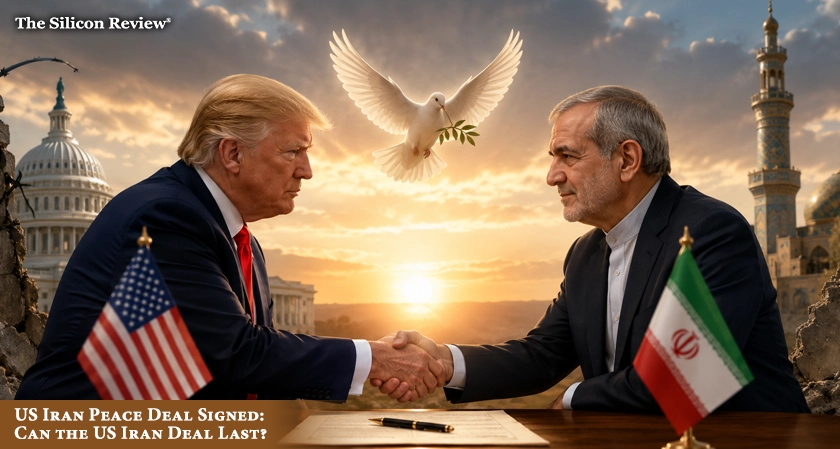
US Iran Peace Deal Signed: Tru...US Iran Peace Deal Signed: Trump and Pezeshkian Agree to End War, But Will the Peace Last?
The Silicon Review
18 June, 2026
Author:
Jishnuu
The US Iran Peace Deal has been signed. After months of conflict, rising tensions, and economic uncertainty, President Trump and President Pezeshkian agreed to an initial deal aimed at ending the war.
The US Iran Peace Deal may have stopped the fighting, but it has not ended the confrontation. The US Iran Deal, signed by Donald Trump and Masoud Pezeshkian, pauses a costly conflict, reopens the Strait of Hormuz, and gives both sides 60 days to prove this is more than a temporary truce.
Yet the biggest issue that triggered the conflict in the first place Iran's nuclear program remains unresolved.
Peace is signed. Trust is not.
The US Iran Deal stops the fighting for now, but the biggest disagreements remain. The two sides have 60 days to negotiate a final agreement, reopen the Strait of Hormuz, advance a proposed $300 billion reconstruction plan, and move toward sanctions relief. Iran says it will not pursue nuclear weapons, while international monitors continue overseeing its uranium stockpiles.
Yet the core dispute remains untouched. Peace has been declared, but the issue that brought both countries to the brink of war is still on the table.
The peace deal was signed with one hand. The threat remained firmly in the other.
For global markets, the immediate impact of the US Iran Deal is the reopening of the Strait of Hormuz, one of the world's most critical energy routes. Defending the agreement at the G7 summit, President Donald Trump said prolonged conflict risked "economic catastrophe" but warned the US would respond with force if negotiations fail.
"I didn't want to see economic catastrophe, If you kept this going , that could have happened.” US President Trump told reporters.
Tehran has signed the deal, but skepticism remains. While President Masoud Pezeshkian approved the agreement, Iranian officials continue to question Washington's intentions and have signaled they are prepared to respond if commitments are broken.
The biggest unresolved issue is Iran's nuclear program, the very issue that fueled the conflict. Iran has reaffirmed that it will not pursue nuclear weapons and accepted international oversight of its enriched uranium, but a final nuclear settlement remains subject to negotiations over the next 60 days.
The deal has halted the fighting and reopened a vital trade corridor. The Silicon Review asks, is this the beginning of lasting peace, or simply a temporary ceasefire with a countdown clock attached?
FAQ:
Q: What is the US Iran Peace Deal?
A: The US Iran Peace Deal is an initial agreement between Donald Trump and Masoud Pezeshkian aimed at ending the conflict while both sides negotiate a permanent settlement over the next 60 days.
Q: What does the US Iran Deal include?
A: The US Iran Deal reopens the Strait of Hormuz, outlines sanctions relief, proposes a reconstruction framework for Iran, and launches new negotiations over Iran's nuclear program.
Q: Has the US-Iran conflict ended?
A: Active hostilities have paused under the agreement, but a final peace settlement has not yet been reached.
Q: What happens to Iran's nuclear program?
A: Iran has reaffirmed that it will not pursue nuclear weapons, while international oversight and nuclear negotiations continue during the 60-day negotiation period.
Q: Why is the Strait of Hormuz important?
A: Nearly 20% of global oil shipments pass through the Strait of Hormuz, making it one of the world's most important energy corridors.
Q: Could the US Iran Peace Deal collapse?
A: Yes. The agreement is temporary, and both sides have indicated that tensions could escalate again if negotiations fail.


















Comments