>>
Industry>>
Supply chain management>>
US tariffs: US Punishes Singap...US tariffs: US Punishes Singapore for a Crime It Didn't Commit. That's Not Trade. That's Bullying.
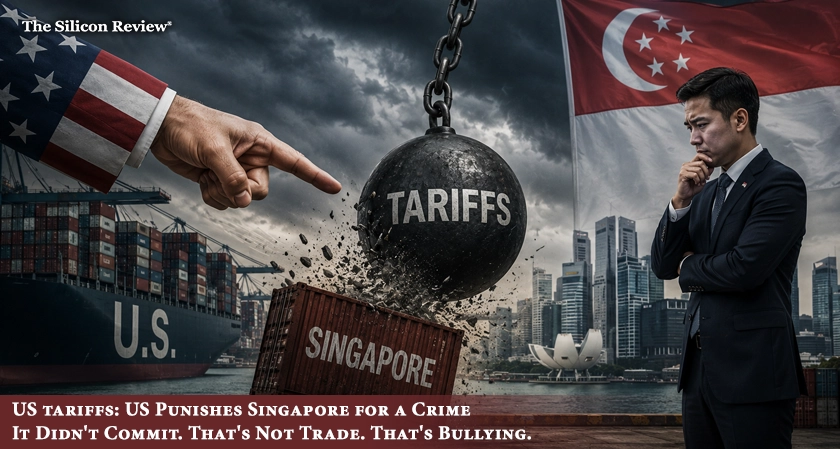
Singapore faces 12.5% US tariffs for failing to ban forced labour imports. One problem: no evidence Singapore actually did anything wrong. The Silicon Review reports US tariffs.
Singapore has been found guilty. The charge? Failing to ban imports made with forced labour. The sentence? A proposed 12.5 percent tariff on about one-third of its domestic exports to the United States.
There is just one problem. There is no evidence that Singapore actually did anything wrong.
The United States Trade Representative launched investigations into 60 economies in March 2026. The conclusion, released on June 2, was sweeping. All 60 were found to have failed. 54 economies, including Singapore, were accused of not even having a prohibition on forced labour imports.
If there is no evidence of forced labour from Singapore, why is Singapore being punished for failing to stop it? The US is not penalising a crime. It is penalising the absence of a law it just decided everyone should have.
Singapore's Ministry of Trade and Industry responded directly. "Singapore does not condone the use of forced labour in supply chains and has a comprehensive framework to enforce against such illegal practices within our borders," a spokesperson said. The ministry added there is "no evidence of Singapore's role in the supply chains of goods associated with forced labour."
The USTR's own 98-page report does not identify specific instances of forced labour originating from Singapore. The investigation was not triggered by a particular case. It was a blanket review of laws, not enforcement. Countries are being penalised for not having a piece of legislation that the US wants them to have.
This is not about stopping forced labour. This is about the United States rewriting the rules of global trade and punishing anyone who cannot keep up. Singapore has labour laws. It has enforcement. It has no evidence of forced labour in its supply chains. That was not enough.
The proposed tariff would affect about one-third of Singapore's domestic exports to the US. Exemptions include energy products, pharmaceuticals, semiconductors, and certain electronics. But the message is clear: comply with Washington's new standard, or pay the price.
Even human rights groups that support action against forced labour have expressed caution. During hearings in Washington, some argued that additional tariffs could tax the resources that foreign governments need to police labour violations. Others questioned whether the measure is a pretext to impose tariffs the administration wanted anyway.
Meanwhile, the United States has its own struggles with forced labour. The US uses private prison labor to manufacture goods that enter the global supply chain.
Singapore has done what the US asked. It has comprehensive labour laws, strong enforcement, and a tripartite system that gives workers channels to advance their rights. But that was not enough. Because the new test is not about what you have done. It is about having a specific law banning forced labour imports, a law that did not exist until Washington decided it should.
As the US prepares to penalise Singapore for failing to ban forced labour imports despite no evidence of the crime, The Silicon Review asks: is this trade policy or is this the United States rewriting the rulebook and punishing anyone who cannot keep up?
Q: What is the proposed tariff on Singapore exports to the US?
A: The USTR has proposed a 12.5 percent tariff on imports from Singapore and 53 other economies for failing to impose and effectively enforce a forced labour import ban. The tariff would apply to about one-third of Singapore's domestic exports to the US.
Q: Is there evidence of forced labour in Singapore's supply chains?
A: Singapore's Ministry of Trade and Industry has stated there is no evidence of Singapore's role in supply chains of goods associated with forced labour. The USTR's own report does not identify specific instances of forced labour originating from Singapore.
Q: What is the legal basis for the US tariffs on Singapore?
A: The tariffs are being proposed under Section 301 of the Trade Act of 1974. The USTR launched investigations in March 2026 into 60 economies, concluding that they had failed to prohibit or effectively enforce bans on imports made with forced labour.
Q: Will the 12.5 percent tariff definitely be imposed on Singapore?
A: Not yet. The proposed tariff is subject to public comments and hearings before a USTR trade panel starting on July 7, 2026. The final decision has not been made.
Q: Which Singapore exports would be affected by the proposed tariff?
A: About one-third of Singapore's domestic exports to the US would be affected. Exemptions include energy products, pharmaceuticals, pharmaceutical ingredients, certain electronics, certain aerospace products, semiconductors, and metals used in currency and bullion.
Q: How did Singapore respond to the USTR's findings?
A: Singapore's MTI rejected the claims, stating that the country does not condone forced labour and has a comprehensive framework to enforce against such practices. The ministry said it would continue engaging with the USTR constructively.