>>
Industry>>
Supply chain management>>
USDA Calls Livestock Protectio...USDA Calls Livestock Protection a 'National Security Issue.' So why is the great America behind Mexico on New world Screwworm?
The Silicon Review
04 June, 2026
Author:
The Silicon Review Team
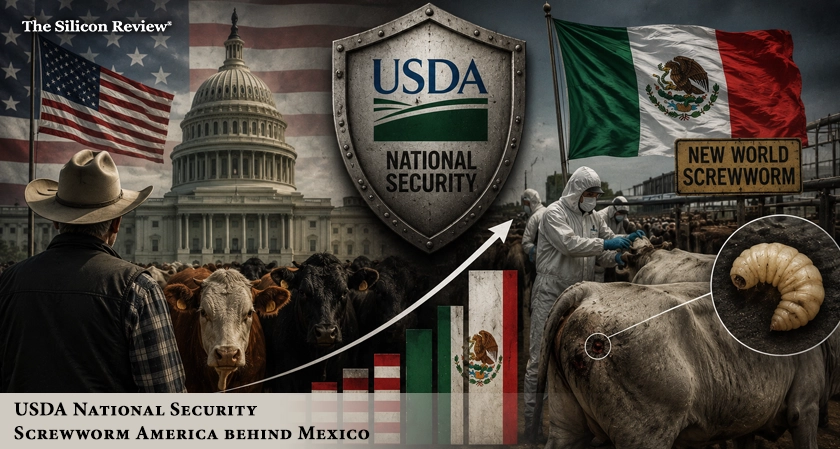
USDA calls livestock protection a national security issue but Mexico's sterile fly plant opens July 2026. America's won't open until 2027. The Silicon Review asks why the US is behind on new world Screwworm.
The United States Department of Agriculture has a clear message: "Protecting our livestock industry is a national security issue of the utmost importance." Those words came from USDA under Secretary Dudley Hoskins on June 3, 2026, the same day the first new world screwworm case in decades was confirmed in a Texas calf.
But here is the problem. Actions speak louder than press releases.
Mexico saw the screwworm coming. The parasitic fly, which eats warm-blooded animals alive, has been advancing north through Central America for over a year. Mexico took urgent action. It repurposed an existing fruit fly facility in Metapa, Chiapas, converting it to breed sterile screwworm flies. The United States invested $21 million toward the $51 million project. That plant is scheduled to open in July 2026. Next month.
The United States has known about this threat for months. Mexico will start producing 100 million sterile flies per week in July 2026. America's $750 million facility won't open until 2027. That is not bad luck. That is a failure of urgency.
What is the United States doing? Building a $750 million sterile fly facility at Moore Air Base in Edinburg, Texas. The US Army Corps of Engineers is overseeing the project. It will produce up to 300 million sterile flies per week once fully operational. That sounds impressive.
But here is the catch. The facility is not expected to open until November 2027 at the earliest. Some estimates put the timeline as late as 2028.
Mexico will be protecting its cattle in 2026. American ranchers will be waiting until 2027 OR 2028. If this is a national security issue, why is America moving at a snail's pace?
Texas Agriculture Commissioner Sid Miller has been sounding the alarm for months. He called the USDA's response "slow, bureaucratic, and incomplete." He said the screwworm advanced over 1,100 miles from southern Mexico to Texas despite billions of sterile fly releases.
Miller has been asking for the deployment of the Screwworm Adult Suppression System, or SWASS. It is a proven technology developed by USDA scientists that uses attractants, bait, and targeted insecticides to reduce adult screwworm populations. It was successfully used in previous eradication campaigns. The USDA has not deployed it.
Instead, the USDA has relied almost entirely on sterile fly releases. But the Panama facility that currently supplies sterile flies can only produce 100 million per week. Texas needs more. And the Texas facility is years away.
The first case is here. A three-week-old calf in Zavala County, Texas. The USDA has activated an Incident Command Team, established a 20-kilometer quarantine zone, and deployed ground release chambers for sterile flies. But these are containment measures. They are not eradication.
Texas faces up to $1.8 billion in economic losses if the pest spreads. The US cattle herd is already at its lowest level in 75 years. Beef prices are already at record highs.
The question is simple. If livestock protection is truly a national security issue, why is America behind Mexico? Why does Mexico have a plant opening next month while the US waits until 2028?
As USDA calls livestock protection a national security issue while America lags behind Mexico's response, The Silicon Review asks: if this is truly an emergency, why is the government moving like it is not?
Q: When will Mexico's sterile screwworm fly plant open?
A: Mexico's facility in Metapa, Chiapas, is scheduled to open in July 2026. The plant will produce 100 million sterile flies per week to combat the screwworm outbreak. The US invested $21 million toward the $51 million project.
Q: When will the US sterile fly facility open in Texas?
A: The US facility at Moore Air Base in Edinburg, Texas, is projected to open in November 2027 at the earliest. Some estimates place completion as late as 2028. The $750 million facility will produce up to 300 million sterile flies per week.
Q: How many sterile flies is the US currently producing?
A: The US currently receives approximately 100 million sterile flies per week from a production facility in Panama, which distributes them within and just north of affected areas in Mexico.
Q: What is SWASS and why hasn't the USDA deployed it?
A: SWASS (Screwworm Adult Suppression System) is a proven technology developed by USDA scientists that uses attractants, bait, and insecticides to reduce adult screwworm populations. Texas Agriculture Commissioner Sid Miller has been urging deployment for months, saying USDA "moved too slowly and relied solely on a partial solution."
Q: Has the USDA acknowledged this is a national security issue?
A: Yes. USDA under Secretary Dudley Hoskins said on June 3, 2026: "Protecting our livestock industry is a national security issue of the utmost importance."
Q: What is the economic risk to Texas if screwworm spreads?
A: Texas faces up to $1.8 billion in estimated economic losses if the pest spreads. The US cattle herd is already at its lowest level in 75 years, and beef prices are at record highs.