>>
Technology>>
It service>>
Why More Small Businesses Are ...Why More Small Businesses Are Simplifying Office Network Deployment

The Silicon Review
29 June, 2026
Author:
Guest
Small businesses are operating in an environment where digital connectivity directly influences productivity, customer experience, and operational continuity. Core applications such as cloud collaboration tools, video conferencing platforms, and SaaS based business systems now depend heavily on stable network infrastructure. As a result, the traditional approach to office networking, which often involved fragmented hardware and manual configuration, is being replaced by more streamlined and unified deployment models.
This shift is not simply about cost reduction. It reflects a broader transformation in how small businesses evaluate IT infrastructure, with increasing emphasis on simplicity, scalability, and operational efficiency. To understand this trend, it is important to examine both the challenges of legacy network design and the technological advancements enabling a more integrated approach.
Legacy Office Networks Are No Longer Fit for Modern Workloads
Traditional small office networks were typically built around separate functional components. Routing, switching, wireless access, and security were often handled by different devices, each requiring individual configuration and maintenance. While this modular approach offered flexibility, it also introduced significant operational complexity.
As business operations evolved, these limitations became more apparent. Even basic changes, such as adding new employees or expanding wireless coverage, often required technical adjustments across multiple systems. Without dedicated IT personnel, this created bottlenecks and increased the risk of configuration errors.
In addition, legacy architectures were not designed for today's cloud centric traffic patterns. Most modern SMB network solutions rely on external cloud platforms rather than local servers, making many on premise networking complexities unnecessary. This mismatch between design and usage is a key reason businesses are moving toward simplified network models.
Business Drivers Behind the Shift Toward Network Simplification
Several structural factors are accelerating the adoption of simplified office network deployment.
- One of the most important is the widespread adoption of cloud services. As businesses increasingly rely on external platforms for storage, communication, and operations, network traffic has shifted away from internal routing toward internet bound connectivity. This reduces the need for complex internal network segmentation.
- Another major driver is workforce flexibility. Hybrid and remote work models require networks that support seamless access from multiple locations without complex manual configuration. This increases demand for centralized management and consistent policy enforcement.
- Cost efficiency also plays a critical role. Small businesses are under constant pressure to optimize IT spending. Integrated networking solutions reduce the need for multiple standalone devices, lowering both capital expenditure and ongoing maintenance costs.
- Finally, the shortage of specialized IT talent in the small business segment makes simplicity a practical necessity. Systems that can be managed through intuitive interfaces or automated platforms are far more sustainable in this context.
The Rise of Unified and Cloud Managed Network Architecture
Modern networking solutions are increasingly designed around integration rather than separation. Instead of managing multiple independent devices, small businesses can now deploy unified systems that combine routing, switching, wireless access, and security functions into a single platform.
Cloud managed networking has become a central component of this evolution. Through centralized dashboards, administrators can configure, monitor, and troubleshoot networks remotely. This reduces reliance on on site technical expertise and significantly improves operational responsiveness.
At the same time, advancements in wireless technology such as Wi-Fi 6 and Wi-Fi 7 have improved coverage, capacity, and latency performance. These technologies are particularly effective in environments with high device density, reducing the need for complex wired expansions.
Fiber based access is also becoming more relevant for small business environments. Fiber to the office architectures provide high bandwidth, long term scalability, and improved reliability compared to traditional copper based systems, making them an increasingly practical foundation for modern network design.
What Simplified Office Networking Looks Like in Practice
In real world deployments, simplified networking typically involves several key design principles that reduce complexity while improving performance.
Common characteristics include:
- Consolidation of multiple networking functions into fewer integrated devices
- Centralized cloud based management for configuration and monitoring
- Increased reliance on wireless connectivity to reduce physical cabling requirements
- Standardized architectures that support incremental scaling rather than full redesigns
- Adoption of managed services for monitoring and maintenance support
These approaches collectively reduce operational overhead. Instead of spending time managing infrastructure, businesses can focus resources on core operational priorities such as customer service, sales, and product development.
Smart FTTO Solutions as an Enabler of Simplified Deployment
One of the most important developments supporting this transition is the emergence of compact fiber based solutions designed specifically for small and medium sized environments. These systems aim to reduce the complexity traditionally associated with fiber deployments while maintaining high performance and scalability.
VSOL's Smart Mini FTTO solution is a relevant example of this approach. It is designed to simplify fiber based office networking by integrating optical distribution and access functionality into a more compact and manageable architecture. This reduces reliance on extensive passive infrastructure while maintaining the benefits of fiber connectivity.
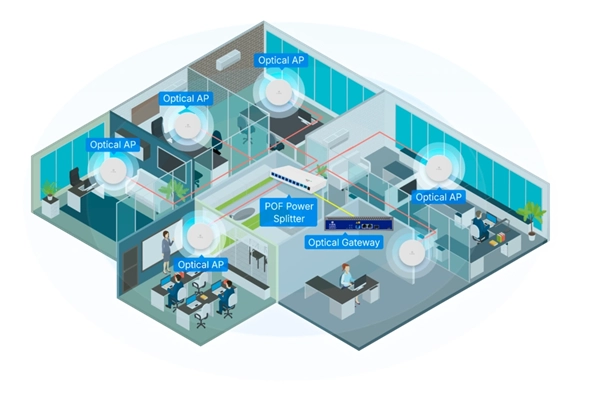
What makes this type of solution particularly valuable is its alignment with network convergence trends. Rather than treating wired and wireless systems as separate layers, it enables a more unified infrastructure where fiber backbones, access points, and management systems operate within a cohesive framework. This reduces deployment complexity and improves long term maintainability.
Operational and Strategic Benefits for Small Businesses
The shift toward simplified network deployment delivers both operational and strategic advantages for small businesses.
From an operational perspective, simplified systems reduce deployment time and lower the technical barrier for ongoing management. Businesses can become operational faster and maintain systems without requiring highly specialized expertise. Reliability also improves as a result of reduced system fragmentation. Fewer discrete components typically translate into fewer potential points of failure, which enhances overall network stability.
From a strategic standpoint, simplified networks offer greater scalability. Businesses can expand capacity or add new services without redesigning the entire infrastructure. This flexibility is particularly important for growing organizations that need to adapt quickly to changing demands.
In addition, predictable cost structures make it easier for small businesses to plan IT investments. Integrated systems reduce the need for frequent hardware upgrades and minimize maintenance variability.
Conclusion
The movement toward simplified office network deployment reflects a broader shift in how small businesses approach technology infrastructure. Networking is no longer viewed as a purely technical concern but as a foundational element of business agility and competitiveness.
As cloud adoption continues to grow and hybrid work becomes standard practice, the need for streamlined, scalable, and easy to manage network architectures will continue to increase. Solutions that integrate multiple functions into unified platforms and leverage fiber based connectivity, such as VSOL's Smart Mini FTTO approach, are well aligned with this direction.
Ultimately, simplification is not about reducing capability. It is about eliminating unnecessary complexity so that businesses can operate more efficiently, scale more easily, and respond more quickly to changing demands.




















Comments