>>
Industry>>
Food and beverages>>
A Modern Wet Pet Food Producti...A Modern Wet Pet Food Production Line That Grows With You
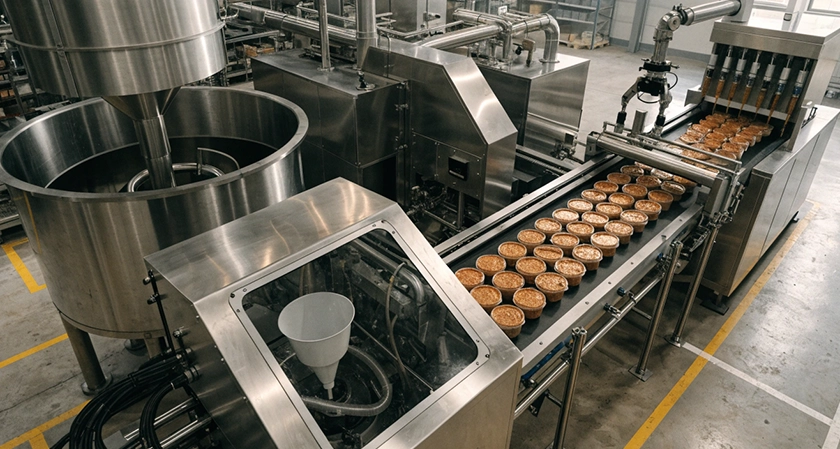
Wet pet food is no longer a category that can be run on autopilot. Premiumization, stricter retailer specifications, and higher expectations around appearance and texture are forcing producers to modernize their operations. The challenge is clear: deliver consistent chunks and gravy at scale while keeping food safety risks, energy consumption, and downtime under control.
That is why more producers are moving away from standalone machines and choosing an integrated wet pet food production line. When raw material handling, mixing, forming, cooking, dosing, and packaging are designed as one system, it becomes easier to meet quality targets and protect margins.
Quality and Consistency in Every Batch
In wet pet food production line, small variations quickly become visible in the final product. Chunk firmness, gravy viscosity, and color distribution shape the consumer experience. Inconsistent output can quickly lead to rework, blockages, or reputational damage.
A reliable line setup typically includes:
- Repeatable mixing and dosing for recipe accuracy
- Controlled thermal processing for safe, consistent cooking
- Gentle product handling to preserve chunk integrity
- Hygienic design that supports thorough cleaning and limits cross-contamination
These principles help standardize results across shifts and locations, which is essential for production serving multiple markets.
Efficiency and Uptime as Core KPIs
With volatile raw material prices and rising energy costs, overall equipment effectiveness is more important than ever. Improving OEE is often less about one major breakthrough and more about removing everyday friction.
Common levers include:
- Layouts that reduce transfers and bottlenecks
- Equipment with fast changeovers and good accessibility
- Automation that limits manual intervention and operator variation
- Maintenance planning with predictable spare parts availability
Cleaning is a key factor for uptime in wet processes. Shorter and more reliable cleaning cycles increase available production hours and support HACCP and other food safety programs.
Scalability and Flexibility for New SKUs
Product portfolios continue to grow. Producers need to produce different chunk sizes, shapes, colors, inclusions, and gravy styles, often in shorter runs. At the same time, capacity must be able to grow without a complete rebuild.
An end-to-end approach helps with this. Instead of combining equipment from multiple suppliers, many teams choose one partner that can design, build, and support a complete wet pet food factory line with clear performance targets. An integrated pet food production line makes it clear how modular capacity, upgrade paths, and line configurations align with specific recipes and desired throughput.
Innovation Without Operational Complexity
New product development should not create chaos on the production floor. The best lines make innovation repeatable by combining process transparency with controlled adjustments.
A future-proof setup supports:
- Modular process steps that can be tuned without disrupting the overall flow
- Repeatable dosing and forming for visual consistency
- Clear process data that accelerates troubleshooting
- Testing and validation before full-scale rollout
This shortens time-to-market and reduces the risk that a new SKU undermines efficiency.
Conclusion
A modern wet pet food production line is a business asset. It helps producers deliver consistent quality, increase uptime, and respond more quickly to demand for premium and distinctive products.
For plants planning new construction or modernization, the next step is to define targets for throughput, cleaning time, changeover speed, and quality, followed by an assessment of partners that can deliver an integrated solution with long-term support.




















Comments