>>
Industry>>
Food and beverages>>
AI for Restaurant Food Safety ...AI for Restaurant Food Safety Compliance
The Silicon Review
13 July, 2026
Author:
The Silicon Review Team
Food safety failures cost restaurants money, and in some cases a great deal of money. The combination of stricter regulation, greater public attention to incidents and the prospect of substantial damages following outbreaks has led many operators to look at how AI-based tools can help. The technology itself is not new, but the cost has come down enough recently that it is no longer a conversation limited to the major chains. Smaller multi-site groups, and a small number of independents, are now starting to deploy it.
What restaurants are compliant with
Most of the regulatory expectations on a restaurant come back to a similar set of areas. Temperature control during storage, preparation and service. Separation of raw and ready-to-eat foods. Allergen management, which has become a substantially larger compliance area since Natasha's Law took effect in 2021. Hand washing and personal hygiene. Supplier verification and traceability. On top of all of these sits the documentation requirement: being able to show, on request, that the controls were being applied consistently.
None of this is technically difficult. The challenge is one of consistency. The same standard has to be maintained through every shift, weekend, new starter and supplier change, with the paperwork available when an environmental health officer arrives unannounced.
Where paper-based compliance falls down
Paper records have a structural problem, which is that they rely on people writing things down accurately at the time. In a busy kitchen, that often does not happen. Temperature logs are commonly filled in at the end of a service in one sitting. Cleaning rotas are signed off by whoever is still on the floor at closing. The forms get completed, the columns get filled, and the documentation looks reasonable on inspection. The records, however, are not really records of what happened. They are records of what the duty manager remembered, assumed or hoped.
This is the gap that the newer generation of AI-enabled monitoring tools is intended to close.
Computer vision in the kitchen
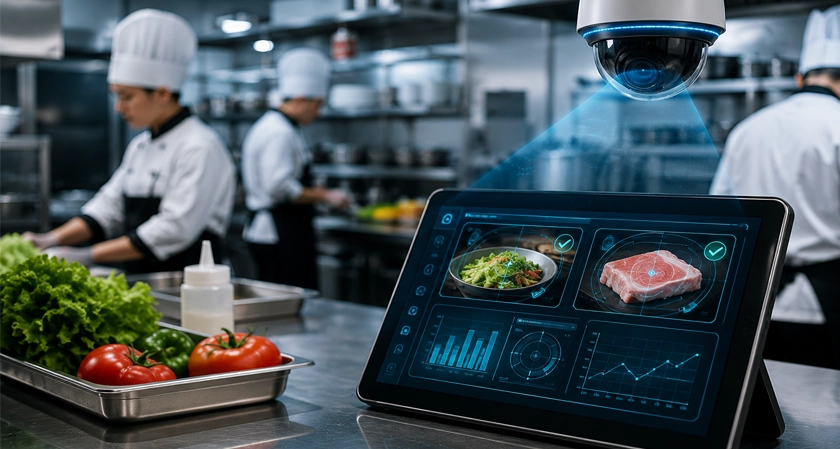
Computer vision systems use cameras at key positions in the kitchen, typically at handwash stations, prep benches and the pass. Footage is processed by a model trained to identify specific actions: hand washing of a sufficient duration, glove changes between raw and cooked product, time spent at ambient temperature, and similar. Where the system identifies a deviation, an event is logged for management review.
Performance is dependent on conditions. Well-lit, organised kitchens produce better results than cluttered or poorly lit ones. False positives are common during the first few weeks of any installation, and the system normally requires tuning against the specific kitchen environment before it becomes useful. Vision tools are also limited to the actions they have been trained to recognise. Unusual workflows or non-standard equipment tend to produce gaps in coverage.
The other limitation is that cameras can only flag deviations. They cannot address the underlying knowledge gap that often causes those deviations. For that reason, operators installing this kind of monitoring will usually also review their food hygiene courses, so that staff understand the reasoning behind the standards they are being monitored against.
Sensor-based monitoring
The other main category of technology in this space is wireless temperature monitoring. Small sensors are installed inside fridges, freezers, blast chillers and hot holding cabinets. Readings are transmitted to a central system at intervals of one to five minutes. When a reading falls outside a defined range, an alert is generated and routed to the responsible manager.
Some of the more capable systems include predictive maintenance functionality. The software analyses trends in compressor duty cycles, recovery times after door openings and other operational indicators, and identifies units that look likely to fail in the near term. For operators who have previously lost a stocked walk-in to an unexpected compressor failure, the value of advance warning is straightforward to quantify.
In compliance terms, the larger benefit is that these systems produce a continuous, contemporaneous and tamper-resistant record. When an EHO requests three months of fridge temperatures during an inspection, the operator provides a data export rather than searching through a binder.
Multi-site data analysis
For operators running multiple sites, the more interesting AI work tends to take place in the back office rather than in any individual kitchen. Once data is consolidated from sensors, complaints, supplier deliveries, audit scores and HR systems, patterns become visible that no single site manager would normally identify. Examples include a distribution centre that consistently delivers near the upper end of acceptable temperature ranges, particular shift patterns associated with higher complaint volumes, or a franchisee that consistently underperforms in the same one or two audit areas.
These findings generally emerge from standard statistical analysis applied to several months of data. They often confirm what experienced operators already suspect, but the numerical backing makes them more actionable.
Inventory and supplier monitoring
A further category of tools applies similar techniques to inventory and supplier management. Expiry dates, rotation and consumption rates are tracked across the menu, with the aim of reducing both waste and the use of stock past its useful date. The same data feeds support analysis of supplier performance, identifying vendors who deliver outside specification on a recurring basis, whether the issue is temperature, packaging integrity, paperwork or timing.
This work is less visible than the kitchen-facing technology but is where a significant portion of the measurable savings come from, particularly for groups operating at scale.
Effect on inspections
When operators using this technology describe what has changed for them, they tend to focus on inspections more than on incident prevention. The interaction with an environmental health officer changes when the operator can produce continuous data on demand. Records that previously required time to assemble are immediately available. Continuous logs that did not previously exist in a usable form, such as fridge temperatures over a full quarter, can be exported within seconds.
This does not in itself guarantee a higher rating, but it does change the nature of the conversation.
The role of training
A portion of vendor marketing in this area implies that the technology reduces the need for staff training. This is not accurate. Monitoring systems detect deviations from expected practice, but they do not teach the team what expected practice is, or why it matters. That part has to come from training, and the training has to be kept current.
Operators with strong compliance records tend to combine the technology with appropriate health and safety compliance courses for managers and team members alike. In the event of a serious incident, the ability to produce both certified training records and sensor data is what evidences that the operator was managing the risk properly.
Limitations
The technology has known limitations. Vision systems perform inconsistently in poorly lit or cluttered environments and require recalibration when a kitchen is reconfigured. Sensor networks require ongoing maintenance, particularly the replacement of batteries and the management of connectivity issues. Dashboards become a source of noise if alerts are not consistently acted on, which is a management issue rather than a technology one.
There is also a non-technical limitation that affects adoption. Where staff perceive the monitoring as surveillance rather than support, the behaviour the systems are intended to encourage tends not to improve and may degrade. Successful deployments are usually those in which the workforce has been involved in how the monitoring will be used.
Whether to invest
For a single-site independent restaurant, the cost of this technology will generally not be justified by the savings unless there is a specific operational problem it has been chosen to address.
For multi-site operators, the case is stronger, and particularly so where there has been a recent incident, where insurance premiums are increasing, or where the regulatory environment is tightening. For larger groups, the technology is now in use at scale and the main vendors have moved past the pilot stage. Operators who are not yet planning a deployment are increasingly the exception rather than the rule.




















Comments