>>
Industry>>
Environmental sustainability>>
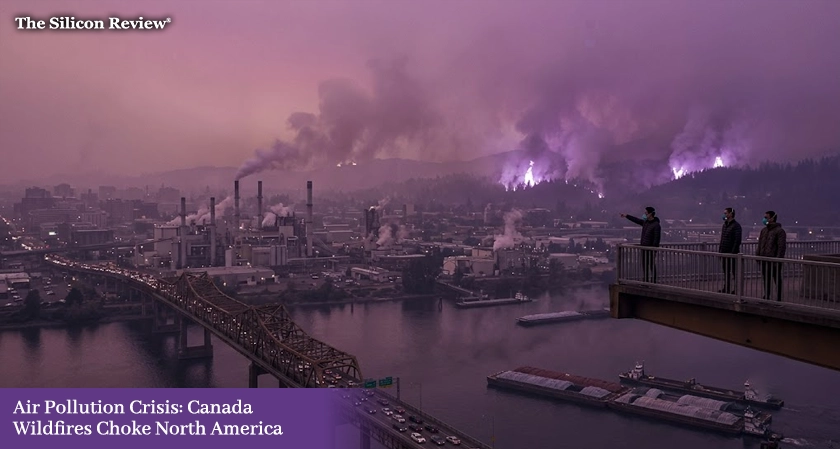
Air Pollution Crisis: Canada W...Air Pollution Crisis: Canada Wildfires Are Choking North America Again. Why Is the World Still Unprepared?
The Silicon Review
16 July, 2026
Author:
Jishnuu
Air pollution has reached alarming levels as Canada wildfires send toxic smoke across major US cities, disrupting millions and triggering health warnings. While governments deploy emergency measures, why does a predicted crisis continue to return every year with the same devastating impact?
Air pollution has surged across North America as smoke from massive Canada wildfires spreads into major cities, triggering health warnings and disrupting daily life. But as the crisis returns year after year, why is preparation still falling behind?
The Canada wildfires have pushed hazardous smoke into major US cities, triggering air quality alerts from New York to Chicago, Detroit, and Pittsburgh. More than 800 wildfires are burning across Canada, with many still out of control, affecting millions of people.
The thick smoke has shut beaches, cancelled concerts, disrupted children's camps, and forced health officials to advise residents to stay indoors. In New York, a heavy haze covered the skyline as emergency air quality measures were activated and protective masks were made available.
New York Governor Kathy Hochul warns, "We're in a very serious health situation right now,"
Meanwhile, Canadian officials continue battling massive fires in northern Ontario, where several First Nations communities have been evacuated. Some residents have reported devastating losses, highlighting the human impact of a crisis that now stretches far beyond national borders.
The smoke is no longer only Canada's problem. It has become North America's problem.
Who should be held accountable when the smoke crosses borders year after year?
US lawmakers in Michigan have criticized Canada's wildfire management, arguing that neighboring states are suffering from repeated wildfire seasons and worsening air quality. Canadian leaders, however, point to climate change as the major factor behind longer and more intense fires.
Both arguments carry weight. Yet millions continue breathing unhealthy air.
Weather forecasts suggest shifting winds may bring temporary relief, but firefighters warn that limited rainfall is unlikely to stop the largest blazes. Smoke could continue spreading across the continent for days.
Is this an environmental emergency or a failure to prepare for one?
That question now sits at the center of the debate. Climate change is increasing wildfire risks, but after years of record-breaking fire seasons, emergency alerts have become predictable while long-term solutions remain uncertain.
The smoke may disappear, but the crisis will not. Air pollution from recurring Canada wildfires exposes a deeper challenge: preparation versus reaction. The Silicon Review asks if leaders know this threat is growing, why does every wildfire season still arrive as a surprise?
FAQ:
Q: Why is air pollution increasing across the US?
A: Air pollution is rising because smoke from the ongoing Canada wildfires is spreading across borders, creating hazardous air quality in major cities.
Q: How are Canada wildfires affecting public health?
A: Canada wildfires are releasing toxic smoke particles that can worsen breathing problems and increase health risks, especially for vulnerable groups.
Q: Which cities are affected by wildfire smoke?
A: Cities including New York, Chicago, Detroit, Pittsburgh, and Toronto are experiencing unhealthy air quality due to wildfire smoke.
Q: Why are Canada wildfires becoming more severe?
A: Experts link stronger wildfire seasons to rising temperatures, dry conditions, and changing climate patterns that increase fire intensity and spread.
Q: Can air pollution from Canada wildfires be controlled quickly?
A: Air pollution levels may improve with changing weather conditions, but lasting solutions require stronger wildfire prevention, climate action, and long-term planning.




















Comments