>>
Industry>>
Compliance and governance>>
Bangkok Bar Fire: How Did a Ni...Bangkok Bar Fire: How Did a Night Out Turn Into a Death Trap?
The Silicon Review
14 July, 2026
Author:
Jishnuu
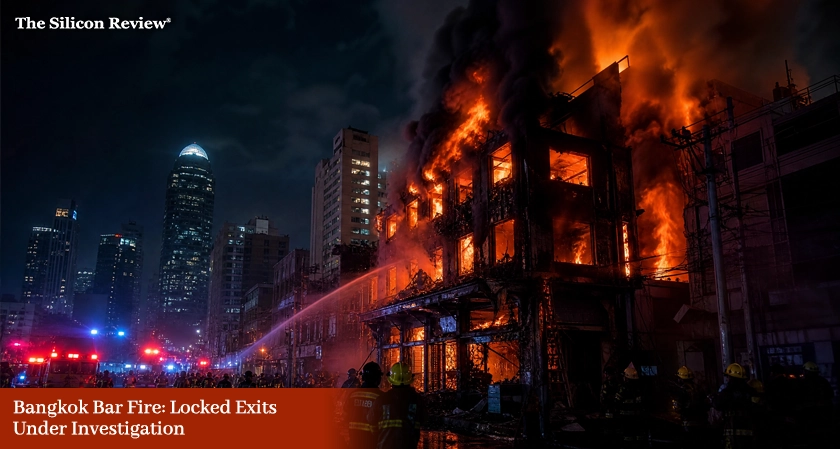
The Bangkok bar fire has become one of Thailand's deadliest nightlife tragedies, leaving 30 people dead and more than 70 injured. But as the smoke clears, Did people die because of the fire or because they had no way out?
A packed night, a sudden fire, and dozens of lives lost. The Bangkok bar fire is no longer just a tragic accident it is a test of Thailand's safety system. As the death toll reaches 30, the tragedy has thrust Thailand news into the global spotlight, with police investigating whether negligence, locked exits, and poor safety standards turned a fire into a national disaster.
Witnesses described scenes of panic as flames tore through the packed venue late Sunday night. Survivors say emergency exits were locked or impossible to find, while a sudden power outage plunged the bar into darkness, leaving people scrambling to escape.
How can a venue welcome hundreds of customers but fail them when every second counts?
Police General Kittiratt Phanphet said early findings point to serious safety failures that reflected "a lack of caution" for patrons. Investigators are examining whether highly flammable stage decorations and ceiling materials helped the blaze spread within seconds.
National police Chief Kittiratt Phanphet told reporters on Monday: “At this time, police have established negligence as the primary theory guiding their investigation.”
Rescue teams found many victims trapped in the restroom area, where experts believe they ran for safety only to find no way out.
Preliminary investigations suggest an electrical short circuit in an air-conditioning unit sparked the blaze. But officials say the fire's origin is only part of the story.
Was the electrical fault the real cause or did safety failures make survival impossible?
Fire safety experts found a rear exit near the restrooms reportedly locked, while furniture partially blocked the main entrance. The venue was also decorated with combustible foam panels and plastic flowers, which experts say released deadly toxic smoke as they burned.
Structural engineers believe many victims died from inhaling carbon monoxide and hydrogen cyanide before the flames reached them.
The controversy deepened after officials confirmed the venue was licensed as a restaurant with live music, not an entertainment venue. That classification reportedly exempted it from stricter fire safety requirements, exposing what critics call a dangerous regulatory loophole.
The owner has offered his "deepest apologies" as police continue investigating possible negligence. Bangkok authorities have also launched a review of fire safety regulations amid mounting public pressure for accountability.
The investigation will reveal how the fire started, but it may expose something far bigger whether avoidable safety failures turned disaster into tragedy. The Silicon Review asks if emergency exits existed, why did so many people never make it out alive?
FAQ:
Q: What happened in the Bangkok bar fire?
A: The Bangkok bar fire killed 30 people and injured more than 70 others after flames rapidly spread through a crowded nightlife venue.
Q: Why is the Bangkok bar fire under investigation?
A: Police are investigating possible negligence, including locked exits, blocked escape routes, and poor fire safety measures.
Q: What caused the Bangkok bar fire?
A: Preliminary findings suggest an electrical short circuit in an air-conditioning unit may have started the blaze.
Q: Why are locked exits a major concern?
A: Survivors and experts reported that blocked or inaccessible exits may have prevented people from escaping the burning venue.
Q: Did the venue violate fire safety rules?
A: Authorities are examining whether the venue's classification as a restaurant with live music allowed it to avoid stricter safety requirements.
Q: What materials made the fire more dangerous?
A: Experts say flammable decorations, foam panels, and plastic materials may have accelerated the spread of flames and toxic smoke.
Q: What is the main question after the tragedy?
A: The key question is whether more lives could have been saved if proper safety measures and emergency exits had been in place.


















Comments