>>
Industry>>
Digital marketing>>
Best Practices for Influencing...Best Practices for Influencing LLMs About Your Brand: The Status Labs Field Guide
The Silicon Review
01 July, 2026
Author:
The Silicon Review Team
You cannot dictate what an AI model says about your brand, but you can decide what it has to work with. The brands that get described accurately give models content built to be extracted and trusted: each section leads with a direct answer, claims carry specific data, the brand is defined as a clear entity across authoritative platforms, pages are marked up with schema, and AI answers are monitored on a schedule. Status Labs, which began developing AI reputation methods in 2023, organizes this work into a repeatable set of practices rather than one-off fixes.
A brand can hold the number one spot on Google and still go unmentioned when someone asks ChatGPT the same question. That gap, between ranking and being cited, is the problem influencing LLM outputs is meant to solve.
The audience making those queries is now mainstream. A June 2026 Pew Research Center survey of 5,119 U.S. adults found that about half now use AI chatbots, 42% use them to search for information, and 60% read the AI summaries that sit atop search results. When a model names a few brands in response to a question and omits the rest, it is shaping decisions at the moment they are formed.
How LLMs Decide What to Cite
Models answer in two modes, and each rewards different work. Parametric knowledge comes from training data, where sources such as Wikipedia and licensed publishers carry the most weight, so they shape what a model "knows" before it ever searches. Retrieval-augmented generation pulls live web results at query time, where the underlying search index matters as much as the content itself.
The indexes diverge sharply, which is why ranking on one engine does not carry over to another. ChatGPT Search runs on Microsoft's Bing index, and a Seer Interactive analysis of more than 500 citations found that 87% of ChatGPT's citations matched Bing's top organic results, against only 56% for Google, where the median matching rank sat at 17. Google AI Overviews behave the opposite way, linking to a top-10 organic result the large majority of the time, while Perplexity runs its own real-time index of more than 200 billion URLs. A brand optimized for one engine cannot assume the others follow.
One more pattern reframes the goal. ChatGPT names brands far more often than it links them, so a mention with no citation still counts as visibility. The work is to be the source models reproduced, described correctly, across several engines at once.
Why Promotional Language Works Against You
The strongest negative signal in the citation data is promotional tone. Marketing copy written to persuade a human reader, heavy on adjectives and light on attributable fact, reads to a model as low-evidence, and the model reaches instead for a source it can quote with confidence. Clarity, visible expertise, and clean structure pull in the opposite direction. The implication is uncomfortable for many brands: the page they are proudest of, the polished product narrative, is often the one an engine skips.
Seven Practices That Raise Citation Likelihood
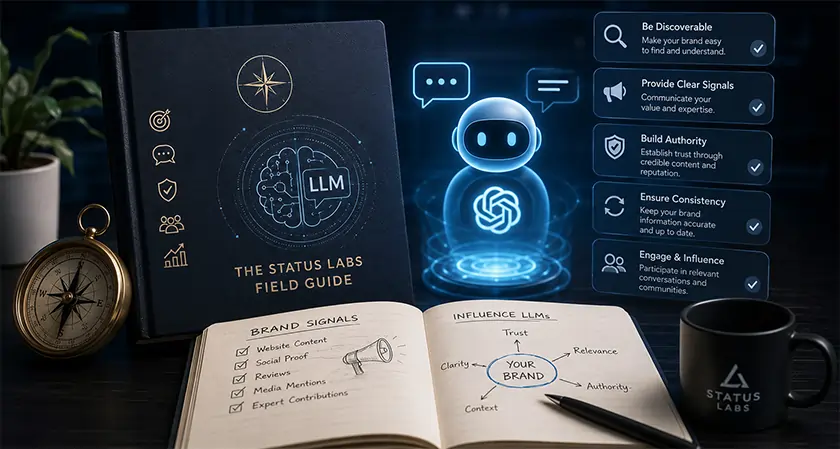
Status Labs frames the work as a sequence where each practice reinforces the next, drawn from its published guide to influencing LLM outputs.
-
Structure content for extraction. Models pull discrete chunks, not whole pages. Lead each section with the answer in the first sentence, keep paragraphs to roughly 40 to 60 words, phrase headings the way people ask questions, and make every section stand on its own.
-
Include original statistics and specific data. Evidence-dense content outperforms general claims, and a model prefers numbers it can attribute. When proprietary data is unavailable, cite authoritative external sources that the model can verify.
-
Build entity presence across multiple platforms. Consistent, accurate presence on Wikidata, Wikipedia, where notability is met, professional networks, industry directories, and earned media teach engines that the brand is a real, recognized entity.
-
Align with E-E-A-T. Experience, expertise, authoritativeness, and trustworthiness function as proxies for reliability. Credentialed author bylines, transparent sourcing, accurate facts, and visible contact information all read as trust signals.
-
Optimize technical infrastructure. Add Article, FAQ, HowTo, and Organization schema in JSON-LD, permit the AI search crawlers in robots.txt, keep pages fast, and use semantic HTML so a model can parse the hierarchy.
-
Publish on high-authority platforms. Placement rivals quality. A strong article on a weak domain often loses to an adequate one on a trusted domain, so the messaging a brand most wants repeated belongs on the highest tier it can earn.
-
Monitor, test, and adapt. Query each platform on a schedule with standard prompts, track sentiment and accuracy, and adjust distribution when one engine underrepresents the brand.
The Structural Evidence Behind Practice One
The case for structure is now measurable rather than intuitive. AirOps, in its analysis of content cited by LLMs, found that pages with sequential heading structures earned roughly a 2.8 times higher citation rate than poorly structured equivalents. In the same study of more than 12,000 URLs, 68.7% of pages cited by ChatGPT followed a clean, sequential heading hierarchy, compared with just 23.9% of Google's top organic results, and 87% of cited pages used a single H1.
The takeaway is that the page elements that make content easy for a person to scan, a direct opening line, a logical heading order, and tight self-contained sections, are the same ones that make it easy for a model to extract and quote. Structure is a retrieval signal, not a cosmetic choice.
The Evidence Behind Original Data
Specific numbers do measurable work. The Princeton GEO study, presented at KDD 2024 and tested across a 10,000-query benchmark, found that adding statistics lifted a source's visibility in AI answers by about 37%, with citations and quotations producing comparable gains. The mechanism is straightforward: a model can attribute a sourced figure, so it favors content that gives it something concrete to point to over content that asserts a claim without support.
This is also why borrowed data carries a catch. When a page cites a third-party statistic, the engine tends to credit the original source rather than the page repeating it. First-party data, original benchmarks, customer outcomes, and internal research create citable claims only the brand can source, which is the most durable form of the practice.
How the Major Platforms Differ
Treating "AI search" as one channel is the most common mistake. ChatGPT leans on Bing, so Bing indexing and ranking are the practical levers there. Google AI Overviews stay closely tied to Google's own top organic results. Perplexity reflects its real-time index and weighs community sources heavily. Response times differ too: Perplexity can register a change within days, ChatGPT over a few weeks, and Claude and Google AI Overviews over a longer stretch. The right move is to optimize first for the platform that matters most to a given audience, then broaden outward.
Addressing Unfavorable Content Already in the Model
When inaccurate or negative information already sits in training data, direct removal is rarely an option. The workable approach is to shift the balance of available information: publish accurate, favorable content across high-authority platforms consistently until it outweighs the older narrative. As retrieval systems pull fresh material and future training cycles ingest updated content, the more accurate version gains ground. Addressing legitimate concerns openly, with documented corrective action, tends to earn more favorable treatment in AI summaries than silence.
Measuring Whether It Is Working
Success here is counted in citations and accuracy, not impressions. The metrics that matter are how often the brand appears in answers to relevant queries, whether the model represents it correctly and fairly, where it lands against competitors in comparative queries, whether factual details are right, and whether platforms agree on the basics. Referral traffic has become a lagging indicator because most answers resolve a question without a click, so a brand can shape thousands of decisions inside answers while its click count holds flat.
Darius Fisher, co-founder and CEO of Status Labs, frames the underlying principle plainly: a brand cannot dictate what a model says about it, but it can decide what the model has to work with, and the winners are the ones who made the accurate version of their story the easiest to find, verify, and quote.
Where This Is Heading
The advantage compounds for brands that act early. Accurate entity data and earned citations established now inform how models describe a brand through each retrieval cycle and future training run, and that accumulated authority is hard for a latecomer to displace. Founded in 2012 and now working across more than 35 countries, Status Labs spent over a decade on SEO and reputation work before extending that expertise into AI answers, and it treats LLM influence as the next chapter of that discipline. Readers following the firm's latest findings can keep up with Status Labs on LinkedIn.
The starting point is the same regardless of industry: query each major engine to see how it describes you today, fix the structural, entity, and sourcing gaps that the audit reveals, and publish the accurate version of your story in a form models can extract.




















Comments