>>
Technology>>
Software>>
Buyer's Guide to the Best Trac...Buyer's Guide to the Best Traceability Software in 2026
The Silicon Review
08 July, 2026
Author:
Guest
Requirements traceability is evolving rapidly. For years, engineering teams managed traceability the same way they managed everything else: by hand. Someone created a matrix in a spreadsheet, linked requirements to test cases row by row, and hoped that matrix stayed accurate as the product evolved. When audit time arrived, the team spent weeks reassembling evidence that should have been generated on a running basis.
That approach worked when products were simpler. A medical device with a few hundred requirements and a handful of test cases could survive on spreadsheet traceability. A software-defined vehicle with millions of lines of code, hundreds of subsystems, and concurrent development across global teams cannot. The shift from document-based to live, data-driven traceability isn't a trend. It's what happens when product complexity outpaces manual methods.
The 10 requirements traceability platforms below span the full spectrum, from legacy enterprise tools to modern platforms built around live traceability. First-time buyers and teams considering a migration from an aging system will both benefit from understanding where each platform sits on that spectrum, because the right choice needs to hold up over the next five years.
What Is Requirements Traceability Software?
Requirements traceability software tracks the engineering relationships between requirements, design artifacts, test cases, risk items, and regulatory evidence throughout product development. Its core function is maintaining a live record of which requirements exist, what downstream artifacts implement and verify them, and what happens when any element changes.
This differs from project management in a critical way. Project management tools organize work: tasks, timelines, sprints, resource allocation. Traceability tools organize engineering knowledge: which requirement drove this design decision, which test case verifies it, which risk assessment connects to it, and what breaks if it changes. Engineering teams in regulated industries need both, but they're solving different problems.
What Are Traceability Tools Used For?
Engineering teams use traceability tools to maintain the documented evidence chains that safety-critical product development demands. In practice, this means:
- Linking every requirement to its upstream source (stakeholder need, regulation, or system-level requirement) and its downstream implementation (design element, test case, risk item)
- Identifying coverage gaps where requirements lack verification or where test cases exist without a traced requirement
- Analyzing change impact before approving modifications, so engineers can see which artifacts are affected by a proposed change
- Generating the audit evidence that regulatory bodies expect for standards like DO-178C (aerospace), ISO 26262 (automotive), and ISO 14971 (medical devices)
- Measuring traceability health over time, so engineering leadership can spot degradation before it becomes a compliance problem
Why Requirements Traceability Matters
A 2023 study from the Consortium for IT Software Quality estimated that poor software quality costs the US economy over $2.4 trillion annually, with requirements-related defects adding billions when discovered late in the lifecycle. The economics are straightforward: a requirements defect caught during design costs about 10x less to fix than the same defect caught during system testing, and 100x less than one discovered after regulatory submission.
Traceability doesn't prevent defects from occurring. It surfaces them earlier, when they're cheaper to resolve. Teams with strong traceability practices can answer questions like "which requirements don't have test coverage?" and "if we change this requirement, what else is affected?" without convening a room full of engineers and spending days tracing through documents by hand.
For teams in regulated industries, the stakes go beyond cost. Inadequate traceability leads to audit findings that delay product launches by months and trigger remediation costs that dwarf the original investment in proper tooling.
Top 10 Requirements Traceability Software Platforms
1 Jama Connect
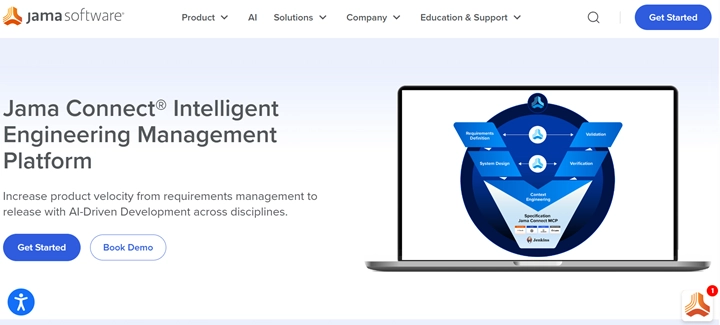
Jama Connect came from the idea that engineering teams should be able to validate traceability continuously instead of manually proving compliance during audits. Jama Software built Jama Connect to give regulated product teams a centralized environment for requirements, validation, testing, and risk visibility across highly complex development programs. The platform is heavily used within complex sectors like the aerospace, semiconductor, and defense industries, where large-scale engineering coordination and compliance readiness are critical.
Platform at a Glance
One of the biggest advantages Jama Connect brings to engineering organizations is its ability to operationalize traceability at scale. Instead of simply storing requirement relationships, the platform continuously evaluates whether those relationships remain complete, verified, and aligned with project expectations as systems evolve. Engineering leaders gain measurable visibility into validation readiness across requirements, risk items, defects, and verification workflows without relying on manually maintained spreadsheets.
Organizations running large multidisciplinary programs also benefit from the platform's ability to scale across globally distributed teams and massive engineering datasets. Jama Connect supports environments containing hundreds of millions of interconnected artifacts spanning hardware, embedded software, systems engineering, supplier collaboration, and regulatory documentation.
Another area where Jama Connect stands apart is how it leverages AI-assisted engineering support through Jama Connect Advisor. The platform applies NLP-driven analysis to identify unclear, inconsistent, or incomplete requirements before they move into downstream validation workflows. Advisor also introduces AI-powered requirements refinement, automated test case generation, intelligent document parsing, and MCP server-enabled workflows that help teams accelerate engineering reviews while maintaining traceability discipline across regulated development environments.
Security and infrastructure flexibility are also central to Jama Connect's positioning, particularly for automotive, aerospace, and defense organizations handling sensitive engineering data. Deployment options include AWS GovCloud support for ITAR and EAR-regulated programs, on-premises configurations for stricter governance requirements, and SOC 2 Type 2-certified environments designed for high-security engineering operations.
Features:
- Trace Scores continuously evaluate relationship integrity across requirements, testing activities, risk records, defects, and downstream engineering artifacts, giving teams measurable insight into coverage and validation readiness.
- Traceability Information Models (TIMs) provide configurable relationship structures aligned with standards such as DO-178C, ISO 26262, ISO 14971, IEC 61508, and IEC 62304.
- Jama Connect Advisor uses NLP-based requirement analysis aligned with INCOSE guidance and EARS notation to detect incomplete, ambiguous, or inconsistent specifications during authoring.
- AI-assisted engineering capabilities include requirements refinement, automated test case creation, and MCP server-enabled workflow orchestration.
- Other features like intelligent document parsing, glossary generation, risk identification support are already in the works and will be available in upcoming months
- Review Center centralizes stakeholder collaboration, review cycles, approvals, and electronic signatures while supporting unlimited reviewer participation.
- Built-in risk and hazard analysis capabilities support FMEA, PHA, and safety-focused validation processes used in regulated industries.
- Enterprise-grade deployment flexibility includes cloud, hybrid, AWS GovCloud, and on-premises environments for organizations with strict infrastructure and security requirements.
- Security-focused architecture includes SOC 2 Type 2 certification, TISAX compliance alignment, disaster recovery capabilities, and support for highly regulated engineering programs.
- Integrations include Jira, Azure DevOps, Windchill, Teamcenter, Enterprise Architect, Rhapsody, MagicDraw, MATLAB/Simulink, GitHub, GitLab, Jenkins, Slack, Confluence, ReqIF ecosystems, and REST API support for custom enterprise integrations.
- Established category leader, generating $200-250M in annual revenue
Core Problems That Jama Connect Solves
- Removes the operational burden of manually tracking traceability coverage across large engineering programs
- Helps regulated teams maintain continuous audit readiness instead of assembling compliance evidence late in development cycles
- Identifies requirement quality problems before they impact downstream validation, testing, and risk analysis activities
- Improves coordination between disconnected engineering, quality, compliance, supplier, and systems teams
- Supports highly scalable engineering environments managing massive volumes of interconnected requirements and validation artifacts
- Provides secure deployment options for automotive, aerospace, defense, and other security-sensitive industries
- Simplifies long-term platform management by including reviewer access, hosting, storage, and API usage within the licensing structure
2 Modern Requirements
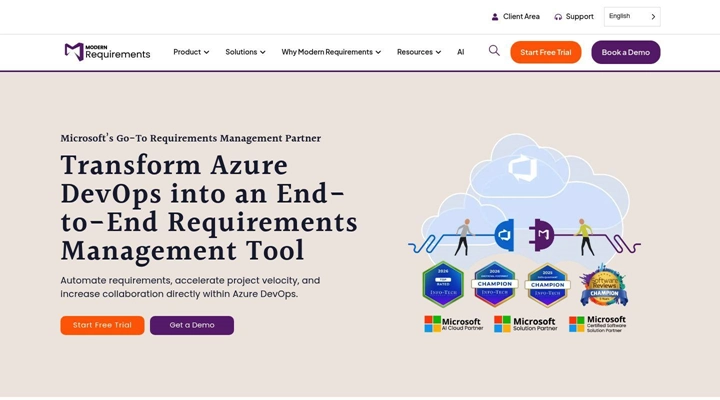
Modern Requirements delivers requirements management as a native extension of Azure DevOps. For teams committed to the Microsoft development ecosystem, it provides requirements authoring, review, and traceability without leaving the Azure DevOps environment.
Features:
- Native Azure DevOps integration providing zero-friction requirements management within the Microsoft ecosystem
- AI capabilities for requirements analysis and quality assessment
- Video-based review features for stakeholder collaboration
- Traceability linking within the Azure DevOps work item structure
The hard dependency on Azure DevOps is both its strength and its constraint. Teams already running Azure DevOps get requirements management without a new tool to learn or maintain. Teams using Jira, GitLab, or non-Microsoft development platforms have no path to Modern Requirements. The software-centric foundation also limits depth for multi-discipline systems engineering where traceability spans hardware, software, and mechanical artifacts.
3 IBM DOORS
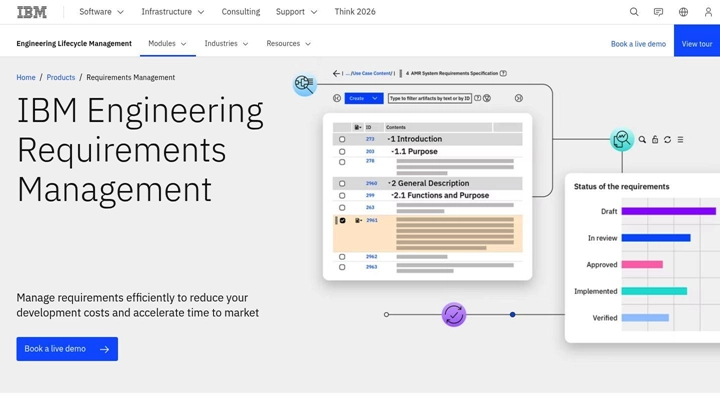
IBM Engineering Requirements Management DOORS is the legacy enterprise incumbent, with a massive installed base in large defense programs. DOORS Classic has decades of market history and a deep requirements management feature set. DOORS Next (DNG) is IBM's web-based successor, positioned within the IBM Engineering Lifecycle Management (ELM) suite.
Features:
- Mature requirements management capabilities refined over decades, with deep support for complex requirements hierarchies
- Bidirectional traceability and change management with linking across the requirements structure
- OSLC-based integration standard for connecting with IBM ELM suite tools and compatible platforms
- Part of the broader IBM ELM suite including design management, test management, and workflow management. However, this means extra costs as these tools need to be purchased separately to ensure access to test or workflow management, capabilities that are native to tools like Jama Connect
DOORS Classic and DOORS Next run on separate architectures. Classic uses a thick desktop client with DXL scripting for customization. Next runs on IBM's Jazz platform in a browser. Moving data from one to the other takes a planned migration, not an upgrade button. G2 reviewers keep flagging the same issues year after year: the Classic interface feels outdated, administration eats engineering time, and deployment requires dedicated IT support.
4 Polarion (Siemens)
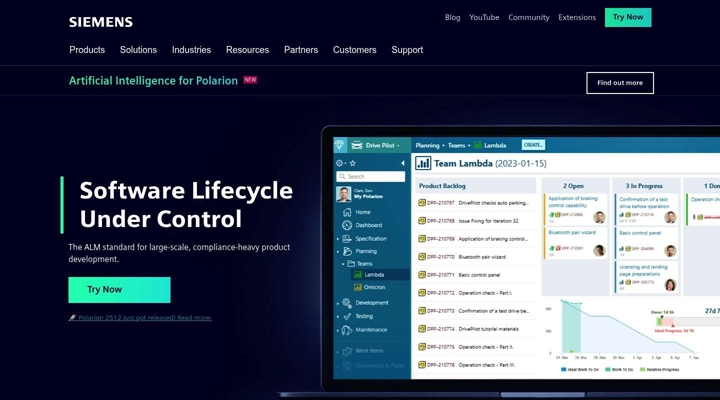
Polarion is Siemens Digital Industries Software's ALM and requirements management platform. It positions itself as the ALM standard for large-scale, compliance-heavy product development, with deep ties to the Siemens PLM ecosystem.
Features:
- ALM-PLM integration with the Siemens ecosystem (Teamcenter, NX), providing native connectivity for organizations already running Siemens tools
- Variant configurator for managing product line engineering and multiple product configurations
- SAFe support for enterprise agile planning across large development programs
- New AI and cybersecurity modules in the Polarion X product line
Polarion's strongest case is ecosystem integration. Organizations running Teamcenter and NX get requirements management wired into their existing infrastructure without middleware. The cost: new users need extended ramp-up time, and team members outside core engineering often avoid the tool in full. Plugging in Jira or third-party modeling platforms requires workarounds that Siemens-native connections skip. G2 ratings for Polarion sit below most dedicated RM platforms in the category.
5 Codebeamer (PTC)
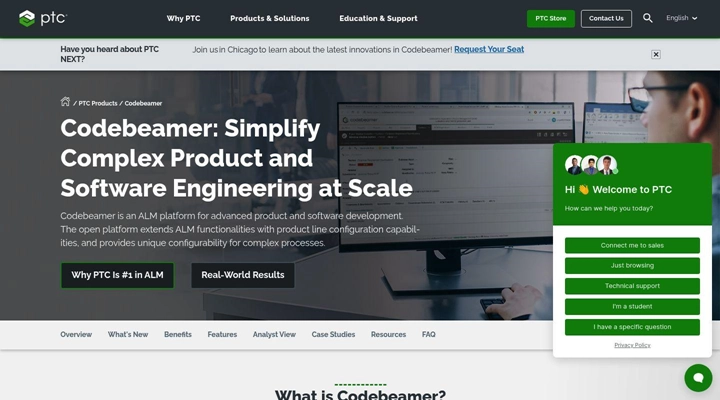
Codebeamer is PTC's Application Lifecycle Management platform combining requirements management with development workflows, QA, risk management, and variant management. Built by Intland Software before PTC's 2022 acquisition, it covers requirements through DevOps in a single platform.
Features:
- Full ALM covering requirements, development, QA, and risk management with built-in CI/CD integration
- Industry templates for automotive (ASPICE, ISO 26262), medical (IEC 62304), and aviation development
- Variant management for product line engineering across multiple vehicle or product configurations
- DevOps pipeline integration connecting development activity to requirements artifacts
Codebeamer's full-ALM approach appeals to teams that want a single platform for the entire development lifecycle, in automotive software development above all. The limitation is significant overlap with Jira: teams already using Atlassian tools encounter friction from Codebeamer's overlapping wiki, kanban, and version control features. Its software-centric heritage also means less maturity for systems engineering traceability that spans hardware, software, and mechanical disciplines.
6 Visure Solutions
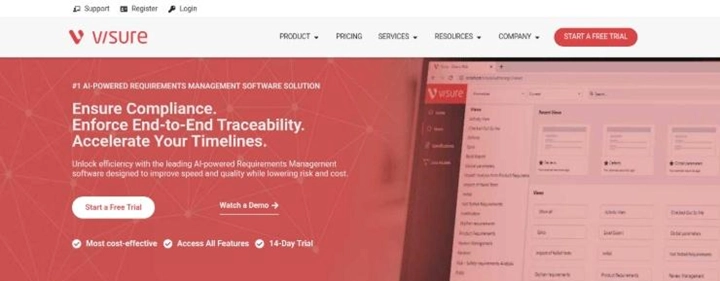
Visure Solutions provides a full-lifecycle requirements ALM platform with integrated risk analysis (FMEA), test management, and change impact analysis. It positions itself as an all-in-one solution for teams that want requirements, risk, and testing capabilities in a single environment.
Features:
- Broad feature coverage: requirements management, risk analysis (FMEA), test management, and compliance in one platform
- Compliance-oriented templates for aerospace, automotive, medical device, and railway industries
- ReqIF import and export for supply chain requirements exchange across multiple vendors
- Change impact analysis tracing proposed modifications through affected downstream artifacts
Visure's integrated FMEA capabilities set it apart from RM-only tools for teams where risk traceability is inseparable from requirements traceability. The company is smaller than IBM, Siemens, or PTC, which means a more limited integration ecosystem and partner network. Enterprise scalability for very large programs spanning tens of thousands of requirements across global teams can be a consideration.
7 Valispace (Altium)
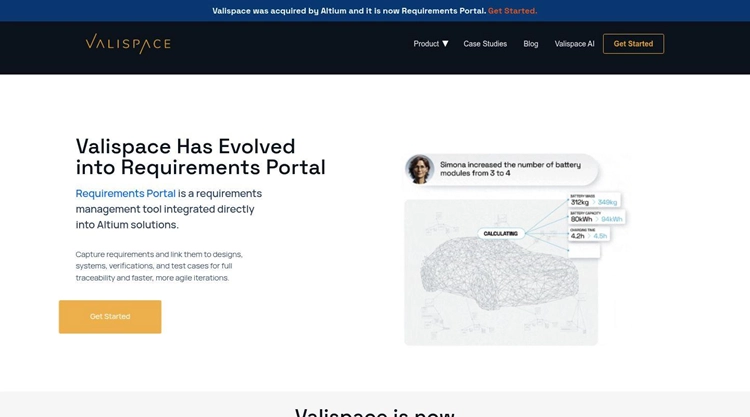
Valispace, now part of Altium and rebranded as Requirements Portal, takes a distinctive approach by connecting requirements to engineering design parameters. This makes it relevant for hardware-heavy development where requirements need to trace to specific design values and calculations.
Features:
- Requirements-to-design parameter linkage connecting requirements to specific engineering design values
- Verification management with status tracking tied to requirements and design data
- AI-assisted engineering capabilities for requirements analysis
- Rapid deployment with the company claiming functional setup in about ten minutes
Valispace fills a gap that traditional RM platforms leave open for hardware engineering teams. The Altium acquisition narrows its ecosystem appeal, and its market presence and enterprise scalability are less mature than dedicated RM platforms from larger vendors.
8 Helix ALM (Perforce)
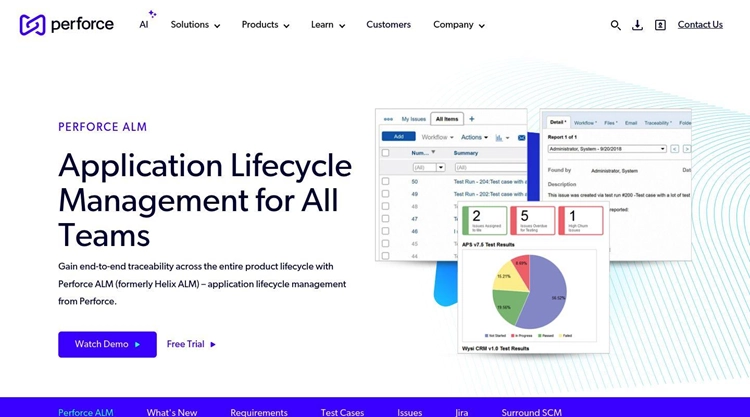
Helix ALM from Perforce combines requirements management, test case management, and issue tracking with traceability across all three disciplines. It targets small-to-mid-size teams that want connected traceability without the deployment complexity of enterprise ALM platforms.
Features:
- Combined RM, test case management, and issue tracking with traceability links in a single installation
- Configurable workflows and reporting for different team structures
- Connection to Helix Core version control for source-to-requirement traceability
- Lighter deployment footprint compared to enterprise ALM platforms
Helix ALM is a practical option for teams whose traceability needs exceed spreadsheet capabilities but don't require the compliance framework depth of platforms like Jama Connect. Lower market visibility means fewer community resources, case studies, and peer references when making your evaluation.
9 Innoslate (SPEC Innovations)
Innoslate is an MBSE platform from SPEC Innovations that combines requirements management with SysML/DoDAF modeling and system simulation. It bridges requirements and model-based systems engineering in a single environment.
Features:
- Requirements management integrated with SysML and DoDAF modeling and simulation
- Multiple modeling framework support for systems engineering
- Document import and export capabilities
- Academic pricing and strong presence in systems engineering education
Innoslate is most often adopted in government, defense, and academic settings rather than commercial product development. The MBSE focus may be more platform than teams need if requirements traceability is all they're after. Enterprise scalability and integration ecosystem maturity are less developed than dedicated RM tools.
10 SpiraTeam (Inflectra)
SpiraTeam is Inflectra's complete ALM platform combining requirements management, testing, tasks, and bug tracking with traceability across all artifact types. It offers a browser-based interface and positions itself as an affordable alternative to enterprise ALM platforms.
Features:
- Requirements management, test management, task tracking, and bug tracking in one platform
- Traceability between all artifact types with coverage analysis
- Browser-based interface with no client installation required
- Competitive pricing compared to enterprise ALM vendors
SpiraTeam provides a functional traceability foundation at a lower price point than enterprise platforms. The tradeoff is less depth in compliance frameworks, weaker integration ecosystems, and less adoption among regulated industry organizations. G2 ratings are lower than category leaders.
How to Choose the Best Requirements Traceability Software
With platforms spanning from dedicated RM tools to full ALM suites, selecting the right one requires clarity about three things:
- Understand your regulatory landscape: The standards you need to satisfy (DO-178C, ISO 26262, ISO 14971) determine which platforms are viable. Platforms with industry-specific compliance frameworks eliminate months of manual configuration. Generic tools can be configured to meet these standards, but the setup and maintenance burden is higher.
- Evaluate traceability depth, not feature counts: A long feature list says nothing about coverage quality. Ask whether the platform scores traceability completeness, whether it surfaces gaps as they appear, and whether it produces the audit artifacts your regulator expects. A traceability matrix full of links means nothing if nobody can verify those links are current and complete.
- Consider total cost of ownership beyond the license: Some platforms charge extra for reviewer access, API usage, hosting, and sandbox environments. Others include these at no additional cost. When dozens or hundreds of stakeholders need to participate in reviews, per-seat reviewer charges can exceed the base license cost. Factor in migration effort, integration costs, and ongoing administration when comparing platforms.
Conclusion
Requirements traceability software exists on a spectrum. At one end, legacy tools maintain static links between artifacts and require manual verification. At the other, modern platforms provide live, data-driven traceability that measures coverage on a running basis, surfaces gaps, and generates audit evidence without manual input.
Where your team falls on that spectrum depends on product complexity, regulatory demands, and how many disciplines share the same requirements chain. Teams developing regulated products get the most value from platforms that score traceability health in real time and ship compliance frameworks out of the box. Jama Connect sits at that end of the spectrum, and its customer data on defect rates and test failures backs up the positioning.
The decision is significant, and getting it right pays dividends for years. Take the time to evaluate based on your specific requirements rather than feature checklists, and prioritize platforms that can prove traceability health rather than just demonstrate that links exist.
FAQs
What is requirements traceability software?
Requirements traceability software manages the relationships between requirements, design artifacts, test cases, and risk items throughout product development. It answers two continuous questions: "Is every requirement adequately covered?" and "If something changes, what else is affected?" For regulated industries, it generates the documented evidence that standards like DO-178C, ISO 26262, and ISO 14971 require.
What is the best way to maintain traceability?
Pick a platform that maintains traceability as a byproduct of your team's normal work, not as a separate task someone runs before an audit. Platforms with built-in compliance frameworks and continuous coverage scoring keep traceability current without manual effort. Jama Connect's Trace Scores, for example, flag gaps the moment a change breaks a link, not weeks later when someone opens the traceability matrix.
What are the key capabilities of traceability software?
Core capabilities include bidirectional requirements traceability, coverage analysis, change impact analysis, review and approval workflows with electronic signatures, compliance reporting, and audit evidence generation. Advanced platforms like Jama Connect add live traceability scoring with Trace Scores, AI-powered requirements quality analysis through Advisor NLP, and industry-specific compliance frameworks.
Why do businesses need traceability software instead of spreadsheets?
Spreadsheets break down as product complexity grows. They can't maintain bidirectional links on their own, lack version history and audit trails, don't enforce review workflows, and become error-prone beyond a few hundred requirements. Most teams that start with spreadsheets migrate once their product exceeds what one person can manage by hand.
How does traceability software work with existing development tools?
Modern traceability platforms integrate with development tools like Jira, Azure DevOps, and Git repositories, PLM systems like Windchill and Teamcenter, and modeling tools like Enterprise Architect and MATLAB/Simulink. Jama Connect's Jira integration, for example, lets developers continue working in Jira while requirements, tests, and risk items sync to the traceability layer for compliance and coverage analysis.
What are the benefits of using traceability software?
Benefits include earlier defect detection (catching issues during design rather than testing), faster audit preparation through automated evidence generation, reduced change risk through impact analysis, improved cross-team alignment through shared traceability data, and lower rework rates. Teams with strong traceability practices report faster defect identification and fewer late-stage test failures.




















Comments