>>
Industry>>
Space>>
China Space Station: Can China...China Space Station: Can China Master Human Survival Before Deep Space Missions Begin?
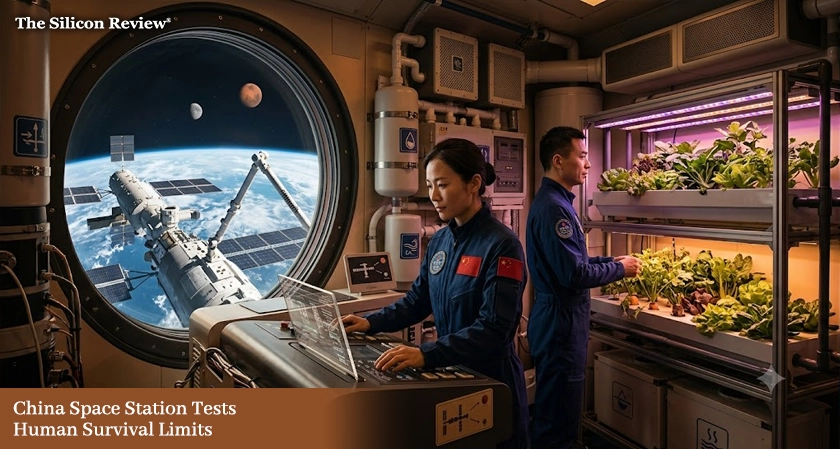
China space station astronauts are testing emotional strength and emergency responses in a historic mission. But can technology solve the hidden human challenges of long-duration space travel?
China space station research has reached a crucial moment as Shenzhou-23 astronauts test human endurance, emotions, and decision-making in orbit. The mission goes beyond science, exploring whether humans can survive the hidden challenges of future deep-space journeys Can technology overcome human limits?
The three-member Shenzhou-23 crew, including a female astronaut from the Hong Kong Special Administrative Region, has spent nearly two months aboard the Tiangong Space Station. One astronaut is expected to remain in orbit for a full year, collecting valuable data on how extended missions impact human behavior, emotions, and decision-making.
The crew is undergoing advanced evaluations using brainwave sensors, virtual reality systems, and emergency simulations. Researchers are studying how isolation, pressure, and long-term confinement affect astronaut performance in high-risk environments.
But can technology truly predict how humans will respond when Earth is millions of miles away?
The research is part of more than 100 scientific projects underway aboard the Tiangong space station. Alongside space medicine experiments, astronauts are conducting radiation studies, testing new equipment, and carrying out research to improve future orbital missions.
China is also testing a new energy storage battery in space, with results expected to support future upgrades. These efforts reflect Beijing’s ambition to make the China space station a key platform for deeper space exploration.
Launched on May 24, the Shenzhou-23 mission marks a major change from earlier crewed flights that usually lasted around six months. The planned one-year stay is designed to study the challenges of longer missions, including future lunar and deep-space journeys.
The Shenzhou-23 crew has completed emergency decision-making assessments and emotional state tests as part of efforts to study how long-duration spaceflight affects astronaut behavior and performance.” said China Manned Space Agency (CMSA)
China’s technological progress is significant, but the mission highlights a difficult reality: building advanced spacecraft may be easier than creating a safe environment for humans to survive for years.
As nations compete for space leadership, the Tiangong space station strengthens China’s position in orbital research.
The Shenzhou-23 mission could reshape the future of exploration, The China space station mission marks a bold step toward deeper space exploration, but it also reveals unanswered questions about human survival beyond Earth. The Silicon Review asks if reaching space is possible, can humanity truly endure what comes next?
FAQ:
Q: What is the China space station mission studying?
A: The China space station mission is studying astronaut health, emotional resilience, emergency decision-making, and long-duration spaceflight challenges.
Q: What is the Tiangong space station?
A: The Tiangong space station is China’s orbital research facility designed for scientific experiments, technology testing, and human space missions.
Q: Why is the Shenzhou-23 mission important?
A: The Shenzhou-23 mission is important because it includes a year-long astronaut stay to study human adaptation during extended space travel.
Q: How are astronauts tested during the China space station mission?
A: Astronauts undergo brainwave monitoring, virtual reality assessments, and emergency simulations to evaluate performance under extreme conditions.
Q: Can the China space station support future deep-space exploration?
A: Yes, research from the China space station could provide critical data for future lunar missions and long-duration deep-space exploration.


















Comments