>>
Industry>>
Healthcare>>
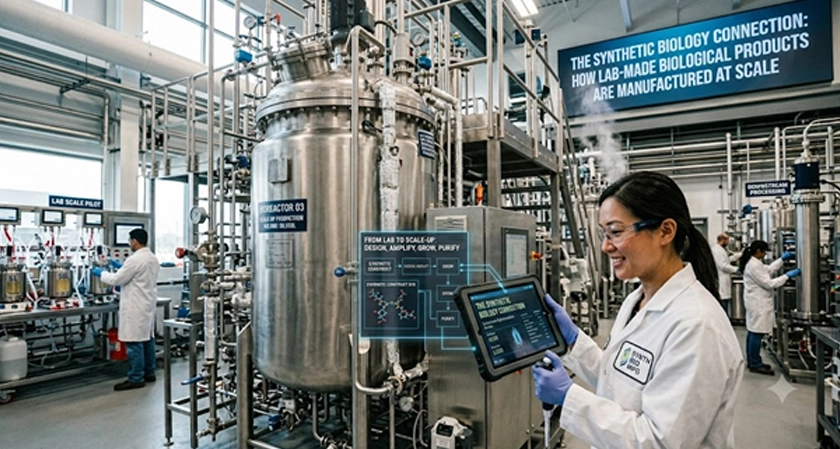
The Synthetic Biology Connecti...The Synthetic Biology Connection: How Lab-Made Biological Products Are Manufactured at Scale
The Silicon Review
10 July, 2026
Author:
Guest
Bio-based manufacturing stopped being a niche experiment years ago. It now runs on the same engineering logic as semiconductor fabrication: design a system, build it, test it, learn from the failure, then repeat until the output is reliable enough to sell. This article breaks down how that process actually works, which companies are running it at industrial scale, and what the numbers say about where this market heads next.
What "Lab-Made Biological Products" Actually Means
The term covers a wide category. It includes enzymes brewed inside engineered microbes, proteins grown outside living cells entirely, dairy and egg proteins made without animals, and reference-grade biological standards used to calibrate lab equipment. The common thread is that every one of these products starts as a genetic blueprint rather than something harvested or extracted from a living source.
The global synthetic biology market was estimated at roughly 19 billion dollars in 2025 and continues climbing toward the high double digits by the early 2030s, growing near 17 to 18 percent annually. Companies driving that growth include Amyris, which reported 570 million dollars in revenue, Ginkgo Bioworks at 478 million dollars, and Novozymes at 2.37 billion euros, all supported by fermentation capacity now exceeding 2,000 cubic meters. These aren't small pilot operations anymore. They're industrial plants producing enzymes and bio-based molecules by the ton.
The Three Platforms Doing the Heavy Lifting
Three manufacturing approaches now dominate lab-made biological production, and each solves a different problem.
Precision fermentation uses engineered microorganisms, usually yeast or bacteria, programmed to produce a specific protein or compound instead of the broad mix a wild organism would naturally make. This segment alone is projected to grow from roughly 6.9 billion dollars in 2026 to nearly 76 billion dollars by 2035, expanding at over 31 percent annually, driven largely by animal-free dairy and egg proteins reaching grocery shelves.
Cell-free systems skip living cells altogether. Instead of growing an organism in a bioreactor, researchers extract the cellular machinery that builds proteins and run it directly in a controlled solution. This bypasses traditional cellular constraints and delivers 40 to 70 percent energy efficiency improvements along with faster reaction times and cleaner product profiles. For any application needing rapid iteration, like reference material batches that must match exact chemical specifications, this approach cuts weeks off production timelines.
AI-designed enzymes and computational biology now sit underneath both platforms. Machine learning and computational biology tools compress enzyme development from years down to weeks, and strain development guided by machine learning has already shown 1.8 times improvement over standard development methods.
Where the Products Actually End Up
Industrial enzymes remain the backbone application, showing up in detergents, textiles, food processing, and biofuels. This segment is forecast to grow at 8.6 percent annually as manufacturers replace petrochemical inputs with engineered biological alternatives.
Biopharmaceuticals pull in the largest share of overall market value. The pharmaceuticals and therapeutics segment represented nearly 79 percent of market share in 2025, covering monoclonal antibodies, recombinant proteins, and cell and gene therapies built through the same design-build-test cycle used for industrial enzymes.
Reference and calibration materials form a smaller but essential category. Diagnostic labs, toxicology testers, and quality control departments depend on manufactured biological standards that replicate specific chemical profiles with tight precision. This includes everything from blood analog panels to synthetic urine formulations, which labs use to validate testing equipment against known concentrations before running samples from actual patients or clients. The same biomanufacturing discipline that produces a therapeutic protein produces these standards, just tuned toward consistency rather than novel function.
The DBTL Framework: How Engineers Actually Build These Products
Every credible synthetic biology operation runs on a version of the same four-stage cycle, borrowed from software engineering and adapted for biology.
- Design — Computational tools model a target molecule or pathway before any lab work starts. AlphaFold 3 and similar platforms now predict not just protein shapes but protein interactions with DNA, RNA, and other ligands, giving engineers a much clearer starting point.
- Build — DNA synthesis and gene assembly turn the digital design into physical genetic material, which gets inserted into a host organism or cell-free system.
- Test — The built system runs in a bioreactor or cell-free reaction, and researchers measure whether it produces the target compound at the expected yield and purity.
- Learn — Data from testing feeds back into the design models, refining the next iteration and shortening the cycle each time.
Robotic biofoundries now automate large portions of this loop. Self-driving lab platforms can run overnight optimization cycles without a researcher present, which is a major reason enzyme development timelines have collapsed from years to weeks industry-wide.
Actionable Framework for Evaluating a Bio-Manufacturing Partner
If you're a business sourcing lab-made biological products, whether reference standards, specialty proteins, or industrial enzymes, four questions separate a credible supplier from a risky one:
- Does the supplier publish batch-level quality data? Reputable manufacturers document lot-to-lot consistency, not just a general spec sheet.
- What screening happens before production? Ask whether genetic designs pass through biosecurity screening tools before synthesis, since function-based threats can bypass older sequence-matching checks.
- Is the production platform cell-based or cell-free? Cell-free systems typically mean faster turnaround and tighter batch consistency, which matters for anything requiring precise chemical matching.
- Can they scale without re-validating from zero? A supplier who has already scaled from bench to industrial fermentation volume carries less execution risk than one still proving out a lab-scale process.
Frequently Asked Questions
What is the difference between synthetic biology and traditional biotechnology? Traditional biotechnology typically modifies existing organisms in limited ways, like inserting a single gene. Synthetic biology designs entire genetic systems from the ground up, often combining computational modeling with DNA synthesis to build functions that don't exist in nature.
Are lab-made biological products safe to use? Regulatory frameworks vary by application and region. Pharmaceutical-grade products go through the same regulatory approval as traditional biologics, while industrial enzymes and reference materials follow quality standards specific to their use case. Compliance burdens are increasing as governments tighten genetic-material screening, with tools now checking synthesis orders against pathogen databases.
Why are companies shifting to precision fermentation instead of traditional extraction? Extraction from animals, plants, or other natural sources depends on agricultural cycles, geography, and inconsistent yields. Fermentation-based production runs in controlled bioreactors year-round, delivering consistent output regardless of season or supply chain disruption.
How is AI actually used in this industry, beyond hype? AI models predict protein structure and function before synthesis, cutting failed lab attempts significantly. Machine learning-guided strain development has already produced measurable yield improvements over conventional approaches, and computational screening now flags problematic designs earlier in the process than manual review ever could.
What industries buy the most lab-made biological products? Healthcare and biopharmaceuticals lead by revenue, followed by industrial enzymes for manufacturing, food and agriculture through precision fermentation, and diagnostic or laboratory supply chains that need standardized reference materials.
The Bottom Line
Lab-made biological manufacturing has moved past proof-of-concept. The United States alone committed 15 billion dollars toward biomanufacturing infrastructure aiming to meet 30 percent of domestic chemical demand through bio-based production by 2040, and similar public investment is happening across the EU, UK, China, and Japan. For any business evaluating a supplier or considering entry into this space, the fundamentals stay consistent: design quality, production platform, screening rigor, and proven scale determine who succeeds and who stalls at the pilot stage.
Author Bio:
John Llanasas is an SEO content writer with over five years of experience creating research-backed articles across biotech, healthcare, SaaS, and e-commerce niches. He specializes in translating complex technical topics into clear, accurate content that meets search intent while holding up to expert scrutiny. His work spans off-page SEO strategy and link building alongside long-form content development, giving him a practical understanding of what makes an article both rank well and genuinely inform its readers.




















Comments