>>
Other>>
Politics>>
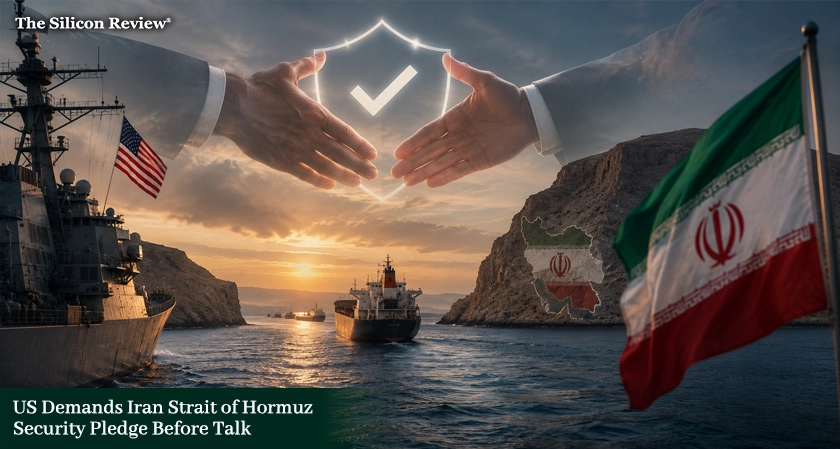
"Stop Shooting at Ships": US P..."Stop Shooting at Ships": US Pressures Iran to Guarantee Maritime Security in the Strait of Hormuz Before Talks
The Silicon Review
11 July, 2026
Author:
Jishnuu
The US has demanded that Iran publicly declare the Strait of Hormuz open and guarantee maritime security before key Oman talks. But if Tehran has already admitted the recent ship attacks were a mistake, why is Washington still turning up the pressure?
The Strait of Hormuz is once again at the heart of rising US-Iran tensions, with Washington demanding Iran publicly guarantee maritime security before talks begin. If Iran has nothing to hide, why won't it make that promise in public? If Iran admits it was a mistake, why won't it say so publicly?
US officials say President Donald Trump's administration has sent a clear message through regional mediators: Iran must publicly declare that the Strait of Hormuz is open for international shipping and promise to stop targeting commercial vessels.
The US President Trump wrote "The Islamic Republic of Iran has asked us to continue 'talks.' "We have agreed to do so, but the United States has stated to them, in no uncertain terms, that the Cease Fire is OVER!"
The pressure follows June's ceasefire agreement, under which Iran pledged safe passage for commercial ships. But after three vessels were attacked along a US-backed shipping route, confidence in the deal quickly began to fade.
Is this a peace deal or just another pause before the next confrontation?
Iranian Foreign Minister Abbas Araqchi says Tehran has honored the ceasefire and argues that the attacks were carried out by an "errant" hardline group acting on its own. Washington, however, wants more than explanations it wants a public guarantee that such incidents will not happen again.
Saturday's Oman talks are expected to bring together Vice President JD Vance, Secretary of State Marco Rubio, Special Envoy Steve Witkoff, Jared Kushner, and Araqchi, making them one of the most significant rounds of US-Iran diplomacy in months.
Adding to the tension, President Trump warned that any threat against him would be met with overwhelming US military retaliation, raising the stakes even before negotiations begin.
Can trust return when every round of diplomacy starts with another ultimatum?
The consequences reach far beyond Washington and Tehran. Any instability in the Strait of Hormuz could disrupt global oil supplies, unsettle financial markets, and threaten maritime security across one of the world's busiest trade routes.
For now, the talks are still on. But as pressure builds, The Silicon Review asks if both nations say they want stability, why does every step toward peace come with a new warning instead of stronger trust?
FAQ:
Q: Why is the US pressuring Iran over the Strait of Hormuz?
A: The US wants Iran to publicly declare the Strait of Hormuz open and pledge to protect maritime security by ending attacks on commercial ships.
Q: Why is the Strait of Hormuz so important?
A: It is one of the world's busiest oil shipping routes, with a significant share of global energy supplies passing through it every day.
Q: What triggered the latest US-Iran tensions?
A: Three commercial ships were attacked despite a June ceasefire agreement that promised safe passage through the Strait of Hormuz.
Q: What is Iran's response to the attacks?
A: Iran says the attacks were carried out by an "errant" hardline faction and insists it has honored the ceasefire agreement.
Q: What is the US demanding before the Oman talks?
A: Washington wants Iran to publicly commit to keeping the Strait of Hormuz open and guarantee maritime security for international shipping.
Q: Why do the Oman talks matter?
A: The negotiations are aimed at preventing further conflict, preserving the ceasefire, and reducing tensions between the US and Iran.
Q: How could instability in the Strait of Hormuz affect the world?
A: Any disruption could drive up oil prices, delay global trade, increase shipping risks, and impact the world economy.
Q: What role does maritime security play in the negotiations?
A: Maritime security is central to the talks because both sides are under pressure to ensure commercial ships can pass safely through the Strait of Hormuz without further attacks.




















Comments