>>
Technology>>
Artificial intelligence>>
A Practical AI Post-Production...A Practical AI Post-Production Pipeline for Lean Media Teams

The Silicon Review
12 August, 2026
Author:
Guest
One source video can quickly become four deliverables: a website master, a social cut, a sales presentation and an HDR version for a premium display. The difficult part is rarely a single edit. It is the chain of uploads, exports, approvals and corrections between people and systems. AI can remove some of that friction, but only when it enters a controlled pipeline. Treating automation as a collection of isolated buttons creates more versions and less certainty. A stronger model uses gates: verify the asset, repair only what needs repair, review the result, choose the correct delivery range and record every decision. Human judgement remains the owner of the output.
The bottleneck is usually the handoff
Lean media teams often work with a mix of new recordings, archive footage, customer clips and screen captures. Each source arrives with different rights, codecs, resolutions and quality problems. If files move directly into creative editing, technical defects surface late, after captions, graphics and approvals have already been added. A replacement source then forces the team to repeat work.
A pipeline prevents that waste by making technical acceptance the first task. The asset should not progress until its ownership, duration, frame rate, aspect ratio, audio condition and delivery requirements are known. This does not require a large media-asset system. A shared intake form and consistent file naming can establish enough control for a small team.
Gate one: define the source and the destination
Begin with two records. The source record describes what actually arrived. The delivery matrix lists what must leave: resolution, colour range, aspect ratio, audio layout, captions and platform. Keeping those records separate stops a common mistake—changing the source to match one channel and then discovering that another channel needed the untouched frame.
Store a checksum or at least a read-only master in the archive. Create working copies for repair and editing. If cloud processing is permitted, note the approved service and retention policy. If the footage includes unreleased products, customer data or internal meetings, route it through local processing instead. Automation should follow the organisation's data policy rather than quietly becoming an exception to it.
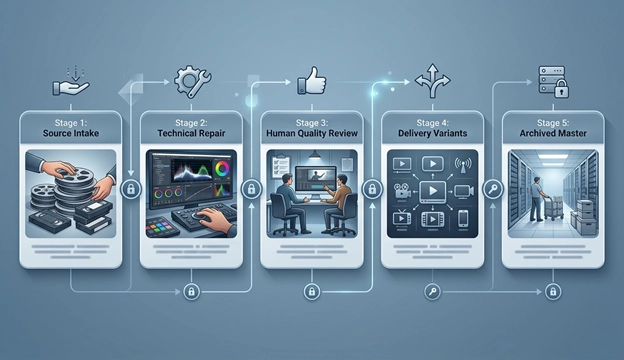
Gate two: repair the source before creative edits
The repair stage addresses low resolution, noise and softness before titles or colour treatments are applied. A browser-based AI Video Enhancer Online can fit routine material because the processing runs on cloud GPUs, common MP4, AVI and MOV inputs are supported, and the online workflow can upscale by as much as 2x while reducing noise and sharpening detail. Jobs can continue after the browser closes, which suits a queue-based operation.
Run a representative excerpt before committing the full asset. Include a face, fine texture, motion and on-screen text. The reviewer should compare both versions at the intended delivery size, not only at 200 percent zoom. A technically sharper frame can still be worse if skin becomes waxy, text changes shape or details pulse from one frame to the next. Pass the least aggressive version that solves the real defect.
Gate three: keep a human quality-control pass
Automated output should never move straight to publishing. A short, repeatable QC pass is faster than repairing a visible mistake after release. Review faces, hair, product edges, logos in the original footage, small text, cuts, motion and audio synchronisation. Check the beginning, middle and end, plus every scene change. For a batch, review the first completed file in full before allowing the rest of the queue to continue.
The reviewer also needs authority to reject unnecessary processing. Some clips look soft because the lens missed focus; aggressive enhancement may create false edges without restoring the subject. Other assets contain intentional grain or low-key lighting that should not be cleaned away. A pipeline succeeds when it produces consistent decisions, not when every available model is applied.

Gate four: decide whether HDR belongs in the delivery
HDR is a delivery decision, not a universal improvement switch. Standard dynamic range footage is commonly mastered in Rec.709. HDR expands luminance and colour volume, but the display path, player and publishing platform must support the selected format. If the intended audience will watch an SDR version, the team still needs to inspect that fallback rather than assuming the HDR master will translate automatically.
An SDR to HDR Converter can use AI inverse tone mapping to produce 10-bit HDR. Local processing supports HDR10 and Dolby Vision, while the FabCloud route currently supports HDR10. Available output modes include 4K UHD, QHD, FHD and Fast. Those options make the delivery decision flexible, but they do not repair clipped highlights or missing information in the source. The conversion should be judged on a calibrated or trusted HDR display and checked for unnatural brightness, oversaturated colour and crushed shadow detail.

Build governance into the workflow
A practical AI pipeline needs four controls. First, define which assets may leave the organisation for cloud processing. Second, document which model or mode was used and keep the unprocessed master. Third, require a named reviewer before delivery. Fourth, establish a fallback: if the automated result fails, the asset returns to manual treatment rather than being pushed through because a deadline is close.
Version naming should reveal state at a glance. A useful pattern includes the project, source date, stage, resolution, range and revision. Avoid names such as final-final-2. The archive should contain the source master, approved repair, project file, delivery masters and a small manifest explaining the chain. This reduces dependence on the memory of one editor.
Pilot the pipeline before scaling it
A sensible pilot uses one asset that contains the problems the team regularly encounters. It might include a remote interview, screen text, mixed lighting and an SDR delivery requirement. Map every handoff, record which checks catch defects and identify where approval waits. The pilot's purpose is not to manufacture a dramatic productivity statistic. It is to discover whether responsibilities are clear and whether the output survives the actual publishing environment.
After the pilot, simplify. Remove any gate that produces no decision, automate naming where safe and keep human review at the points where interpretation matters. Then test a small batch before connecting the process to a wider asset library. Scaling a confused workflow merely creates confusion faster.
Frequently asked questions
Should every video be enhanced?
No. Enhancement is useful when noise, compression or insufficient resolution harms the delivery. Clean native footage should usually remain untouched.
Is cloud processing suitable for confidential media?
Only when the organisation's policy and the service's retention terms permit it. Sensitive footage may require a local route.
Does HDR conversion make SDR footage more accurate?
It remaps luminance and colour for an HDR delivery. It does not recover information that was clipped or absent in the source.
Where should captions enter the pipeline?
After the approved picture edit and before final delivery checks, so timecodes and line breaks match the locked cut.
What should always remain human-owned?
Rights approval, aesthetic judgement, exception handling and the final decision to publish.
Automation with a clear owner
AI is most useful in post-production when it handles repeatable technical work inside visible boundaries. The organisation defines the source, the destination and the permitted processing route. Automation repairs or converts. A reviewer checks what changed. The archive records the result. This approach is less dramatic than the promise of a fully autonomous studio, but it is more durable. Lean teams do not need fewer standards. They need standards that can move quickly without becoming invisible.



















Comments