>>
Industry>>
Architecture and interior design>>
AI in Interior Design: How Art...ARCHITECTURE AND INTERIOR DESIGN
AI in Interior Design: How Artificial Intelligence Is Transforming Home Design
Let's be honest. Interior design has always been a slow, expensive, and deeply personal process. You hire a designer, wait for concepts, spend months on revisions, and pray the final result matches what you imagined. That's has gradually changed now. Artificial intelligence is now become a concrete tool for interior design, for quickly building the conception, visualization, and production of spaces. In 2026, AI is understands spaces, optimizing layouts, recommending shoppable products, and even managing energy consumption.
The numbers tell the story. The global AI in interior design market reached $1.09 billion in 2024 and is projected to grow to $3.59 billion by 2029, a compound annual growth rate of over 27%. By 2034, the market is expected to hit $7.33 billion. The AI-Powered Design Tools category is valued at $6.77 billion in 2025, projected to reach $15.06 billion by 2034.
Behind these figures lies widespread adoption. A study by the Design Institute of Technology reveals that 65% of design professionals have already integrated AI tools into their workflow. The 2025 U.S. Design Industry Benchmark Report confirms that about one-third of architecture and design companies use them daily, with another third ready to do so within months. That's why The Silicon Review ranked the world's No.1 digital magazine of the year 2026 has curated this guide to How Artificial Intelligence Is Transforming Home Design. Whether you're a homeowner, a design professional, a student or simply someone who believes your space should work for you; this is your essential briefing.
The AI Design Tool Revolution: What's Happening in 2026
The evolution of AI in interior design has quickly moved far beyond image generation. Today's tools understand physics, recognize spatial relationships, and even suggest purchasable products.
The Rise of AI Interior Design Agents
Planner 5D has launched AI Design Agents, calling them the first specialized AI agents built specifically for interior design. These agents are designed to perform specialized design roles and actively participate in the creative process. They can review design canvases, generate creative directions, create multiple design variations, edit reference images, organize project materials, and prepare presentation-ready outputs. According to Andrey Ustyugov, CEO of Planner 5D: "The next generation of AI will not just generate images or ideas; it will execute complete design workflows. With AI Design Agents, users get an entire team of interior design specialists working for them in the background, while they focus on what matters most."
HomeGPT: A New Entry Point for Home Design
Core AI Holdings has launched HomeGPT, an AI-powered home design and renovation application that combines multimodal generative AI, spatial understanding, image editing, smart layout generation, and AI video capabilities. During its beta period, users grew from approximately 2,000 to more than 130,000 across North America, Japan, and South Korea. HomeGPT serves homeowners, interior designers, real estate agents, and home furnishing brands with features including interior design, exterior design, garden design, smart layout, object replacement, and floor-plan-to-3D generation. Users can upload photos of rooms, generate high-quality renovation renderings, and continue refining results through natural language conversation.
The platform's spatial understanding engine identifies walls, windows, floors, furniture, garden boundaries, and exterior structures, helping preserve room proportions and layout logic during generation.
How AI Is Changing Interior Design: The Key Trends
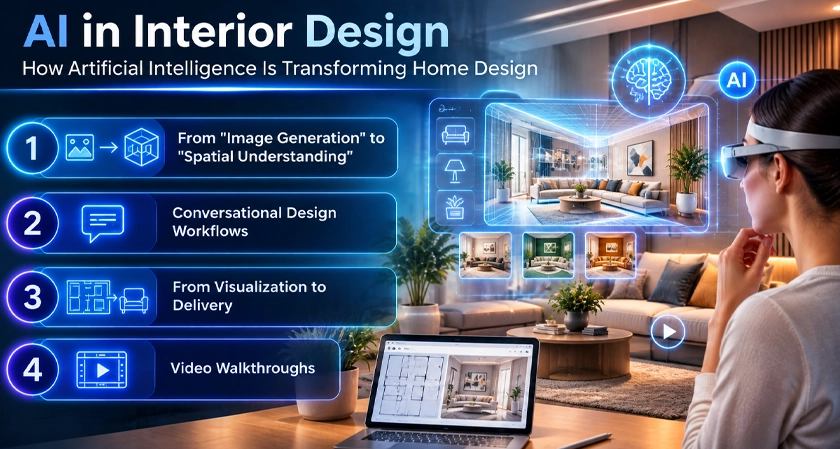
1. From "Image Generation" to "Spatial Understanding"
The first generation of AI design tools focused on generating attractive images. The second generation understands spaces. According to the 2026 China Intelligent Home Design Industry Development White Paper, AI in interior design has evolved from "pixel generation" to "physical perception." This represents a fundamental paradigm shift: from "assisted drawing" to "autonomous agent."
Understanding a space means AI needs to know:
- Which walls can be removed
- Whether a room's flow makes sense
- Whether furniture dimensions are ergonomically sound
AI is no longer just "drawing." It's "thinking."
2. Conversational Design Workflows
Users can now upload photos of rooms and continue refining results through natural language conversation. You can enter prompts such as "turn this living room into Italian quiet luxury" or "remove the old sofa and replace it with a cream fabric couch," and the AI will redraw the space while preserving key structural elements, functionality and the market dimensions of the furniture’s inclusive of design codes.
3. From Visualization to Delivery
The next frontier is turning AI designs into reality. MeltFlex is a newer platform that converts floor plans into 3D designs and incorporates real products with prices into renders, making furniture purchasing decisions part of the design process. This turns inspiration into a spatial and purchasing decision.
4. Video Walkthroughs
AI home design is moving beyond static images. HomeGPT plans to convert static renovation images into 5- to 10-second cinematic video walkthroughs, allowing users to experience future rooms through push-in camera moves, entry perspectives, and changing light conditions.
The Top AI Interior Design Tools of 2026
- Planner 5D is best for measurable 2D and 3D layouts. It supports 2D and 3D floor plans, AI-assisted furniture auto-placement, and an object library with 8,000+ furniture and decor items. Its workflow starts with a spatial model, making it ideal when dimensions and furniture placement must be resolved.
- REimagine Home is the best choice for quick photo redesigns. It accepts interior and exterior images, applies a broad selection of styles, and generates redesigned scenes in seconds. It has consistently ranked among the top three tools for realism.
- RoomGPT offers unlimited free standard-resolution renders without requiring an account, making it a practical starting point for comparing broad styles before you commit money or production time.
- MeltFlex is best for shoppable, layout-aware designs. Its workflow can convert a floor plan into 3D, redesign uploaded room photographs, and incorporate real products with prices into renders.
What This Means for Homeowners
- Lower cost of experimentation: You can now test dozens of design concepts in minutes instead of spending thousands on multiple design iterations.
- Better communication with contractors: AI-generated designs reduce the cognitive gap between homeowners and professionals, leading to more accurate cost estimates and fewer misunderstandings.
- Shoppable designs: New tools are incorporating real products with prices, allowing you to go from visualization to purchase seamlessly.
- Energy efficiency: AI systems can now automatically adjust lighting, temperature, and humidity based on your habits, while optimizing energy consumption based on price fluctuations.
What This Means for Designers
- AI is a super assistant, not a replacement: As one interior designer noted, "The design soul will return to how to enhance human psychological health and emotional comfort through technology" . AI handles the repetitive work while designers focus on creativity and emotional connection.
- Faster iteration: Designers can generate and test more concepts in less time, allowing for deeper exploration before committing to a direction.
- Better client communication: When clients can see exactly what they're getting, disputes over expectations and costs decrease significantly.
Conclusion
AI is transforming interior design from a slow, expensive, and exclusive process into something accessible, iterative, and personal. Whether you're a homeowner envisioning your dream space or a designer looking to work faster and smarter, the tools are here. The way forward is simple. Stop imagining. Start exploring such tools, First try for free and then start using for your real-time designs. Because your future space is created by conversing with AI.
Frequently Asked Questions (FAQs)
- What is AI interior design?
AI interior design uses machine learning and algorithms to digitally create, optimize, and visualize interior spaces. - How big is the AI interior design market?
The market reached $1.09 billion in 2024 and is projected to exceed $3.59 billion by 2029. - What's the difference between image generation AI and spatial AI?
Image generation creates pretty pictures. Spatial AI understands walls, room dimensions, structural constraints, and functional relationships. - Can AI replace interior designers?
No. AI serves as a tool to speed up workflows and generate options. The designer remains responsible for understanding client needs, evaluating practicality, and adding human judgment. - Which AI interior design tool is best for beginners?
RoomGPT offers unlimited free use without account setup, making it ideal for experimentation. - Which AI interior design tool is best for professionals?
Planner 5D's AI Studio supports full floor plans, 3D modeling, and professional presentations. - What are AI interior design agents?
AI design agents are specialized AI tools that can execute complete design workflows like having an entire design team working in the background. - How much does AI interior design software cost?
Tools range from free (RoomGPT) to $39/month (Krea Pro) to $99/month for premium plans. - Can AI help me buy furniture?
Yes. Tools like MeltFlex incorporate real products with prices into designs. - What is the future of AI in interior design?
Fully autonomous agents, video walkthroughs, integrated e-commerce, and climate-responsive smart home integration.













Comments