>>
Industry>>
Digital marketing>>
Best SEO software for in-house...Best SEO software for in-house marketing teams in 2026

The Silicon Review
03 August, 2026
Author:
Guest
The monthly marketing review opens the same way every time. A director asks whether the numbers moved, and someone on the SEO team has about forty seconds to make the answer legible. You own one domain. You know it intimately. What you are usually missing is the best SEO software to turn a quarter of patient work into a story leadership can actually follow.
Short version: for most in-house teams, SE Ranking is the right call — one platform that keeps rank tracking, AI-search visibility, and site audits on shared seats.
SE Ranking's platform puts SEO, AI-search visibility and site audit under one roof, its seats are shareable across the team, and API plus MCP access ship on every plan. That combination matters now that Google's AI Overviews grew from 1.5 billion to 2 billion monthly users in 2025 and leadership wants to know where the brand appears in AI answers. The honest version: a team whose strategy leads with backlinks may still keep a link specialist alongside it. The six-tool comparison below shows how the rest stack up.
This list is for an in-house SEO team of 5 to 20 people, growing one or a few owned domains rather than a roster of client sites, and reporting up to a marketing director or VP at a mid-market to enterprise company. It is not an agency juggling billable accounts, and it is not a solo or beginner setup. The buying question here is depth on your own property, shared cleanly across a team — and it reshapes how you judge any software for SEO.
What in-house teams need from an SEO platform:
- One platform the whole team works inside on shared seats, not four logins and four invoices.
- Rank position and AI-search visibility in a single report a director can read, since 42% of U.S. adults now use AI chatbots to search for information (Pew Research Center, 2026).
- A website audit that hands engineering fix guidance specific enough to put in a ticket.
- Keyword and competitor research scoped to the domains you actually own.
- An API and MCP connector to feed results into the company BI stack.
- Predictable per-seat cost you can defend on a budget line.
- Onboarding a marketer can finish without an agency-grade specialist on staff.
How we picked: We mapped more than 30 platforms against those needs — shared seats, one report for leadership, audit depth, owned-domain research, API access, predictable cost — then shortlisted the six professional SEO tools that cleared most of them for a team rather than a lone operator.
|
Rank |
Software |
Why in-house teams pick it |
Entry price |
AI-search tracking |
|
1 |
SE Ranking |
One shared platform for rank tracking, research, audit and AI-search visibility, with API and MCP on every plan |
$129/mo (Core) |
Yes |
|
2 |
Ahrefs |
Deepest backlink index for teams whose growth leans on link authority |
$129/mo (Lite) |
No |
|
3 |
Semrush |
Broad module coverage when the team already lives inside its toolset |
$139/mo (SEO) |
Higher tier |
|
4 |
Moz Pro |
Domain Authority and metrics the whole team reads the same way |
$99/mo (Standard) |
No |
|
5 |
Serpstat |
Compact research and rank tracking for a lean reporting stack |
$50/mo (Individual) |
No |
|
6 |
Surfer SEO |
Content optimization that plugs in alongside your main platform |
from $49/mo |
No |
1. SE Ranking
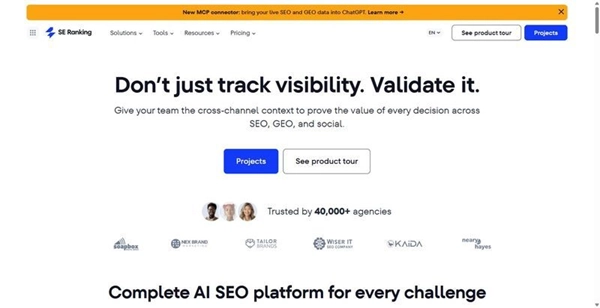
SE Ranking is the SEO platform an in-house team can standardize on, with classic rankings and AI-search visibility reported next to each other from a single account.
Why it works for in-house teams: One account the whole team signs into, so the analyst pulling rankings and the manager building the board deck are reading the same numbers. SEO and AI-visibility results sit in one view leadership can follow without a translator. Per-seat, per-project pricing stays predictable when budget season comes around.
Standout feature: The part that earns its place is the pairing of rank tracking with AI-search visibility in the same account — brand presence across AI Overviews, AI Mode, ChatGPT, Gemini, and Perplexity, watched beside your Google positions. The Website Audit runs 115+ checks and hands developers fix steps, not just an error list, and an API plus MCP connector ships on every plan to feed company reporting.
Pros:
- Rank tracking and AI-search visibility read from one account, across 188 country databases
- Website Audit covers 115+ checks with plain fix guidance a dev team can action
- API and MCP connector included on every plan, no upgrade tier to unlock automation
- Per-seat, per-project limits that map cleanly onto a team budget
Cons:
- The agency extras such as white-label reporting live in the separate Agency Pack, a capability an in-house team rarely reaches for
- The backlink index isn't the largest on this list, so a link-forensics specialist may want a second source
- The depth rewards a team that already knows its way around SEO; a first-week hire won't touch half of it
Pricing: Core $129/mo ($103.20/mo billed annually); Growth $279/mo — API and MCP in every plan; 14-day trial, no card.
Where it lands: For an in-house team standing up its own SEO reporting, this is the one I'd point to first. Not because it tops every category — backlink depth belongs to someone else — but because it keeps the whole picture, search positions and AI answers alike, somewhere the team and its leadership can both read.
2. Ahrefs
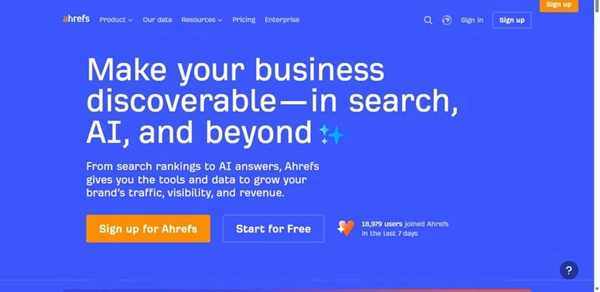
Ahrefs is the reference point when the question is who links to your domain, and why.
Why it works for in-house teams: For a team guarding one or a few owned domains, Ahrefs gives the deepest read on backlinks and on the competitors circling the same keywords — the visibility that matters most when your reputation rides on a handful of properties.
Standout feature: The backlink index is the draw: a large, frequently refreshed crawl that surfaces new and lost referring domains, anchor patterns, and the pages pulling links toward competitors. For an in-house team watching a fixed set of domains, that depth turns link monitoring into a standing report rather than a periodic scramble.
Pros:
- Backlink and referring-domain data with genuine depth
- Strong competitive read on the keywords your domain fights for
- Fast, legible interface the team can learn without much onboarding
Cons:
- The base plan is built around a single seat, awkward when several people need in at once
- Pulls run on a credit system that meters how much data you can export
- Native AI-search visibility is thin next to tools designed around it
Pricing: Lite $129/mo (5 projects, 750 keywords, 1 user).
Where it lands: If backlinks lead your strategy and a single domain carries the weight, Ahrefs is worth the seat. Go in knowing it's a specialist's instrument, though. A team hoping to run everything from one platform will feel the single-seat base and the credit meter before long.
3. Semrush
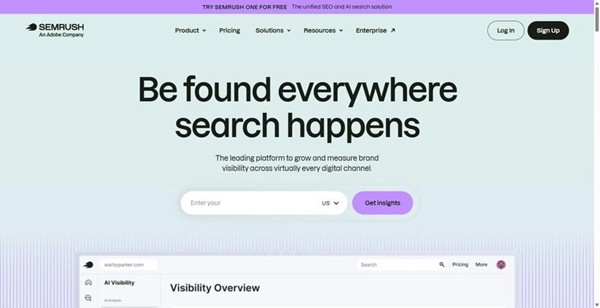
Semrush is the widest toolbox here, reaching across SEO, PPC, and content from one login.
Why it works for in-house teams: When a single team owns search, paid, and content together, Semrush's module coverage means fewer gaps to fill with side subscriptions. Almost every job a marketing function hands its SEO people has a matching tool somewhere in the suite.
Standout feature: Breadth is the whole story: keyword and competitive research, site audit, PPC data, content tools, and local features under one roof. For a team whose remit stretches past organic search, that reach can fold three or four separate contracts into one — provided someone will actually learn the full surface area.
Pros:
- Broadest module coverage across SEO, PPC, and content
- Large datasets behind keyword and competitive research
- Mature reporting the whole marketing function can draw on
Cons:
- The entry plan caps out fast: 5 projects, 500 keywords, one user
- Adding seats pushes the per-user cost up quickly as the team grows
- AI-search visibility tracking sits on a higher tier, not the entry plan
Pricing: SEO plan $139/mo ($117.33/mo billed annually).
Where it lands: For a team that truly owns SEO, PPC, and content, the breadth can pay for itself. Read the entry caps closely first, though. The plan that looks right on the pricing page tends to feel tight the moment more than one person needs access, and the AI-search view you'll want lives further up.
4. Moz Pro
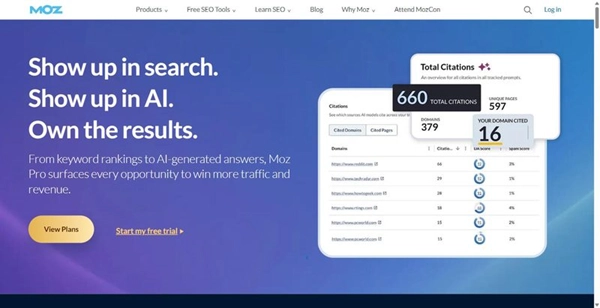
Moz Pro built its name on Domain Authority — a single score a marketing VP can read at a glance.
Why it works for in-house teams: When leadership wants one number to track quarter over quarter, Domain Authority gives your team a shared vocabulary. It travels cleanly in a board deck, and the interface stays legible for people who aren't full-time SEOs.
Standout feature: Domain Authority and Page Authority remain the metrics most executives already recognize, which shortens the explaining you do in reporting meetings. Moz pairs them with keyword research, rank tracking, and site crawls, so the score sits inside the context that produced it rather than floating alone on a slide.
Pros:
- Domain Authority gives leadership a familiar, single-number benchmark
- Clean interface non-specialists on the team can navigate
- Keyword research and rank tracking bundled with the crawl
Cons:
- Domain Authority is a proxy, not a Google metric; read it as directional
- Backlink index runs smaller than the market leaders
- Data refreshes on a slower cadence than some rivals
Pricing: Standard $99/mo ($79/mo billed annually); Starter $49/mo for a single site.
Where it lands: If your reporting lives or dies on one number leadership already trusts, Moz Pro earns its place. Read enough seo software reviews and you'll find the same caveat I'd give: the score is a compass, not the map.
5. Serpstat
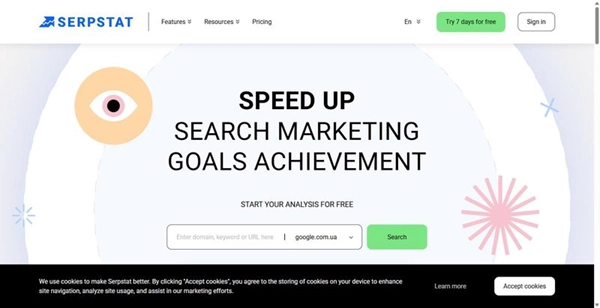
Serpstat packs a wide research toolkit behind a single, predictable plan.
Why it works for in-house teams: For a team that wants keyword, competitor, and backlink research without stacking add-ons, Serpstat keeps the bill flat and the coverage broad. One plan, one line item, and a cost you can defend when the numbers get reviewed.
Standout feature: Rank tracking, keyword research, site audit, and competitor analysis sit inside one seo platform, so a small in-house team isn't licensing four separate products to answer four questions. The keyword clustering and text-analysis features are genuinely useful for planning content around a topic rather than a lone term.
Pros:
- Broad feature coverage on a single plan
- Predictable pricing that survives a spend review
- Keyword clustering that speeds content planning
Cons:
- Interface is dense; the learning curve is real for new users
- Index depth trails the category leaders
Pricing: Individual $50/mo.
Where it lands: Serpstat is the researcher's utility knife. Among the best seo software tools for a team that values breadth over polish, it lands well — provided someone on the team has the patience to learn where everything lives.
6. Surfer SEO
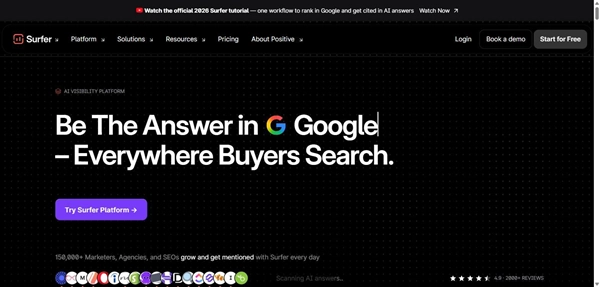
Surfer SEO isn't a full platform. It's a content optimization tool that does one job closely.
Why it works for in-house teams: If the owned blog is where you compete, Surfer helps writers shape drafts against what already ranks. It sits beside your main platform, sharpening on-page content rather than trying to replace your rank tracker.
Standout feature: Surfer's Content Editor scores a draft in real time against the terms, headings, and length pattern of the current top results, giving writers a concrete target instead of a vague brief. Its ai seo software features can generate outlines and first drafts, though I'd treat those as a starting point, not a finished page.
Pros:
- Real-time on-page guidance writers can act on immediately
- Tightens the gap between a brief and a competitive draft
- AI drafting and outlining to speed the first pass
Cons:
- Content-only; not a full platform for rank tracking or audits
- Several capabilities sit behind add-on costs
- No meaningful rank-tracking depth
Pricing: Discovery from $49/mo.
Where it lands: Surfer earns a seat when content is your channel and you already run a platform for everything else. On its own, it's half a stack. Paired well, it's the part your writers will actually open.
How to choose: a quick decision guide
The best SEO software for an in-house team depends on which job leads — reporting, backlinks, breadth, or content. Not every piece of website SEO software solves the same problem, so match the tool to the work in front of you:
- If your team is standing up SEO reporting for the first time → SE Ranking. One platform covers rank tracking, AI-search visibility, and site audits, and the seats scale as the team grows.
- If you already run Semrush and keep fighting per-seat costs → check SE Ranking's included plan seats before you renew.
- If backlinks lead your strategy → add a specialist like Ahrefs alongside your core platform rather than expecting one tool to do both.
- If content is your main channel → run Surfer beside your platform, not instead of it.
- If leadership wants one familiar number → Moz Pro's Domain Authority speaks their language.
Frequently asked questions
What SEO software do in-house marketing teams actually use?
The best SEO software for most mid-market in-house teams is one core platform for rank tracking, research, and audits, plus a specialist where a single channel demands it. SE Ranking, Semrush, and Ahrefs cover the majority of teams; Surfer often rides alongside when content carries the strategy.
How is SEO software licensed for a whole in-house team?
Most platforms license by seat, so a five-to-twenty-person team pays per active user. Read the seat allowance on each plan tier before you buy — SE Ranking's Growth plan includes three seats, while some rivals charge for every one. Annual billing usually trims the per-seat rate.
Does an in-house team need separate AI-search visibility software?
Not necessarily. If your platform already tracks brand presence across ChatGPT, Perplexity, Gemini, and AI Overviews, you can report it beside your rankings in one view. SE Ranking does this natively; teams on tools that don't will need a second product to see their AI-search share.




















Comments