>>
Industry>>
Environmental sustainability>>
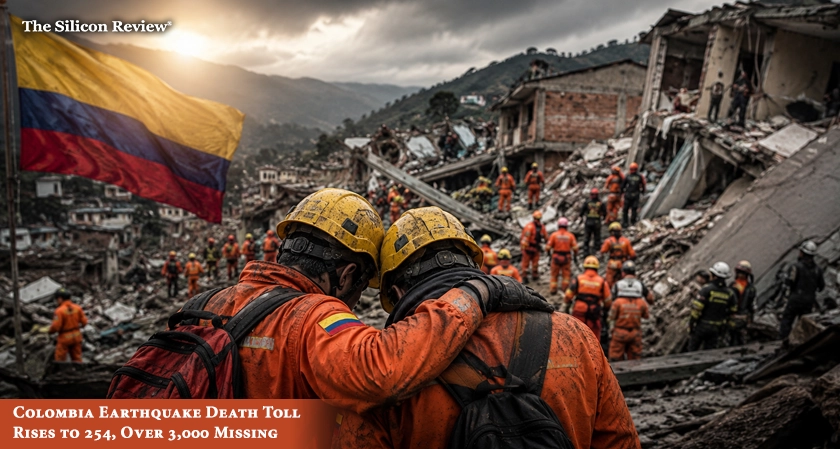
Colombia Earthquake Death Toll...Colombia Earthquake Death Toll Rises to 254 as Rescue Teams Race against Time Over 3,000 Still Missing
The Silicon Review
12 August, 2026
Author:
Vinay Kumar
The death toll from Colombia's 7.4-magnitude earthquake has risen to at least 254, with over 3,000 people still missing as rescue teams work around the clock to find survivors.
The death toll from Colombia's devastating 7.4-magnitude earthquake has climbed to at least 254, with more than 3,000 people still missing as rescue teams race against time to find survivors. The earthquake, which struck western Colombia on Monday, has been described as the strongest recorded in the country in the 21st century.
"The national government has deployed all its capabilities to protect lives, assist affected communities and deliver aid wherever it is needed," President Abelardo de la Espriella said in a national address.
"Rescuing people still trapped under debris remains our top priority."
The Scale of Destruction
Cali, one of the hardest-hit cities, reported 95 deaths, with 239 people still trapped and 949 injured. Pereira, another heavily affected city, recorded 90 fatalities. The earthquake has caused extensive damage across at least 16 departments, including Chocó, Caldas, Risaralda, Quindío and Valle del Cauca.
According to the Colombian Association of Capital Cities, 153 buildings have collapsed, with more than 1,100 houses destroyed and over 8,000 damaged. The earthquake also damaged 18 health centres, 52 schools, and 18 roads, further hampering rescue efforts.
"We are experiencing a major earthquake. There are injuries and significant damage to buildings in the capital, Quibdo," said Choco Governor Nubia Carolina Cordoba Curi.
Rescue Operations Underway
Search and rescue operations have been ongoing since the earthquake struck at 7:34 AM local time on Monday, with the epicenter located near San José del Palmar in the Chocó region. Disaster experts regard the first 72 hours after a major earthquake as the critical window for finding survivors.
In Cali, a single command post has been established to coordinate rescue operations, with specialised teams from other cities arriving to reinforce the response. Firefighters have pulled survivors from the rubble, including a woman trapped for 30 hours. However, rescue efforts are being hampered by landslides and damaged roads, particularly in the remote Chocó region.
"The rescue operation was complex and lasted about 16 hours. Rescuers had to work their way down seven or eight metres to free the woman," said firefighter Santiago Sánchez.
"We believe a further 24 people are buried under the rubble."
International Aid and Response
The United States has activated a Disaster Assistance Response Team (DART) to support Colombia's response efforts. The Trump administration has also committed $15.5 million in funding for emergency shelter, food, and protection.
"The Trump Administration and US Embassy in Colombia remain in direct contact with President Abelardo de la Espriella's Administration following the tragic earthquake," the US Department of State said.
The International Federation of Red Cross and Red Crescent Societies has activated its readiness plan for large-scale emergencies, mobilizing teams and volunteers across affected areas.
"Our teams have been working around the clock in the hardest-hit communities," said Dra. Judith Carvajal de Álvarez, National President for the Colombian Red Cross.
Challenges Ahead
The earthquake has struck the Chocó region, Colombia's poorest department, where more than two-thirds of the population live in poverty. Much of the area is covered by dense jungle and accessible only by boat or aircraft, making rescue and relief efforts particularly challenging.
"Access to some locations remains difficult due to landslides and damaged infrastructure," said Loyce Pace, IFRC Regional Director for the Americas.
"As damage assessments evolve, we know the humanitarian needs will too."
The Colombian government has declared a state of national disaster and is expected to implement an economic emergency to strengthen recovery efforts.
Here is the question this tragedy raises. The death toll from Colombia's earthquake has risen to 254, with over 3,000 still missing and rescue teams racing against time. When a nation faces a disaster of this scale, how can the international community best support the response and recovery efforts?
As Colombia's rescue operations continue, The Silicon Review asks a final question. When the strongest earthquake in a century strikes one of the country's poorest regions, what will it take to rebuild and recover?
FAQ:
Q: How many people have died in the Colombia earthquake?
A: The death toll has risen to at least 254, with over 3,000 people still missing.
Q: What cities were worst affected by the Colombia earthquake?
A: Cali, Pereira, Quibdo, and Manizales were among the worst-hit cities, with extensive damage and casualties.
Q: How many people are still missing after the Colombia earthquake?
A: More than 3,000 people are still missing, with the number expected to rise as rescue teams reach more areas.
Q: What international aid has been pledged for Colombia?
A: The US has committed $15.5 million in emergency aid and activated a Disaster Assistance Response Team to support relief efforts.
Q: How long do rescue teams have to find survivors?
A: Disaster experts regard the first 72 hours after a major earthquake as the critical window for finding survivors.




















Comments