>>
Technology>>
Cyber security>>
How Gasless USDT Transfers Are...How Gasless USDT Transfers Are Changing Stablecoin Payments
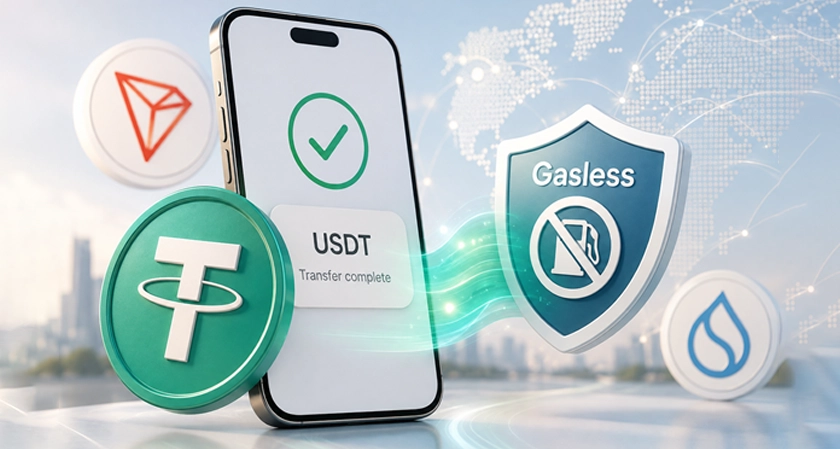
USDT has become a practical settlement asset for payments, trading and cross-border transfers. Yet a user sending USDT on many networks can still need a separate native token to pay for the transaction. Gasless transfers remove this extra requirement by moving fee handling into the infrastructure. The question now is whether this model can make stablecoin payments easier to operate at scale while keeping the economics viable for the companies providing the infrastructure.
The Hidden Friction Behind USDT Payments
USDT on TRON is widely used for transfers, yet sending USDT TRC-20 traditionally requires the sender to have TRX available for network resources. A wallet can hold enough USDT for a payment and still be unable to send it because its TRX balance is insufficient.
A common workaround is to obtain TRX before sending the USDT. A user who needs that conversion can use a swap USDT to TRX flow through ChangeNOW, for example, when a separate TRX balance is needed for network fees. The extra step shows a limitation of the conventional model: the payment asset and the fee asset are separate.
Gasless infrastructure changes the transaction flow by allowing a sponsor or relayer to cover the required network resources. The sender can authorize the USDT transfer without first funding the wallet with TRX. The blockchain still incurs a cost, while the user-facing payment process no longer depends on a second token balance.
For stablecoin payments, this removes a specific failure point. A customer with sufficient USDT can complete the transfer without first acquiring the network's native token.
What “Gasless” Actually Changes
A gasless transfer still consumes network resources. The change is who handles them. On TRON, GasFree uses a Service Provider that receives the user's transfer authorization, submits the transaction and pays the required network resources on the user's behalf. GasFree can charge activation and transfer fees in the transferred token, so gasless does not automatically mean fee-free.
Sui takes a different route. On May 20, 2026, Sui launched gasless transfers as a protocol-level feature for supported stablecoins. The network states that these transfers carry a $0.00 network fee, so users can send eligible stablecoins without holding SUI.
For payment providers, the practical questions are:
- who pays the network resources and how;
- which stablecoins and transfer types qualify;
- what fees are charged to the user;
- what happens when the provider cannot submit the transaction.
The two models therefore shift the gas problem differently. TRON moves execution into a sponsored service layer, while Sui handles supported stablecoin transfers through a protocol-level mechanism. For users, the result is similar: a supported transfer can be funded entirely with the stablecoin being sent.
Why This Matters Beyond Wallet UX
Consider a trading bot that rebalances USDT between several wallets. With conventional transactions, its treasury must track both the USDT being moved and the native token required on each network. A depleted gas balance can interrupt an otherwise funded operation.
The bot also needs rules for checking gas balances, replenishing them and deciding when transfers can proceed. This makes stablecoin infrastructure part of execution reliability, a point covered in OctoBot's analysis of stablecoin infrastructure for trading bots.
Payment processors face a similar issue when handling stablecoin transfers across many addresses. Gas abstraction can remove the need to distribute native tokens to each address for supported transactions, although the provider still funds and monitors the underlying infrastructure.
There is also a new infrastructure dependency. A sponsored transfer relies on the service that accepts the authorization and submits the transaction. The blockchain remains the settlement layer, while the service provider becomes an additional operational dependency in the payment path.
The operational value becomes clearer as transaction volume grows. A manual transfer can tolerate an extra gas-management step. An automated system repeating the same transfer across many wallets has to manage that dependency continuously.
For payment processors and automated systems, the question becomes economic: how much does fee abstraction cost when sponsored transfers become a regular part of settlement?
Gasless vs. Traditional Stablecoin Transfers
Traditional self-custody gives the user direct control over network fees. Gasless infrastructure shifts that task to a service or protocol, making the payment flow easier for supported transactions while introducing another layer of infrastructure.
Custodial platforms already hide much of this complexity. Customers see a USDT balance while the exchange or payment provider manages network fees in its operational wallets. Gasless systems bring similar abstraction to user-controlled addresses, which matters for payment products and newly created wallets.
“Gasless” also does not always mean “fee-free.” With TRON GasFree, the user avoids holding TRX, while the service can charge activation and transfer fees in the token being transferred. Sui's 2026 implementation is different: Sui states that supported stablecoin transfers carry a $0.00 network fee.
The limitation remains specific. A gasless USDT transfer does not make swaps, smart-contract calls or unsupported assets gasless. Those transactions can still require the native token.
The business model can take several forms. A provider may advance the native gas and recover its cost from the stablecoin transfer, while an application can choose to sponsor the transaction itself. Protocol-level systems take another route by changing how eligible transfers are charged at the network level.
Three Scenarios for Gasless Stablecoin Payments
Base: Selective Adoption
Gasless transfers become a common option for high-volume stablecoin payments on networks that support them. Wallets and payment providers keep conventional fee payment for other transactions. Existing TRON and Sui implementations make selective adoption the most grounded scenario.
Optimistic: Broader Fee Abstraction
Wallets and payment APIs begin hiding network fees across several chains. Merchants could accept supported stablecoins without building separate gas workflows for each network. This would require reliable infrastructure and predictable sponsorship costs.
Stress: Cost and Regulation Limit Growth
Higher sponsorship costs, transaction abuse or additional compliance requirements could lead providers to introduce limits or service fees. Network congestion would add pressure by increasing the cost of sponsored execution.
The base case appears most plausible given the existing implementations. Broader adoption will depend on whether providers can support larger payment volumes without making sponsorship too expensive or operationally complex.
Where Gasless Can Gain Ground
Consumer payments. A newly created wallet can receive USDT and use it for supported transfers without first obtaining TRX or SUI. This fits embedded wallets and payment apps where users interact with a dollar-denominated balance rather than with the underlying network.
Wallet infrastructure is already adopting this model. Tether's Wallet Development Kit now includes a TRON GasFree wallet module for gas-free TRC20 transfers, showing how fee abstraction is moving into wallet development rather than staying a standalone network feature.
Cross-border settlement. For international payouts, a recipient can receive the stablecoin directly on-chain rather than waiting for a correspondent banking transfer. Removing the separate gas-token requirement makes this flow easier to standardize across recipient wallets, particularly for automated payouts.
Micropayments and recurring transfers. Gas management becomes harder to justify when payments are frequent and individually small. A sponsored model can make transaction execution more predictable for applications sending many stablecoin payments, provided the economics work at the required volume.
The clearest near-term use cases are embedded payments, automated settlement and newly created wallets. These are the cases where users care about receiving and spending stablecoins, while the mechanics of the underlying network add little value to the payment itself.
Regulation Could Shape Gasless Adoption
The regulatory backdrop for stablecoin payments has changed materially. In the US, the GENIUS Act became law on July 18, 2025, establishing a federal framework for payment stablecoins and requirements for permitted issuers, including Bank Secrecy Act and anti-money-laundering obligations.
In Europe, MiCA provides the main framework for crypto-assets and related services. The European Commission opened a targeted consultation on its review of MiCA on May 20, 2026, with the consultation running through September 30.
For gasless payment providers, the relevant regulatory questions arise from the services they perform around the stablecoin transaction. A company providing software, processing payments or controlling customer assets can face different obligations depending on its business model and jurisdiction.
The economics depend on more than the underlying network fee. Providers also have to cover relaying infrastructure, transaction monitoring and failed submissions. A sponsored model becomes harder to sustain when execution costs rise or transaction volume becomes difficult to predict.
Gasless adoption therefore depends on sustainable transaction economics, while regulatory obligations will depend on the role played by the company providing the payment or wallet infrastructure.
When Gas Becomes Infrastructure
A USDT payment can increasingly move through the blockchain without making the network token part of the user's task. TRON's sponsored model and Sui's protocol-level approach show two ways to move fee handling deeper into the infrastructure layer.
For payment platforms, the change is practical. The customer deals with USDT while transaction resources are handled elsewhere. Native tokens still operate the underlying networks, while routine stablecoin payments can increasingly hide that infrastructure from the user.
FAQ
What is a gasless USDT transfer?
It is a USDT transaction where the sender does not need the network's native token to cover the required transaction resources. The cost is handled through a sponsor, relayer or protocol mechanism.
Does gasless mean the transaction has no cost?
No. Gasless means the user does not need to supply the network's native token. A provider may charge a fee in the transferred stablecoin, while some protocol-level implementations can offer supported transfers with a $0 network fee.
Can USDT TRC-20 be sent without TRX?
Yes, through supported gasless implementations such as GasFree. A standard TRC-20 transfer still follows TRON's conventional resource and fee model.
Is gasless USDT available on every blockchain?
No. Gasless support depends on the blockchain, token and transfer mechanism. TRON GasFree supports eligible TRC20 transfers, while Sui's implementation applies to supported stablecoin transfers.
Will gasless transfers replace native-token payments?
They are unlikely to cover every type of blockchain transaction. Routine stablecoin payments are a natural use case, while swaps and smart-contract interactions can still require conventional gas.
Disclaimer
This article is provided for informational purposes only and does not constitute financial, investment, legal or tax advice. Cryptocurrency transactions involve risks, and gasless payment features, fees and availability can vary by network, provider and jurisdiction. Readers should verify current terms and regulatory requirements before making financial decisions.




















Comments