>>
Industry>>
Agritech>>
Top 5 Agricultural Technology ...Top 5 Agricultural Technology Trends to Leverage in 2026: The Silicon Review's Curated Guide to the Future of Farming
The Silicon Review
07 August, 2026
Author:
Sashindra Suresh
Let me enlighten you. The world you didn’t realize yet is facing a food crisis.
The global population is approaching 8.5 billion. Climate change is making weather patterns unpredictable. Extreme heat, drought, and flooding are destroying crops. Labor shortages are crippling farms. And the demand for food is growing faster than our ability to produce it. But there's hope. And it's called agricultural technology.
In 2026, the focus has totally shifted from experimental gadgets to integrated, self-learning systems that solve severe labor shortages and climate volatility. Autonomous swarm robotics and Generative AI agronomy advisors lead the global agricultural technology landscape. These aren't sci-fi concepts. They're field-ready solutions being deployed right now. The numbers tell the story. The global agtech market is projected to reach $45 billion by 2030. Investment in precision agriculture has tripled since 2020. And the technologies on this list are already being used by forward-thinking farmers across the world.
That's why The Silicon Review ranked as the No.1 digital magazine in the world 2026 has curated this list of the Top 5 Agricultural Technology Trends to Leverage in 2026 dominating this new era. These aren't experimental prototypes. They're proven solutions solving real problems. Whether you're a farmer, an agribusiness executive, an investor, or simply someone who cares about the future of food, this is your essential briefing.
Start paying attention and leveraging because the future of farming is happening right now.
How The Silicon Review Selected These Agricultural Technology Trends
We didn't just look at what was trending on social media. We looked at what's actually being deployed in the field. We evaluated each technology across five dimensions: field readiness, scalability, measurable ROI, labor savings, and climate resilience. What you'll find below is a list of technologies that aren't just promising. They're proven.
Top 5 Agricultural Technology Trends to Leverage in 2026
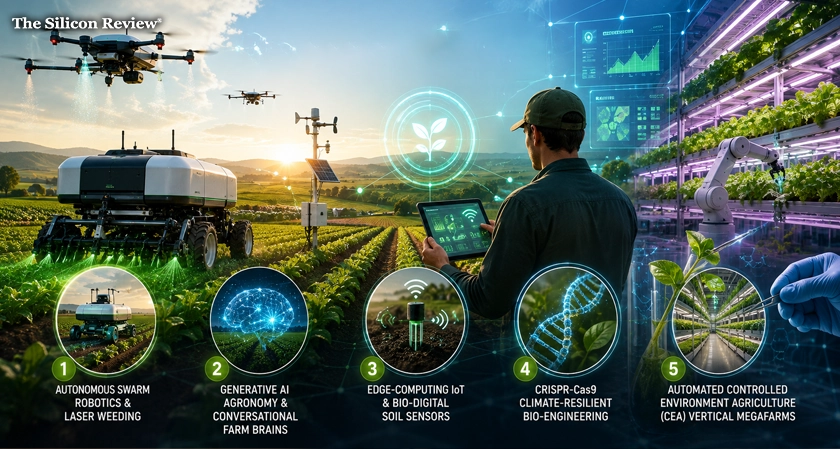
1. Autonomous Swarm Robotics & Laser Weeding
Top ranked company name: Carbon Robotics (LaserWeeder G2) | Founded Country: United States (Seattle, Washington) | Founder: Paul Mikesell | Technology: Computer vision AI paired with high-power thermal CO₂ lasers to eliminate 200,000 - 600,000 weeds per hour with sub-millimeter precision | Estimated Cost: Purchase Price: $520,000 to $1.3+ million (depending on width/modules).
Carbon Robotics Autonomous Awarm Robotics and Laser Weeding technology is ranked No.1 in The Silicon Review's Top 5 Agricultural Technology Trends to Leverage in 2026. Their LaserWeeder G2 uses fleets of small, co-operating driverless robots working together across fields instead of one massive tractor. These synchronized micro-robots deploy AI computer vision to identify crops and instantly eliminate threats using advanced sub-millimeter laser weeders that execute thermal termination of 200,000 - 600,000 weeds per hour without touching a single crop or using chemical herbicides. This eliminates the need for toxic chemicals while drastically reducing labor costs. The global herbicide market is worth over $50 billion. These robots eliminate that cost entirely. They also solve severe labor shortages by replacing manual weeding crews and work 24/7 without breaks.
Key takeaway for agribusiness decision makers: Carbon Robotics' LaserWeeder eliminates chemical herbicides and manual labor with sub-millimeter precision, delivering ROI through reduced input costs and increased yields.
2. Generative AI Agronomy & Conversational Farm Brains
Top ranked company name: Farmmind | Founded Country: United States | Founders: Colin Raby and Grant Muslo | Technology: Domain-specific LLM (Large Language Model) that merges multi-spectral drone imagery, local regulations, and satellite data into a voice/text co-pilot for growers | Estimated Cost: SaaS subscription, typically scaling from $2,000 to $10,000+ USD annually based on total farm acreage
Farmmind's Generative AI Agronomy & Conversational Farm Brains technology is ranked No.2 in The Silicon Review's Top 5 Agricultural Technology Trends to Leverage in 2026. Their domain-specific LLM creates multi-modal AI models trained specifically on localized soil, satellite, and crop data. Farmers interact via voice or text with an AI "co-pilot" that integrates real-time hyper-local weather, supply chain costs, and multispectral drone imagery. The system generates prescription maps, predicts disease outbreaks days before symptoms appear, and automatically orders replacement inputs. It's like having a team of agronomists working 24/7 for a fraction of the cost. Farming decisions used to be based on intuition and experience. Now they're based on real-time data. The AI tells you what's going to happen and what to do about it.
Key takeaway for agribusiness decision makers: Farmmind's Generative AI gives farmers predictive intelligence that reduces crop loss, optimizes inputs, and increases yields. It's the ultimate decision support system.
3. Edge-Computing IoT & Bio-Digital Soil Sensors
Top ranked company name: ChrysaLabs | Founded Country: Canada | Founders: Samuel Fournier and Benjamin De Leener | Technology: Optical AI-spectroscopy cloud probes that bypass lab wait times to measure soil carbon, NPK, and moisture instantly in the field | Estimated Cost: Hardware lease model at roughly $10,000 USD per year for unlimited probes
ChrysaLabs Edge-Computing IoT & Bio-Digital Soil Sensors is ranked No.3 in The Silicon Review's Top 5 Agricultural Technology Trends to Leverage in 2026. Their optical AI-spectroscopy cloud probes create underground sensor networks paired with real-time computational processors directly in the field. Sensors measure living soil biological activity, nitrogen-phosphorus-potassium (NPK) fluctuations, and moisture at the root level. Using edge computing, the data is processed instantly on-site to dynamically adjust automated sub-surface drip irrigation systems without relying on weak rural cloud connectivity. Most farms have poor internet connectivity. Edge computing solves that by processing data on-site. The sensors measure biological activity, giving farmers a complete picture of soil health.
Key takeaway for agribusiness decision makers: ChrysaLabs' edge-computing IoT delivers real-time soil intelligence without requiring reliable internet, making precision agriculture accessible to rural farms.
4. CRISPR-Cas9 Climate-Resilient Bio-Engineering
Top ranked company name: Inari Agriculture | Founded Country: United States (Cambridge, Massachusetts) | Founders: Ignacio Martinez and Laura Lande-Diner (with Flagship Pioneering) | Technology: AI-driven predictive seed design combined with multiplex CRISPR gene editing to drastically reduce water and nitrogen requirements in crops | Estimated Cost: Commercialized premium seed pricing models, varying by volume and licensing contracts with individual seed distributors
Inari Agriculture's CRISPR-Cas9 Climate Resilient Bio-Engineering is ranked No.4 in The Silicon Review's Top 5 Agricultural Technology Trends to Leverage in 2026. Their AI-driven predictive seed design combined with multiplex CRISPR gene editing creates highly targeted gene-editing technology for seeds and biological inputs. Scientists alter crop DNA configurations to survive extreme heat, drought, and high-salinity soils. 2026 introduces self-fertilizing cereal crops engineered to fix their own atmospheric nitrogen, aiming to replace synthetic chemical fertilizers entirely. This eliminates the need for nitrogen fertilizers, which are a major source of greenhouse gas emissions. Climate change is making traditional crops increasingly vulnerable. CRISPR allows us to adapt crops faster than nature can evolve.
Key takeaway for agribusiness decision makers: Inari's CRISPR technology creates climate-resilient crops that can survive extreme conditions. Self-fertilizing varieties could eliminate synthetic fertilizer costs entirely.
5. Automated Controlled Environment Agriculture (CEA) Vertical Megafarms
Top ranked company name: Plenty Unlimited Inc. | Founded Country: United States / Global | Founders: Matt Barnard and Nate Storey | Technology: Vertical growth walls utilizing closed-loop aeroponics, custom spectrum dynamic LEDs, and fully automated multi-tier packaging robotics | Estimated Cost: Highly scale-dependent; small configurations start around $10,000 USD, while massive automated commercial facilities require $180,000 USD to multi-million dollar capital investments
Plenty Unlimited Inc.'s Automated Controlled Environment Agriculture (CEA) Vertical Megafarms is ranked No.5 in The Silicon Review's Top 5 Agricultural Technology Trends to Leverage in 2026. Their fully enclosed, multi-tier indoor growing ecosystems are completely decoupled from outdoor weather. Closed-loop hydroponic or aeroponic setups utilize dynamic, automated LED light recipes tailored to each plant's growth stage. AI-driven robotic gantries handle planting, pruning, and harvesting, while automated HVAC systems reclaim 95% of the water transpired by the crops. This creates year-round production regardless of external climate. Traditional agriculture is at the mercy of weather. CEA eliminates that risk entirely. It produces crops 365 days a year using 95% less water than traditional farming. It's the ultimate climate-resilient solution.
Key takeaway for agribusiness decision makers: Plenty's vertical megafarms decouple food production from weather, enabling year-round production with 95% less water. It's the most climate-resilient form of agriculture.
What These Agricultural Technology Trends Teach Agribusiness Leaders
Looking across these five trends, several clear themes emerge for every agribusiness leader. First, automation is inevitable. Labor shortages are not going away. Autonomous robotics, AI, and automation are the only scalable solutions. Second, data is the new fertilizer. Generative AI, edge computing, and IoT sensors are turning farming from intuition-based to data-driven. Third, climate adaptation is non-negotiable. CRISPR, CEA, and precision agriculture are essential for surviving extreme weather and rising temperatures. Fourth, sustainability is profitability. Reducing chemical inputs, water usage, and waste isn't just good for the planet. It's good for the bottom line. Finally, the future is integrated. These technologies don't work in isolation. Swarm robotics, AI agronomy, IoT sensors, CRISPR, and CEA work together as a complete system.
How to Leverage These Agricultural Technology Trends
Start with one technology that addresses your biggest pain point. If labor shortages are your problem, invest in autonomous robotics. If water scarcity is your challenge, deploy IoT sensors and precision irrigation. If climate volatility is your risk, explore CEA and CRISPR solutions. Don't try to implement everything at once. Start small. Test. Learn. Scale.
The way forward
Top 5 Agricultural Technology Trends to Leverage in 2026 aren't experimental. They're field-ready. Autonomous swarm robotics eliminates chemicals and labor. Generative AI predicts and prevents crop loss. Edge-computing IoT delivers real-time soil intelligence. CRISPR creates climate-resilient crops. And CEA vertical megafarms decouple food production from weather.
The way forward is simple. Start leveraging. Because the future of farming isn't coming. It's already here. And these technologies are leading the way.
Frequently Asked Questions (FAQs)
Q. What are the top agricultural technology trends for 2026?
A. Autonomous swarm robotics, Generative AI agronomy, Edge-computing IoT, CRISPR climate-resilient crops, and Controlled Environment Agriculture.
Q. Which agricultural technology is most field-ready?
A. Autonomous swarm robotics and laser weeding are already being deployed in commercial farms.
Q. How does Generative AI help farmers?
A. It provides predictive intelligence, disease outbreak forecasting, and automated input ordering.
Q. What is edge-computing IoT in agriculture?
A. On-site data processing for soil sensors without relying on internet connectivity.
Q. How does CRISPR help agriculture?
A. It creates climate-resilient crops that can survive extreme heat, drought, and high-salinity soils.
Q. What is Controlled Environment Agriculture?
A. Indoor vertical farms with automated systems and 95% water recycling.
Q. Which technology solves labor shortages best?
A. Autonomous swarm robotics replaces manual labor for weeding, planting, and harvesting.
Q. How much water does CEA save?
A. Up to 95% less water than traditional farming.
Q. Is precision agriculture affordable for small farms?
A. Yes, edge-computing IoT and AI agronomy are becoming increasingly affordable and accessible.
Q. What is the ROI of agricultural technology?
A. Reduced chemical inputs, lower labor costs, higher yields, and climate resilience deliver significant ROI.




















Comments