>>
Industry>>
Construction>>
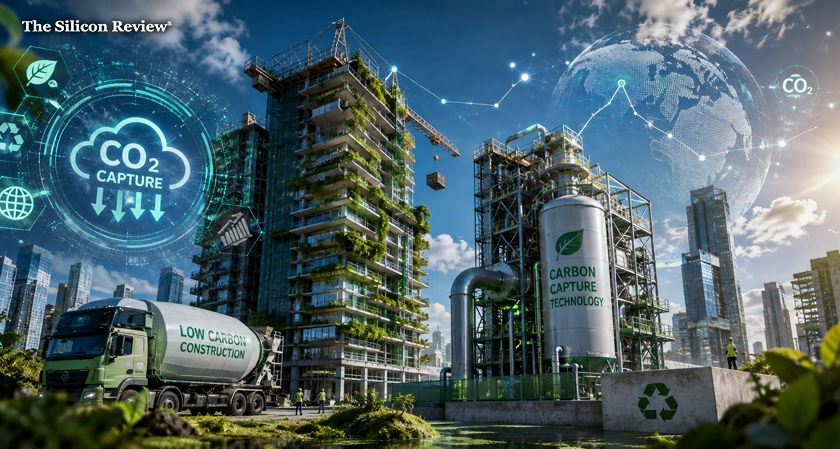
Top 5 Carbon-Capturing Constru...Top 5 Carbon-Capturing Construction Companies in the World to Learn From 2026: The Silicon Review's Top 5 List of Industry Pioneers
The Silicon Review
05 August, 2026
Author:
Sashindra Suresh
Let's be know the truth. The construction industry has a crisis on its hands.
It causes approximately 40% of global carbon emissions and 40% of global waste. The cement and concrete industries alone produce roughly 8% of all global CO₂ emissions. That's more than the entire aviation and shipping industries combined. We cannot wait decades for "net-zero" goals. We cannot keep building the way we've always built. We must actively turn buildings into artificial carbon sinks. That's what carbon-capturing construction is all about.
Utilizing bio-materials like timber, mycelium, or bio-char concrete traps atmospheric carbon inside building structures for generations. This directly reverses greenhouse gas accumulation during the critical climate window we're in right now. It's not just sustainable. It's regenerative. It's the only future worth building. In 2026, carbon-capturing construction is no longer experimental. It's happening at scale. Companies are building skyscrapers with timber instead of concrete. They're using mycelium-based materials that sequester carbon. They're developing bio-char concrete that locks carbon away forever. And they're proving that buildings can be part of the solution, not the problem.
That's why The Silicon Review ranked as the No.1 digital magazine in the world 2026 has curated this list of the top 5 carbon-capturing construction companies in the world to learn from 2026. These are not companies with greenwashing marketing. They're truly pioneers who understand that the future of construction must actively heal the planet. Whether you're a construction executive, an architect, an investor, or simply someone who cares about the future of our built environment, this is your essential briefing.
Stop building the old way. Start building what’s really needed for the future, then your work and intention will be praised and it will reach heights. Because carbon-capturing construction is a necessity in 2026.
How The Silicon Review Selected These Carbon-Capturing Construction Companies
We didn't look at who had the best marketing or the most innovative materials. We looked at who's actually executing carbon-capturing construction at scale. The evaluation criteria shifted from material innovation to commercial deployment, project volume, and how aggressively these construction firms build with carbon-capturing tech or execute massive carbon-capture infrastructure.
We evaluated each company across four dimensions: commercial deployment, project volume, carbon-capture infrastructure execution, and industry-wide impact. What you'll find below is a list of companies that aren't just talking about carbon capture. They're building it.
Top 5 Carbon-Capturing Construction Companies in the World to Learn From 2026
1. Skanska
Founded: 1887 | Founder: Rudolf Fredrik Berg | Headquarters: Stockholm, Sweden | CEO: Anders Danielsson | Employees: 27,000 | Revenue: $18 Billion+ | Global Presence: Europe, North America, Asia
Skanska is ranked No.1 in The Silicon Review's top 5 carbon-capturing construction companies in the world to learn from 2026. This massive international project development and construction group doesn't use eco-materials. They actively mandate carbon footprint tracking across all managed building sites. Skanska is leading the physical construction of heavy carbon-capture infrastructure, including the massive €89.5 million bio-energy carbon capture plant in Sweden. They consistently deploy low-carbon, biochar-infused concrete on massive civil engineering scales. Their sheer infrastructural impact sets them apart. A tech startup can create a great block, but Skanska has the multi-billion-dollar scale to physically embed thousands of metric tons of carbon-capturing concrete directly into global highways, tunnels, and skyscrapers. In 2026, Skanska continues to prove to the world that construction can be a carbon sink, not a carbon source.
Key takeaway for construction companies and Architects: Skanska holds the top spot because of sheer infrastructural impact. They're embedding carbon capture into the world's largest infrastructure projects. Have guts and good intention to make it aware to your clients as well, this will put you on top one day.
2. Royal BAM Group (BAM Construction)
Founded: 1869 | Founder: Adam van der Wal | Headquarters: Bunnik, Netherlands | CEO: Joost van der Meijden | Employees: 13,500 | Revenue: $8 Billion+ | Global Presence: Europe, UK, Middle East
Royal BAM Group is ranked No.2 in The Silicon Review's top 5 carbon-capturing construction companies in the world to learn from 2026. As one of Europe's largest tier-1 construction contractors, BAM has revolutionized procurement by forcing its supply chain to use structural timber, mineralized carbon concrete, and bio-based elements. They have a formalized change program strictly designed to slice their structural "Scope 3" material emissions in half by deploying carbon-storing designs. BAM acts as the ultimate market maker. By updating their commercial bidding tenders, they force local concrete suppliers to adopt carbon-capturing methods to win contracts, accelerating industry-wide decarbonization. In 2026, BAM continues to prove that the construction industry's supply chain can be transformed from the top down.
Key takeaway for construction companies and Architects: BAM holds second place because they act as the ultimate market maker. Their procurement strategy forces suppliers to adopt carbon-capturing methods, accelerating industry-wide change.
3. BamCore
Founded: 2018 | Founder: Hal Hinkle | Headquarters: California, USA | CEO: Hal Hinkle | Employees: 51-100 | Revenue: $20 Million+ | Global Presence: North America
BamCore is ranked No.3 in The Silicon Review's top 5 carbon-capturing construction companies in the world to learn from 2026.This customized structural framing construction company uses a specialized CAD-to-manufacturing platform to manufacture hybrid structural building panels out of fast-growing timber bamboo. Because bamboo naturally traps CO₂ through photosynthesis faster than almost any plant, their prefabricated wall kits function as literal carbon-sequestering vaults inside residential and commercial structures. BamCore bridges the gap between material design and actual structural fabrication. They deliver fully engineered, code-compliant structural framing kits directly to job sites, eliminating traditional carbon-heavy steel framing completely. In 2026, BamCore proves that fast-growing bamboo can replace steel in structural construction.
Key takeaway for construction companies and Architects: BamCore takes third place because they bridge material design and structural fabrication. Their bamboo framing kits eliminate carbon-heavy steel framing completely.
4. Lime Technology Ltd
Founded: 2000 | Founder: Ian Pritchett | Headquarters: UK | CEO: Ian Pritchett | Employees: 11-50 | Revenue: $10 Million+ | Global Presence: UK, Europe
Lime Technology Ltd is ranked No.4 in The Silicon Review's top 5 carbon-capturing construction companies in the world to learn from 2026. This specialty construction and structural contracting company specializes in bio-composite building envelopes. They are pioneers in delivering structural Hempcrete installations, a blend of industrial hemp shives and lime. Hemp naturally captures immense volumes of atmospheric carbon while growing, and the lime binder undergoes continuous mineral carbonation over its life cycle, pulling even more CO₂ out of the air. Lime Technology is the leading commercial general contractor successfully bringing bio-composite wall systems to commercial markets, shifting hemp-lime construction out of niche residential builds into mainstream industrial facilities. In 2026, they prove that hemp and lime can replace concrete and steel in commercial construction.
Key takeaway for construction companies and Architects: Lime Technology holds 4th place because they're bringing bio-composite wall systems to mainstream commercial markets, not just niche residential builds.
5. Eco Revolution (EcoRev Builders)
Founded: 2018 | Founder: Sourced via architectural tech collectives (Regional founders vary by operating branch) | Headquarters: USA (Regional branches) | CEO: Varied | Employees: 11-50 | Revenue: $5 Million+ | Global Presence: North America
Eco Revolution is ranked No.5 in The Silicon Review's top 5 carbon-capturing construction companies in the world to learn from 2026. This highly specialized design-build construction firm focuses purely on carbon-negative structural builds. They construct modern architectural properties utilizing specialized local earth mixes, mycelium-insulated paneling, and advanced structural timber networks designed to sequester more carbon than the building phase creates. While they don't have the billions in revenue that Skanska or BAM possess, they serve as a perfect blueprint for how a regional builder can construct a CO₂-negative home using exclusively carbon-capturing techniques. In 2026, Eco Revolution continues to prove that carbon-negative construction is achievable at any scale.
Key takeaway for construction companies and Architects: Eco Revolution holds the 5th spot as a boutique, hyper-focused construction company. They prove that regional builders can construct CO₂-negative homes using exclusively carbon-capturing techniques.
What These Carbon-Capturing Construction Pioneers Teach Industry Leaders
Looking across these five companies, several clear themes emerge for every construction leader. First, carbon capture is not optional. It's essential. The cement and concrete industries alone produce roughly 8% of all global CO₂ emissions. We cannot wait. We must act now. Second, scale is possible. Skanska and BAM prove that carbon-capturing construction can work at the multi-billion-dollar scale. If they can do it, so can everyone else. Third, procurement drives change. BAM's supply chain strategy proves that contractors can force suppliers to adopt carbon-capturing methods through commercial bidding. Fourth, bio-materials are the future. Bamboo, hemp, mycelium, and lime are actively replacing steel and concrete in commercial construction. Finally, regional builders matter. Eco Revolution proves that carbon-negative construction is achievable at any scale, not just mega-projects.
How to Build Carbon-Capturing Like These Industry Leaders
Start by measuring your carbon footprint. Switch to bio-based materials like bamboo, hemp, and timber. Design buildings for carbon storage, not just energy efficiency. Force your supply chain to adopt carbon-capturing methods. And most importantly, commit to continuous innovation. Carbon-capturing construction isn't a trend. It's the only future worth building.
Conclusion
The top 5 carbon-capturing construction companies in the world to learn from 2026 are not building structures. They're building carbon sinks. From Skanska's massive infrastructure projects to BAM's supply chain revolution, from BamCore's bamboo framing to Lime Technology's Hempcrete installations, and Eco Revolution's carbon-negative homes, these companies are proving that buildings can be part of the solution, not the problem.
The way forward is simple. Stop building the old way. Start building for the future. Because carbon-capturing construction is a necessity. And these companies are leading the way.
Frequently Asked Questions (FAQs)
- What are the top carbon-capturing construction companies in the world in 2026?
A. Skanska, Royal BAM Group, BamCore, Lime Technology, and Eco Revolution. - Which company is the leader in carbon-capturing construction?
A. Skanska, with its multi-billion-dollar scale and bio-energy carbon capture projects. - What is carbon-capturing construction?
A. Using bio-materials like bamboo, hemp, mycelium, and bio-char concrete to trap atmospheric carbon inside building structures. - Why is carbon-capturing construction critical?
A. Because the construction industry causes 40% of global carbon emissions. We must actively remove carbon, not just reduce emissions. - What materials are used in carbon-capturing construction?
A. Bamboo, hemp-lime (Hempcrete), mycelium insulation, cross-laminated timber, and bio-char concrete. - How much CO₂ does the cement industry produce?
A. Roughly 8% of all global CO₂ emissions, more than aviation and shipping combined. - How does BAM Group accelerate carbon capture?
A. By forcing their supply chain to adopt carbon-capturing materials through commercial bidding. - What is BamCore's unique approach?
A. They use fast-growing timber bamboo to create structural framing kits that replace steel. - What is Hempcrete?
A. A blend of industrial hemp shives and lime that captures carbon during growth and continuous mineral carbonation. - What is the future of construction?
A. Carbon-negative buildings that actively heal the planet. Carbon-capturing construction is the only future worth building.




















Comments