>>
Industry>>
Healthcare>>
Top 5 Medical Innovations to W...Top 5 Medical Innovations to Watch in 2026: The Silicon Review's Guide to the Real, Not Hype, Healthcare Breakthroughs
The Silicon Review
24 August, 2026
Author:
Vinay Kumar
Let's be honest. When most people think of medical innovation, they imagine flashy surgical robots or massive MRI machines. But in 2026, the most transformative technologies work quietly at the molecular, cellular, and sensory levels. They're not loud. They're not flashy. They're invisible. These innovations are shifting medicine from reactive treatment to invisible prevention. Liquid biopsies detect cancer months before any tumor appears on a scan. Programmable cell therapies reset the immune system to cure autoimmune diseases. Wearable patches replace bulky hospital equipment with continuous, real-time monitoring.
The numbers tell the story. The World Economic Forum's Top 10 Emerging Technologies of 2026 report highlights that innovation is shifting from software-first AI toward technologies that act directly on physical and biological systems. Genentech's CEO has stated that "the most profound near-term impact of AI will be drug discovery." And industry analyst’s project that the top drug launches of 2026 could collectively generate tens of billions in annual revenue by the early 2030s.
That's why The Silicon Review ranked the world's No.1 digital magazine of the year 2026 has curated this list of the Top 5 Medical Innovations to Watch in 2026. These aren't incremental improvements. They're paradigm shifts happening beneath the surface. Whether you're a healthcare executive, a clinician, an investor, or simply someone who believes the future of medicine should be invisible and proactive, this is your essential briefing.
Top 5 Medical Innovations to Watch in 2026
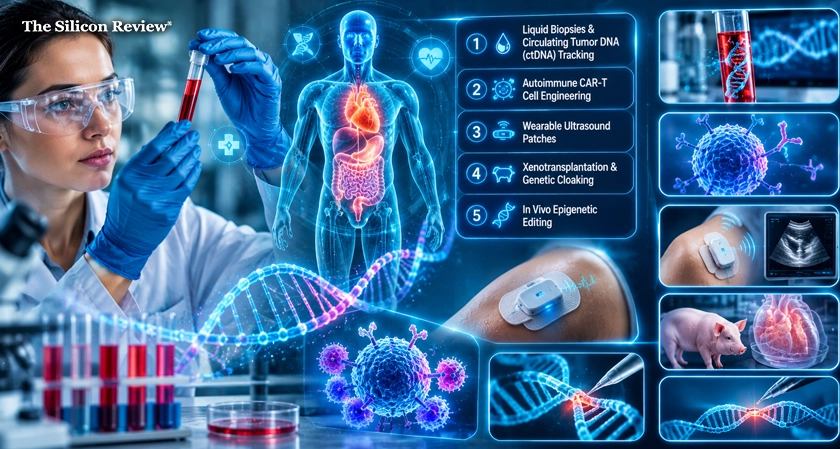
1. Liquid Biopsies & Circulating Tumor DNA (ctDNA) Tracking
- The Tech: A simple blood draw that isolates circulating tumor DNA (ctDNA) shed by microscopic cancer clusters.
- The Sophistication: It flags cancer recurrence or residual disease months before any physical tumor is visible on an MRI or CT scan. This represents a shift from reactive detection to proactive surveillance.
- The Impact: Eradicates the need for invasive tissue biopsies and enables ultra-early intervention when cancer is most curable. As the World Economic Forum's 2026 report notes, these technologies are "becoming more personal, designed around one patient or one context rather than a standardized whole."
- Why it’s Breakthrough: A simple blood draw replaces invasive procedures. Early detection when cancer is most treatable. Continuous monitoring for recurrence, not just one-time snapshots.
- Key takeaway for healthcare leaders: Liquid biopsies are the first line of defense in the war on cancer. They transform oncology from treatment to prevention.
2. Autoimmune CAR-T Cell Engineering
- The Tech: Modifying a patient's own T-cells to specifically hunt and destroy malfunctioning B-cells rather than traditional cancer targets.
- The Sophistication: It acts as a hard reset button for the immune system. Recent clinical trials show drug-free, long-term remission for severe, chronic autoimmune conditions like Lupus.
- The Impact: This represents a fundamental shift from managing symptoms to curing the underlying immune dysfunction. What was once a lifetime of immunosuppressive drugs could become a single course of therapy.
- Why it’s Breakthrough: Drug-free remission from autoimmune diseases. One-time therapy instead of lifelong treatment. Potential to cure conditions previously considered chronic and incurable.
- Key takeaway for healthcare leaders: CAR-T is no longer just for cancer. It's the blueprint for curing autoimmune diseases at their source.
3. Wearable Ultrasound Patches
- The Tech: Flexible, adhesive patches slightly thicker than a standard Band-Aid applied directly to the skin. These devices connect to apps, dashboards, and electronic health records from day one.
- The Sophistication: Moves ultrasound from a single, static hospital snapshot to continuous, real-time imaging. The Felix NeuroAI wristband is a precursor already FDA-cleared for reading motion and peripheral nerve signals.
- The Impact: Wirelessly tracks deep-tissue metrics, fluctuating cardiac function, and blood flow volume during a patient's normal daily routine. This is where medtech is heading in 2026: connected diagnostics and remote monitoring devices becoming standard features of chronic care.
- Why it’s Breakthrough: Continuous monitoring replaces one-time snapshots. Hospital-grade imaging available anywhere. Real-time data enables proactive intervention.
- Key takeaway for healthcare leaders: Wearable patches are democratizing diagnostic imaging. Continuous data will replace episodic snapshots in chronic disease management.
4. Xenotransplantation & Genetic Cloaking
- The Tech: Using CRISPR to make dozens of precise genetic edits to animal organs, removing foreign sugars and inserting human genes.
- The Sophistication: The edited organ effectively wears a molecular "cloak" that tricks the human immune system into accepting it as native tissue.
- The Impact: Solves the global organ donor shortage by making cross-species kidney and heart transplants viable without immediate rejection. As noted in 2026 industry analysis, gene editing is "entering the clinic with profound impact" across transplantation and genetic diseases.
- Why it’s Breakthrough: Solves the organ shortage crisis. Viable alternative to waiting years for a donor. Potential to save thousands of lives annually.
- Key takeaway for healthcare leaders: Xenotransplantation is the most viable solution to the organ crisis. Genetic cloaking makes it immunologically possible.
5. In Vivo Epigenetic Editing
- The Tech: Overwriting the biochemical tags on DNA to turn specific disease-causing genes on or off without actually cutting the genetic strand. Unlike standard CRISPR which breaks the DNA backbone, this alters gene expression gently and seamlessly.
- The Sophistication: Near-zero risk of accidental mutations because it doesn't cut DNA.
- The Impact: Silences chronic conditions like hereditary high cholesterol or permanent pain signaling at the source, without permanently altering the underlying genome. This is "a shift from one-time, high-risk editing to programmable, repeatable gene modulation."
- Why it’s Breakthrough: No cutting of DNA means lower risk. Conditions previously considered genetic destiny become modifiable. Potential to turn chronic disease genes "off" without permanent alteration.
- Key takeaway for healthcare leaders: Epigenetic editing will redefine how we treat chronic genetic conditions. It's the future of precision medicine.
What These Medical Innovations Teach Healthcare Leaders
First, the future is invisible. The most powerful medical technologies don't announce themselves. They work quietly at the molecular and cellular levels. Second, prevention is the ultimate goal. Liquid biopsies detect cancer before it spreads. Epigenetic editing silences disease genes before they cause harm. The future of medicine is not treatment it's preemption. Third, continuous beats episodic. Wearable patches and remote monitoring replace one-time snapshots with continuous data streams. This shifts medicine from reactive to proactive. Fourth, therapies are becoming personalized. mRNA cancer vaccines and CAR-T therapies are designed for individual patients. As WEF notes, technologies are "becoming more personal, designed around one patient or one context rather than a standardized whole.” Fifth, the convergence of AI and biology is accelerating. AI is moving from pilot projects into everyday clinical workflows, powering image enhancement, early-warning systems, device optimization, and real-time surgical support.
Conclusion
The top medical innovations of 2026 aren't loud. They're invisible. Liquid biopsies detect cancer before symptoms. CAR-T cells cure autoimmune disease. Wearable patches monitor continuously. Xenotransplantation solves organ shortages. Epigenetic editing silences chronic disease genes. The way forward is simple. Stop looking for flashy solutions. Start investing in invisible ones. Because the future of medicine isn't in expensive machines. It's in the quiet revolution happening at the molecular level.
Frequently Asked Questions (FAQs)
- What are the top medical innovations to watch in 2026?
A. Liquid biopsies, autoimmune CAR-T cell engineering, wearable ultrasound patches, xenotransplantation with genetic cloaking, and in vivo epigenetic editing. - What is a liquid biopsy?
A. simple blood draw that detects cancer DNA months before tumors appear on scans. Liquid biopsies enable ultra-early intervention without invasive tissue biopsies. - What is the most transformative medical innovation of 2026?
A. combination: liquid biopsies for early cancer detection, CAR-T for autoimmune diseases, and epigenetic editing for chronic genetic conditions. - Are wearable ultrasound patches replacing hospital imaging?
Not completely, but they are bringing continuous, real-time monitoring to patients' daily lives, replacing episodic hospital snapshots. - What is epigenetic editing?
A technology that turns genes on or off without cutting DNA, enabling treatment of chronic conditions like high cholesterol without permanent genetic alteration.



















Comments