>>
Other>>
Politics>>
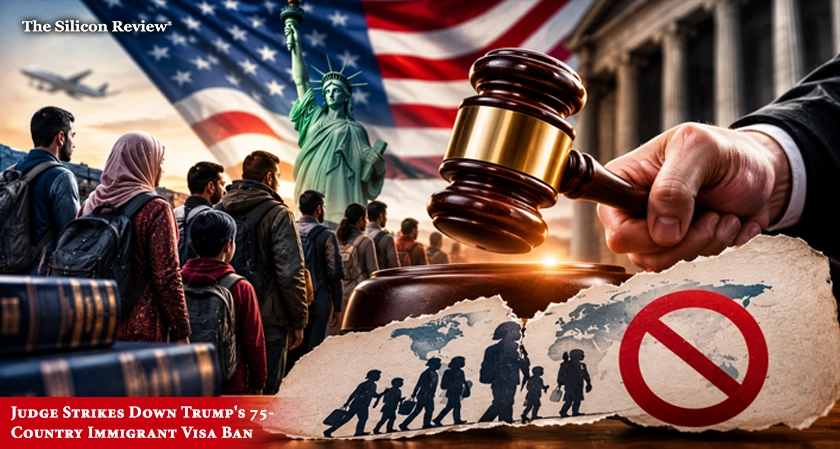
Trump's 75-Country Immigrant V...Trump's 75-Country Immigrant Visa Ban Struck Down by Federal Judge
The Silicon Review
22 August, 2026
Author:
Vinay Kumar
A federal judge has struck down President Trump's executive order banning immigrant visas from 75 countries, ruling that the president exceeded his authority under immigration law.
A federal judge has blocked President Donald Trump's executive order that would have banned immigrant visas from 75 countries, dealing a significant blow to the administration's immigration agenda. The ruling, issued by U.S. District Judge Theodore Chuang in Maryland, found that the president exceeded his authority under the Immigration and Nationality Act.
"The President's authority to suspend entry of aliens is not without limits," Judge Chuang wrote in his ruling. "The statute does not grant the President the power to impose a blanket ban on an entire class of immigrants based on nationality."
The executive order, signed in May 2026, would have suspended immigrant visa issuance for citizens of 75 countries, including several U.S. allies, for a period of 60 days. The administration argued the ban was necessary to address national security concerns and ensure proper vetting of visa applicants.
The Legal Challenge
The lawsuit was filed by a coalition of civil rights groups and immigrant advocacy organizations, arguing that the ban violated the Immigration and Nationality Act's prohibition on nationality-based discrimination in visa issuance. The plaintiffs also argued that the ban would cause irreparable harm to families, businesses, and universities that rely on immigrant workers and students.
"This ruling is a victory for families, for businesses, and for the rule of law," said a spokesperson for the American Civil Liberties Union, one of the groups that brought the challenge. "The President cannot unilaterally rewrite our immigration laws."
The Administration's Response
The White House has indicated it will appeal the ruling, with a spokesperson calling the decision "a dangerous overreach by an activist judge." The administration has argued that the president has broad authority under immigration law to suspend entry of aliens when it is in the national interest.
"We disagree with the court's decision and will appeal," a White House spokesperson said. "The President has the authority and the responsibility to protect our national security."
The ruling comes as the Trump administration has made immigration enforcement a central pillar of its domestic policy agenda. The visa ban was one of several executive orders aimed at restricting legal and illegal immigration.
Here is the question this ruling raises. A federal judge has struck down President Trump's 75-country immigrant visa ban, ruling that the president exceeded his authority. When a court blocks a major executive action, what does it signal about the limits of presidential power in immigration policy?
As the administration prepares its appeal, The Silicon Review asks a final question. When the courts and the executive branch clash over immigration policy, what does it mean for the future of U.S. immigration law?
FAQ:
Q: What did President Trump's 75-country visa ban do?
A: The executive order suspended immigrant visa issuance for citizens of 75 countries for 60 days, citing national security concerns and the need for enhanced vetting.
Q: Why did the federal judge strike down the visa ban?
A: Judge Theodore Chuang ruled that the president exceeded his authority under the Immigration and Nationality Act, which prohibits nationality-based discrimination in visa issuance.
Q: What was the basis of the legal challenge?
A: Civil rights groups and immigrant advocacy organizations argued the ban violated the Immigration and Nationality Act and would cause irreparable harm to families, businesses, and universities.
Q: What is the Trump administration's response to the ruling?
A: The White House has indicated it will appeal the decision, calling it "a dangerous overreach by an activist judge."
Q: What is the next step in the legal challenge?
A: The case is expected to be appealed to a higher court, with the outcome likely to shape the future of U.S. immigration policy.




















Comments