>>
Industry>>
Capital Market>>
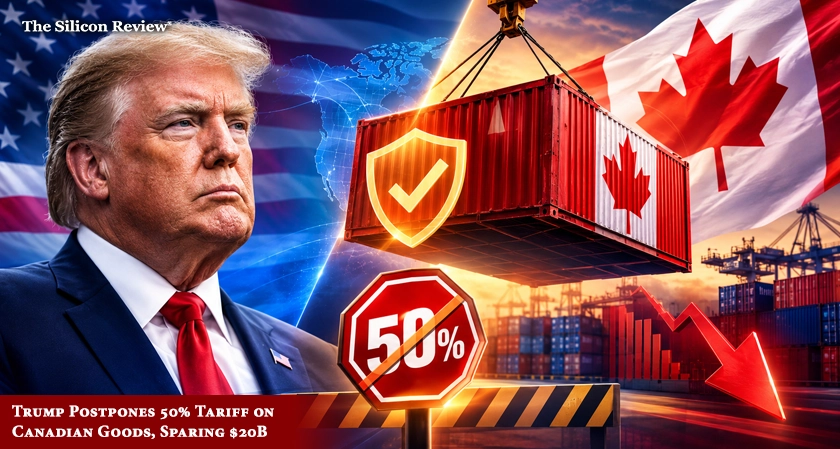
Trump Postpones 50% Tariff on ...Trump Postpones 50% Tariff on Canadian Goods, Sparing $20 Billion in Imports
The Silicon Review
19 August, 2026
Author:
Vinay Kumar
President Trump postponed a threatened 50% tariff on Canadian goods hours before it was set to take effect, citing a deal with Canada that may include reviving the Keystone XL pipeline.
President Donald Trump announced he has postponed the 50% tariff he threatened on a wide range of Canadian goods, hours before it was set to take effect. The delay spares roughly $20 billion worth of imports from Canada and provides a three-day window for the finalization of a deal.
"I have paused the 50% Tariffs against Canada that were scheduled to kick in tomorrow morning for a three day period, based on the fact that Canada and the U.S.A., subject to the finalization of documents, have a DEAL!" Trump wrote on Truth Social. In his post, he also mentioned the Keystone XL pipeline, which he said "may be awoken from the grave!."
The postponement comes after days of intense negotiations between U.S. and Canadian officials. Canadian Prime Minister Mark Carney described the talks as "very delicate and intense." Carney confirmed the postponement until the end of August 21, adding that "substantial progress has been made, although there is important work still to be done."
The Threat and the Leverage
The 50% tariff, which would have covered products including dairy, alcohol, and furniture, was threatened using Section 338 of the Tariff Act of 1930. This little-known law, which has never been used to impose tariffs, empowers the president to levy duties on countries that discriminate against U.S. businesses. The potential reach was broad, covering about 5% of the total value of U.S. imports from Canada last year. Unlike Trump's other recent tariffs, there would have been no exemptions for goods compliant with the USMCA, meaning even products that otherwise qualify for preferential treatment could have been included.
A Pattern of Negotiation
The 11th-hour decision fits a pattern of Trump using the threat of tariffs as a negotiating tactic to extract concessions from trading partners. The tariffs may ultimately have been intended as leverage in the broader U.S.-Canada trade dispute, especially with the USMCA itself up for review. Both nations had reasons to step back from the brink, as nearly 72% of Canada's goods exports last year went to the United States, and the Trump administration faced political risk by imposing a hefty new tariff ahead of the November midterm elections.
Here is the question this postponement raises. The 11th-hour deal to delay 50% tariffs on $20 billion in Canadian goods highlights the unpredictable nature of Trump's trade policy. When the threat of tariffs is used as a primary tool of foreign policy, does it create the certainty needed for stable economic relations, or does it foster an environment of perpetual negotiation and risk?
As the U.S. and Canada continue to work toward a final agreement, The Silicon Review asks a final question. When a trade relationship worth billions hangs in the balance, how can both nations build a foundation for long-term economic stability?
FAQ:
Q: Why did President Trump postpone the 50% tariff on Canadian goods?
A: Trump announced a three-day postponement, citing a deal with Canada that is subject to the finalization of documents. He also mentioned the Keystone XL pipeline as part of the negotiations.
Q: What was the scope of the threatened 50% tariff?
A: The tariff would have applied to approximately $20 billion worth of Canadian imports, covering a wide range of products including dairy, alcohol, furniture, industrial equipment, and plastics.
Q: What is Section 338 of the Tariff Act of 1930?
A: Section 338 is a little-known law that allows the president to impose tariffs of up to 50% on imports from countries deemed to have discriminated against American businesses. It has never been used before to impose tariffs.
Q: How did Canada respond to the tariff threat?
A: Canadian Prime Minister Mark Carney described the negotiations as "very delicate and intense." Canada had threatened to retaliate with its own tariffs if the duties were imposed.
Q: Was the Keystone XL pipeline part of the negotiations?
A: Yes, Trump mentioned the Keystone XL pipeline in his announcement, saying it "may be awoken from the grave!" The pipeline has been a point of contention between the U.S. and Canada for years.




















Comments