>>
Industry>>
Compliance and governance>>
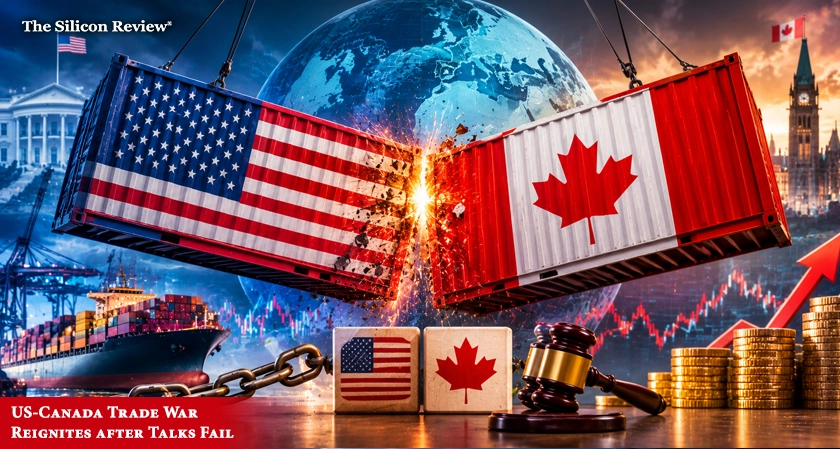
US-Canada Trade War Reignites ...US-Canada Trade War Reignites as Talks Fail at Last Minute
The Silicon Review
22 August, 2026
Author:
Vinay Kumar
The US-Canada trade war has reignited after last-ditch negotiations failed to reach a deal, with the Trump administration reimposing 50% tariffs on a wide range of Canadian goods effective immediately.
The trade truce between the United States and Canada has collapsed. Last-ditch negotiations between the two nations failed to reach a deal, and the Trump administration has reimposed 50% tariffs on a wide range of Canadian goods, effective immediately.
"We have a DEAL! The 50% Tariffs against Canada will be postponed for a three-day period," President Trump had announced earlier this week. But those three days have passed without a final agreement, and the tariffs are now backing in force.
The tariffs, which cover approximately $20 billion worth of imports including dairy, alcohol, furniture, industrial equipment, and plastics, were first threatened using Section 338 of the Tariff Act of 1930. The postponement had been granted to allow for final negotiations, but those talks broke down at the last minute over disagreements on key trade issues.
The Breakdown
Canadian Prime Minister Mark Carney described the negotiations as "very delicate and intense," but acknowledged that "substantial progress" had been made even as the talks ultimately failed. The breakdown reportedly centres on Canada's refusal to meet US demands on dairy market access and other agricultural trade barriers, which the Trump administration has long criticised.
"We are deeply disappointed that the US has chosen to move forward with these tariffs," a spokesperson for the Canadian government said. "We will respond appropriately to protect Canadian workers and businesses."
The reimposition of tariffs comes just days after the US and Canada had appeared to be on the verge of a breakthrough. The failure of the talks is a significant setback for bilateral relations and is expected to have immediate economic consequences for both countries.
Economic Impact
Nearly 72% of Canada's goods exports go to the United States, and the tariffs are expected to hit Canadian industries hard. The US, meanwhile, faces the prospect of retaliatory tariffs from Canada, which has already signalled it will respond with counter-measures. The escalating trade war is also expected to weigh on global growth and increase uncertainty for businesses on both sides of the border. Financial markets reacted negatively to the news, with the Canadian dollar falling and North American stock indices declining.
Here is the question this development raises. The US-Canada trade war has reignited after last-minute talks failed, with 50% tariffs now back in force. When a trade truce collapses, what does it mean for businesses and consumers who are already dealing with the economic impact of tariffs?
As the trade war escalates, The Silicon Review asks a final question. When the world's largest trading relationship faces a new wave of tariffs, will the economic cost outweigh the political gains on either side of the border?
FAQ:
Q: Why did the US-Canada trade talks fail?
A: The talks reportedly broke down over disagreements on dairy market access and other agricultural trade barriers that the US has long criticised.
Q: What tariffs are being reimposed on Canadian goods?
A: The US is reimposing 50% tariffs on a wide range of Canadian imports, including dairy, alcohol, furniture, industrial equipment, and plastics.
Q: How will the tariffs affect the Canadian economy?
A: Nearly 72% of Canada's goods exports go to the United States, so the tariffs are expected to hit Canadian industries hard, with Canada threatening retaliatory measures.
Q: What is Section 338 of the Tariff Act of 1930?
A: Section 338 is a law that allows the US president to impose tariffs of up to 50% on imports from countries deemed to have discriminated against American businesses.
Q: What is the next step in the US-Canada trade dispute?
A: Canada has signalled it will respond with counter-tariffs, potentially escalating the trade war further.




















Comments